The Shrapnel or Steel Helmet.
Introduction.
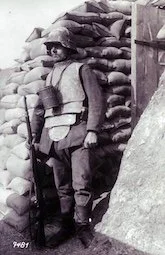
It is a popular misconception that steel helmets were introduced to protect the wearer from the direct impact of a rifle or a machine gun bullet, but this is not so for the thickness of bullet-proof steel required to prevent penetration by a high velocity missile, such as a rifle bullet, given the state of metallurgical technology available in 1915 would have placed an intolerable weight burden on the head of the soldier. From 1916 onwards, small numbers of such heavy helmets were manufactured to protect soldiers, particularly in the German army, who occupied static positions, such as snipers, sentries, or machine gun crews, against a single high-velocity bullet fired by a sniper.
German Trench Sentry Wearing Body Armour.
The appreciation that soldiers in trenches required some special form of head protection became apparent when the medical services reported the appearance of an unusual pattern of wounding, a higher than expected number of fatal and non-fatal wounds to the head, face, and eyes, which seemed a consequence of the highly attritional nature of trench warfare. In traditional warfare, most of the missiles directed at an infantryman came from his front, whether it was a crossbow bolt or a rifle bullet, but once he had made himself secure from the effects of such direct fire by taking refuge in a deep trench, his situation changed. He had become a static target, subjected to artillery and trench mortars firing shrapnel, and high explosive artillery shells, that showered him with airborne shrapnel balls, shell fragments, stones, and all sorts of other debris thrown up by the explosions. It was the impact of this medium to low velocity missiles that produced this unexpected pattern of wounding, and protection became a priority.
As with many of the innovations in trench warfare, the French made the first moves to address this issue.
Intendent-General August-Louis Adrian was an officer with a reputation for looking after the welfare of his men, a reputation stemming from his time in North Africa, where he introduced measures to improve the health and efficiency of his troops in what was a very trying climate. In late 1914, as the story goes, General August-Louis Adrian was talking to one of his men lying on a stretcher with a head wound, who told his General that he was lucky to be alive, having been saved from a fatal head wound through carrying his metal mess bowl on his head, underneath his kepi.
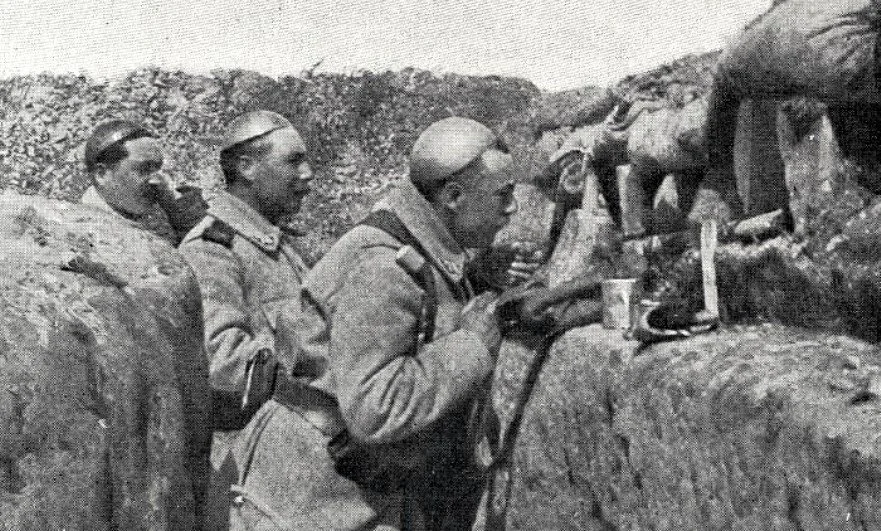
Adrian immediately saw the potential of this remark, and had an armourer make him a steel calotte, the traditional plain skullcap worn by Churchmen, which he wore under his hat for several days to see how comfortable it was and when he was satisfied with the shape, he had several hundred made and evaluated by his troops during the French winter offensive in Champagne. Wearing the calotte appeared to produce a small, but noticeable, reduction in the fatalities from head wounds, and with this information, he persuaded a sceptical General Staff to adopt his skullcap. By March 1915, 700,000 had been made, with about 200,000 issued to the troops. Although intended to be worn under the kepi, the troops took to wearing them on top for comfort, discovering along the way that they made rather good cooking pots, and in extremis, a very serviceable chamber pot.
Wearing la Cervelière in the trenches. https://www.normandythenandnow.com/genets-and-the-man-who-saved-a-million-lives-in-ww1/
Under battlefield conditions, Adrian’s la Cervelière (skull cap or brain pan) only produced a marginal reduction in head wounds, but this was sufficient to engage the attention of General Joffre, who, at the end of February 1915, ordered the development of a more suitable helmet. General Adrian responded by creating a steel helmet based on that used by the Paris Fire Brigade, as the manufacturing moulds were available.
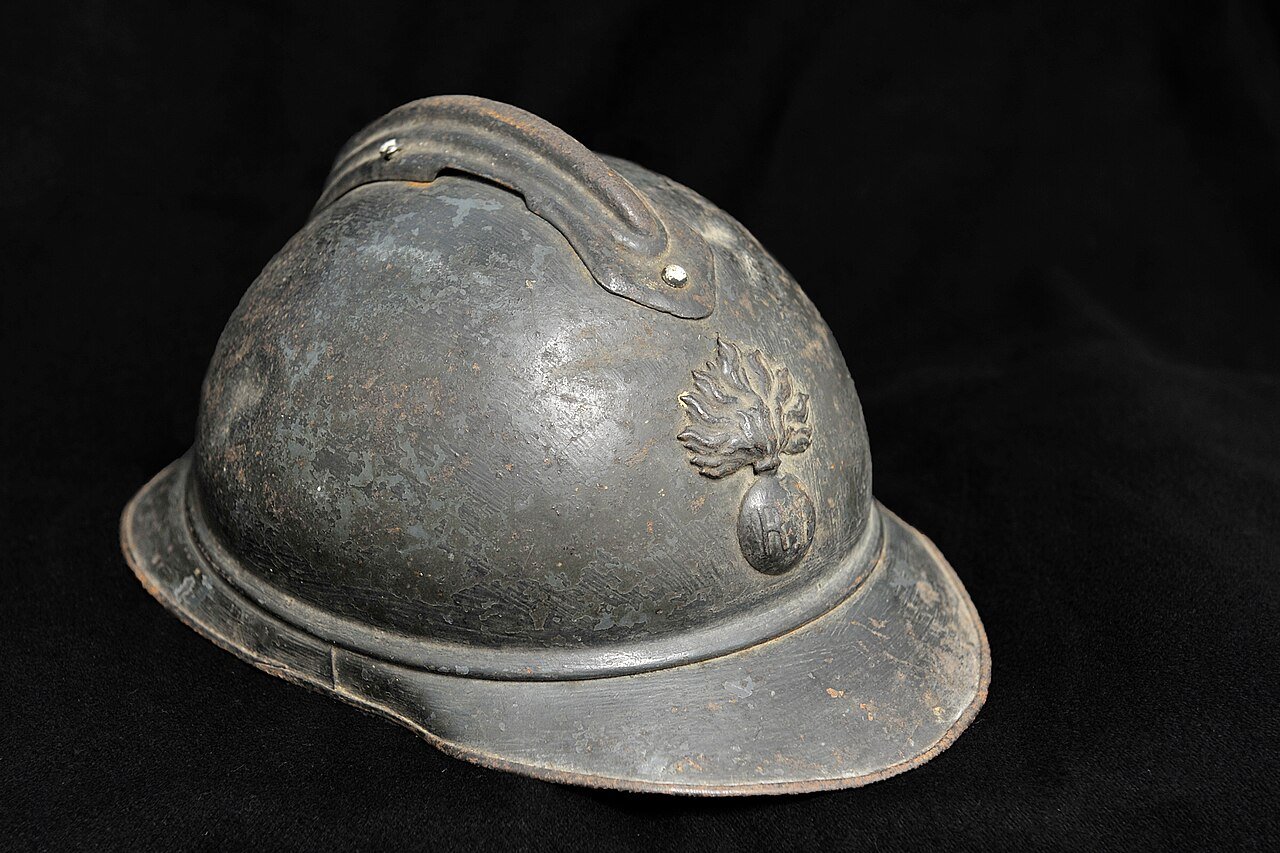
French infantry M15 Adrian helmet. Bibliothèque de Bordeaux. http://www.europeana1914-1918.eu/en/contributions/8760
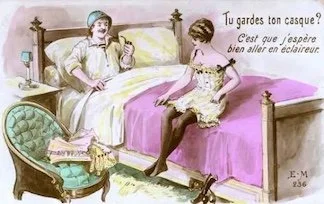
This was the iconic casque Adrian, a complex structure made up of several individual pieces of mild steel riveted or welded together into the characteristic shape, further distinguished by a unique insignia, predominately for decoration rather than identification, such as the grenade for line infantry and cavalry attached to the front of the helmet, each requiring some 50 separate operations to create. The completed helmet weighed only 0.765 kg (1lb 11 oz), which was lighter than the British Brodie or the German Stahlhelm and provided less protection than either. French Infantry wearing Adrian Helmets French authorities approved the design at the end of April 1915, and production started immediately. By the end of August 52,000 helmets were being produced daily, and by the start of the Champagne offensive on 25 September 1915, 1,600,000 Adrian helmets had been distributed to the army, rising to more than 3,000,000 by the end of the year. The cost was 3.35 francs per helmet compared to the regulation kepi that came in at 3.8 francs. The troops quickly adopted this new form of protection, not so much for its effect in reducing head wounds, but because its attractive design was felt to add to the martial distinction and élan of the French soldier, as shown in many contemporary postcards and cartoons.
Why do you keep your helmet on? It’s because I hope to go scouting. circa 1915.
The British Brodie Helmet.[1]
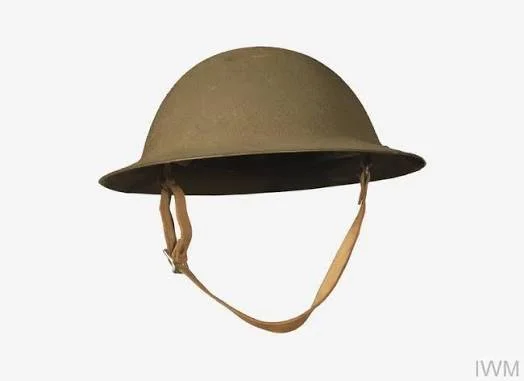
In the early summer of 1915, just before FW3A transferred to the Ministry of Munitions, the War Office asked Jackson to evaluate the French helmet, presumably to introduce it, or something similar, to the BEF. He reported that the Adrian was a complex design, requiring over seventy separate operations, which would make it slow to produce and that the necessary machinery and expertise were beyond the resources currently available. Fortunately, an alternative was at hand in a design recently submitted to the War Office by Mr Brodie, which, unlike the Adrian, was simplicity itself, shaped like an inverted bowl with a narrow shelving rim.
We know little about John Leopold Brodie, or where he got his inspiration for his helmet, a design patented by him in August 1915, but there are several historical precedents for the shape, the most favoured being the medieval kettle hat or chapel-de-fer worn by infantry across Europe in the wars of the fourteenth and fifteenth centuries.[2] Responsibility for manufacturing the Brodie helmet transferred from the War Office to the Ministry of Munitions and then to the Trench Warfare Department, which was attracted to the design by its simplicity and ease of manufacture, for it was possible to stamp out a helmet in a single operation without unduly thinning the metal in the crown.
Steel Helmet, MKII: British Army | Imperial War Museums. Copyright: © IWM (UNI 12833)
hroughout August and September 1915, the department carried out trials to determine the degree of protection provided against low-velocity projectiles by mild steel sheets from different steel makers, and the ease with which they could be rapidly and economically turned into a helmet. Towards the end of September, after making several prototypes, they identified a suitable design. They manufactured a batch of 150, of which 149 were sent to France for field-testing. GHQ quickly approved of the new helmet and requested that they be supplied at a rate of 50 per battalion. These original helmets, sometimes referred to as Type A, were pressed as one unit from sheets of magnetic mild steel. This manufacturing process was straightforward and soon reached 850 a day, but after 4,400 had been pressed, production was halted in the second week of October in response to a suggestion from Sir Robert Hatfield that a superior helmet would be produced if manganese steel was used in place of mild steel, and although this would increase the weight of the helmet to 2lbs it would be capable of resisting the impact of shrapnel hitting it at 750 feet per second.[3]
Unfortunately, this was not a simple matter of substituting one type of steel for another. The Trench Warfare Department estimated that with mild steel, they could produce a million helmets in two or three months, whereas manganese steel was more expensive and more difficult to shape, and it would take 4 to 6 months to produce the same number of helmets. Given the extra expense and manufacturing delays, the issue was put to GHQ, which elected to go for the superior helmet of manganese steel. This decision was to present the Trench Warfare Department with some significant challenges.
Before the war, manganese steel had only been produced in limited quantities by a small number of specialist steel manufacturers for their own use, resulting in steels that differed slightly in composition and method of production, all of which had to be tested individually as to their suitability for producing the helmet. Only one sample, made by Thomas Firth and Sons of Sheffield, turned out to be suitable for cold pressing into the helmet shape; all the other samples tested too brittle to press into shape without heating.
The next problem to be resolved was to find the industrial capacity to manufacture sufficient manganese steel for the number of helmets that would be required. Firth’s furnaces were unavailable, and their smelting capacity was committed to producing other specialised steels needed in the manufacture of artillery and machine tools. To find new manufacturing capacity within the industry, the Trench Warfare Department called a meeting of all the specialised steel makers at which Thomas Firth & Sons agreed to disclose their secret recipe and their method of manufacturing to the other companies that were, in peacetime, their commercial rivals. Of the companies present, only Beardmores took up the challenge, and although they had extensive experience in producing specialised steels, such as armour plate for the Admiralty, it was to take them several weeks before they mastered the art of producing manganese steel that could be cold pressed without cracking.
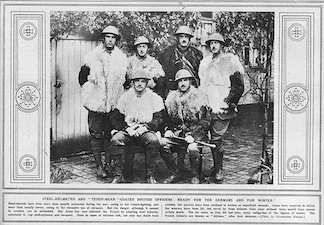
"Illustrated War News" - Nov 17, 1915. The Text reads: Head-wounds have been more than usually numerous during the war, owing to the trench-fighting, and more than usually severe, owing to the extensive use of shrapnel. But the danger, although it cannot be avoided, can be minimised. Our Army has now followed the French by adopting steel helmets, calculated to stop shell-splinters and shrapnel. Even in cases of extreme risk, not only has death been avoided, but injuries have been confined to bruises or superficial wounds. Cases have occurred in which the wearers have been hit but saved by these helmets from what without them would have meant certain death. The fur coats, as they did last year, mean mitigation of the rigours of winter. The French helmets are known as "Adrians," after their inventor, — (Photo by Illustrations Harrow).
With a guaranteed steel supply, the Trench Warfare Department organised two firms to produce the helmets, one in Wolverhampton, contracted to make 25 to 30,000 helmets a week, and one in Glasgow, producing 45,000 a week, with manufacture beginning towards the end of November 1915. This was seen as the best way of ensuring efficiency by concentrating the available machinery where it was needed. Later a third source of supply was organised by the Sheffield Munitions Committee producing 30,000 helmets a week through the formation of a cooperative system of companies in the silver-plating trade whose regular business had suffered severely because of the war, and who adapted the presses commonly used to produce domestic items, such as dish covers, to the manufacture of helmets. The contract for the helmet lining and chin strap was awarded to the Army and Navy Stores.
The Type B Brodie helmet was cold pressed from non-magnetic steel, 0.36 inches thick, with a raw rim 1.5 to 2 inches wide and painted a smooth green colour. They were fitted with an internal liner, designed to absorb a blow, and manufactured from a type of oil cloth known as American cloth, fixed onto the skull of the helmet with a single rivet. A chinstrap was secured directly to the helmet rim. The first batches of helmets may have been successful in reducing the number and severity of head and face wounds. Still, they were not without their problems, highlighted in a report prepared by General Plummer G.O.C. Second Army.[4] He pointed out that the bare rim of the helmet was sharp enough to cause injuries in a crowded trench, the smooth green paint on the helmets was too shiny, reflecting the sunlight making the wearer a target for enemy snipers, and the method of attaching the liner with a single rivet in the crown of the helmet was itself a source of head injuries when the helmet received a sharp blow that pushed the rivet down onto the wearers head. These faults were immediately taken in hand, with a rounded rim welded onto the bare rim, a new pattern of liner with a thick felt pad fitted to the top provided a cushion against impact injury. The paint job was changed to a dull paint dusted with sand or sawdust to reduce the glare of reflected sunlight. The fashion of painting a unit’s insignia, or patch, on the front or side of helmets did not spread across the army until 1917.
The Introduction of Steel Helmets into Battle. The first issues of steel helmets were experimental, or more accurately, on a test and report basis, with the troops of the BEF receiving this new item of equipment in dribs and drabs from October 1915 onwards. The Quartermaster’s War Diary of the 3rd Division records that they received 200 trench helmets on 16 October 1915, followed by 345 Steel Trench Helmets on 6 November, with sporadic deliveries of a few hundred a time at roughly weekly intervals, until 24 March 1916 when they took delivery of their first large batch of 2000.[5]
This pattern of delivery made it impossible to equip a complete unit, such as a battalion, and at first helmets were classified as trench stores to be kept in the trenches and handed over with the other trench stores such as grenades, mortars or catapults, to each unit in turn as they did their tour of duty. Under such circumstances, it would appear they were issued to troops when they were about to undertake particularly dangerous or exposed tasks, such as manning saps, trench sentry duties or raiding the enemy’s positions. Not all the dangers associated with wearing this new form of headgear came from the enemy. Towards the end of February 1916 steel helmets were issued to the bombers of the 10th Royal Welch Fusiliers and one evening, soon after the issue, a soldier of the 2nd Suffolks was working alone tidying up a communication trench when, in the gathering darkness, he saw a figure coming towards him wearing strange headgear and, thinking that it was a German, promptly hit him over the head with his shovel. The Welch Fusilier, for that who it was, greatly resented this familiarity and retaliated vigorously, and when it was all over, the two men, very much the worse for wear, were removed to the field ambulance on stretchers.[6]
The first use of helmets in battle, as opposed to wearing them on trench duties, was in the early morning of March 1st ,1916, when a well-planned attack by the infantry of the 76th Infantry Brigade, supported by two battalions from the 17th Brigade, successfully recaptured the feature known as the Bluff on the Ypres-Comines canal. The notable feature of this little battle is that all the attacking troops, officers and men, were helmeted, although to achieve this all the other battalions in the Division were stripped of their helmets.[7] It is impossible to determine whether the wearing of helmets was an order from GHQ, but they had an interest in the result for Lieutenant-General Sir Arthur Sloggett, Director General Medical Services, ordered Sir Anthony Bowlby, Consulting Surgeon to the Forces, to examine all the casualties from the battle and report back on the efficiency of the new steel helmets.[8] His report makes interesting reading,
General Headquarters, France, 3rd March. 1916.
Dear Sir Arthur Sloggett,
I think that the fight of to-day is the first in which our men have practically all worn our new steel helmets. I therefore spent some hours in investigating the effects of this form of protection. The chief part of the attack fell to the 1st Gordons and 8th ‘Kings Own’ and these regiments were fully helmeted. Officers and men alike spoke with the greatest enthusiasm of the helmets. They said they protected them, especially from the fire of trench mortars and shrapnel bullets, and officers and men alike told me that small pieces of shell and bombs, as well as gravel, could be heard rattling on the helmets, and falling harmless. My own examination of the helmets themselves fully confirmed these statements, for of these I saw, nearly 40 showed evidence of having been hit. In some the metal has been only slightly excoriated.[9] In others it had been definitely bulged inwards. In a few it had been perforated. Here are six typical cases:-
1. A shrapnel bullet perforated a helmet, but only made a small cut in the scalp. It would have perforated the skull. 2. A piece of shell perforated the brim of a helmet and lodged in the eyebrows. It would have destroyed the eye.
2. One helmet shows three large bulges or depressions each as big as a small teaspoon. At each bulge there would have been a wound, but the man was unwounded in the head.
3. A private of the Gordons was struck down by a heavy blow from a clubbed rifle but he killed the German with the bayonet, brought in a Mauser rifle. His helmet has a great dent in it and saved him from a fractured skull. It also showed evidence of 3 other impacts of missiles.
3. A man had the front of his helmet torn open by the nose of a 6-inch shell which he brought in with him. He had only a scalp wound.
4. An officer was struck down by a lump of shell which tore a large hole in his helmet, but only caused a very slight wound. It is evident that the helmets have saved many lives and prevented many wounds, both slight and serious. I saw all the wounded from the fight to the number of 300 to 400 which came in up till 4 pm and I think that the proportion of head wounds was certainly less than usual. I have not yet the figures to show this, but when I do get them I will pass them on to you.
Yours very sincerely, A Bowlby.
When he forwarded Bowlby’s report to the Adjutant-General on March 4th, Sir Arthur Sloggett was in a position to fill in some of the details. He reported that 960 wounded were admitted to No. 10 Casualty Clearing Station in the 24 hours commencing noon on March 2nd. Of these, only four had been shot in the brain, with three others having slight fractures of the skull without endangering the brain. This was a very low rate of head wounds, which previous experience showed was about 3% of total wounded so without the helmets he would have expected to see about 30 cases instead of the seven found, and there was a significant decrease in the number of wounds, both serious and slight, to the scalp and face.[10]
The success of the helmets in reducing severe wounds impressed Sir Douglas Haig, who wrote to the War Office to hustle along and speed up their delivery,
6th March. 1916.
Sir, With reference to War Office letter No.121/Stores/2902 (A.3.) dated 5th February forwarding a copy of a letter from the Ministry of Munitions regarding the supply of steel helmets.
I have the honour to inform you that approximately 660,000 are required to equip the force at present serving in this country on the scale asked for in my letters No.0.490 dated 9th November and 3rd December 1915.
2. In addition to the requirements mentioned above, each new division arriving in the country will involve the provision of approximately 15,000 helmets.
3. I would point out that the supply has fallen far short of the numbers it was hoped would have been received. The Ministry of Munitions notified that 250,000 were expected to be delivered by the middle of February, whereas only 140,341 had been received in this country up to the 2nd instant.
4. In view of the importance of providing the men with these helmets at the earliest possible date, I shall be glad to receive definite information as to the date by which we are likely to receive the 660,000 required to equip the troops at present in this country.
5. In this connection, I attach a copy of a letter dated 3rd instant from Sur. Genl. Sir Anthony Bowlby to the Director General of Medical Services, together with a covering minute dated 4th instant from the latter officer. It will be observed that the helmets afford most useful protection from scalp and face wounds, and I trust that every effort will be made to expedite the supply.
I have the honour to be, Sir, Your obedient Servant, (Sd) D Haig. General Commanding-in-Chief British Forces in France.[11]
n his reply on behalf of the War Office, B. B. Cubitt assured General Haig that his concerns would be taken up with the Ministry of Munitions.[12] The Army Council also wished to placate the Commander-in-Chief, assuring him that the supply situation was improving, the last week’s output being 31,000, which brought the total delivered to date to 270,000 and, in a gentle dig at Sir Douglas Haig focus on his own army, reminded him that the BEF was not the only concern of the War Office and that a proportion of the total manufactured were issued to other theatres of war.[13]
The production of the Brodie helmet continued throughout the war, not only to meet the growth of the army and replace wastage, but also to equip some of our allies with about one and a half million helmets provided to the Americans while they developed their own modified design and set up production facilities. Once the needs of the army had been met, the Government decided to equip others besides the combat troops, such as the troops of the Home Commands, and certain groups of civilians deemed at risk of injury through enemy action, such as police and others who needed protection against spent shrapnel falling from the sky during an anti-aircraft barrage. In total, by the end of the war, about seven and a half million helmets had been manufactured.[14]
[1] For readers interested in all things Brodie through the ages, I recommend the Brodie Helmet website, < http://thebrodiehelmet.weebly.com/ >
[2] John Leopold Brodie (1873–1945), born Leopold Janno Braude in Riga, was an entrepreneur and inventor who had made a fortune in the gold and diamond mines of South Africa. (< https://en.wikipedia.org/wiki/Brodie_helmet >)
[3] History of the Ministry of Munitions. Vol. XI Part 1 Trench Warfare Supplies, p. 101 Sir Robert Abbott Hadfield FRS (1858-1940) was an English metallurgist famous for the discovery of manganese steel, one of the first steel alloys. He took over control of the family company, Hadfield’s Steel Foundry in Sheffield in 1888 and turned it into one of the largest steel foundries in the world. He was also a renowned scientist, publishing over 200 papers on his metallurgical research. He was elected to the Royal Society in 1909: knighted 1908, Baronet in 1917. [4] StephenBull and Adam Hook, World War I Trench Warfare (1): 1914–16. (Oxford, Osprey Publishing, 2002.). pp. 10-11
[5] TNA: WO95/1398: 3rd Division HQ. Deputy Assistant Director of Ordnance Services. War Diary 1915, May to June 1919
[6] C.C.R. Murphy. The History of the Suffolk Regiment 1914-1927. (London: Hutchinson & Co., 1928), p.138
[7] Cyril Falls. The Life of a Regiment. Vol. IV. The Gordon Highlanders in the First World War 1914-1918 (Aberdeen: The University Press, 1958), p. 71
[8] Lieutenant-General Sir Arthur Slogget (1857-1919) was a professional army medical officer who first entered the service in 1881. He was appointed Director-General of Medical Services to the BEF on 28 October 1914; Sir Anthony Bowlby (1855-1929) was born in Namour, Belgium and educated at Durham School and St Bartholomew’s Hospital. He had a successful surgical career, appointed Surgeon to the Royal Household 1904-1910. Served in the Boer War and the Great War as Consulting Surgeon to the Forces with the rank of Major-General.
[9] He is probably using this term in an analogous sense to its medical sense, meaning a superficial loss of substance, such as that seen in the scratching of the skin.
[10] Ms Addison c76, folio 60
[11] Ms Addison c76 folio 58-69
[12] Bertram Blakiston Cubitt. Assistant Under-Secretary of State. War Office. Secretary to the War Office and Army Council.
[13] Ms Addison c76 folio 57: Copy of Letter: B.B. Cubitt to The General Officer Commanding-in-Chief, Army in France. 13 March 1916.
[14] History of the Ministry of Munitions. Vol. XI. The Supply of Munitions. Part 1 Trench Warfare Supplies, p. 102