Mechanical Armour.
Introduction.
It is not my intention to delve into the development of the Tank, a subject on which there is a vast library of books, thesis and articles, large enough to satisfy any enthusiast of armoured warfare and of which I know little, so I will limit myself to the role Colonel Jackson played in the War Office’s initial interest in armoured fighting vehicles, followed by the Trench Warfare Department’s attempts to develop an armoured vehicle to their design to serve as a platform for flamethrowers.
Armoured Shields.
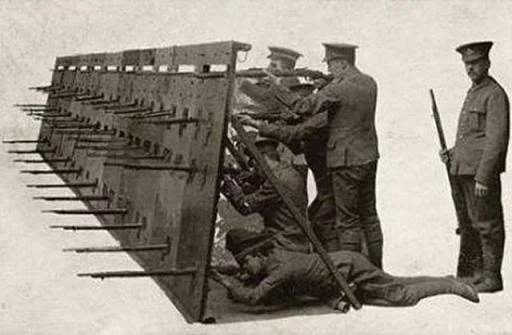
Colonel Jackson and Section FW3’s first foray into armoured warfare concerned the evaluation of body shields. In late November 1914, before No Mans Land became an almost impenetrable crater field, GHQ considered introducing movable shields to protect either the individual soldier or a group of soldiers. Such a concept was not new. Individual shields carried by one man are as familiar to us as any other form of armour, but, as a form of personal protection, they had disappeared with the ascendancy of firearms. However, in the first decade of the twentieth century, they would experience something of a renaissance. The Japanese had used them in the Russo-Japanese War and, in Britain, after the Boer War, the high casualties inflicted on unprotected infantry in some battles stimulated several iron-working companies to patent, and propose to the War Office, large shields to protect infantry from enemy gunfire, some mounted on wheels and fitted with gun ports through which the soldier could make observations or fire his rifle. In late 1914, Winston Churchill, in a letter to Sir John French in December 1914, alluded to his authorisation to the Armoured Car Division of the Royal Navy Air Service to design and produce twenty steel shields on wheels to protect the riflemen of the Royal Naval Division.[1]
Churchill may have visualised something like this.
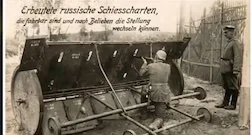
A Russian mobile shield captured by the Germans1914
Mobile-Man Shields.
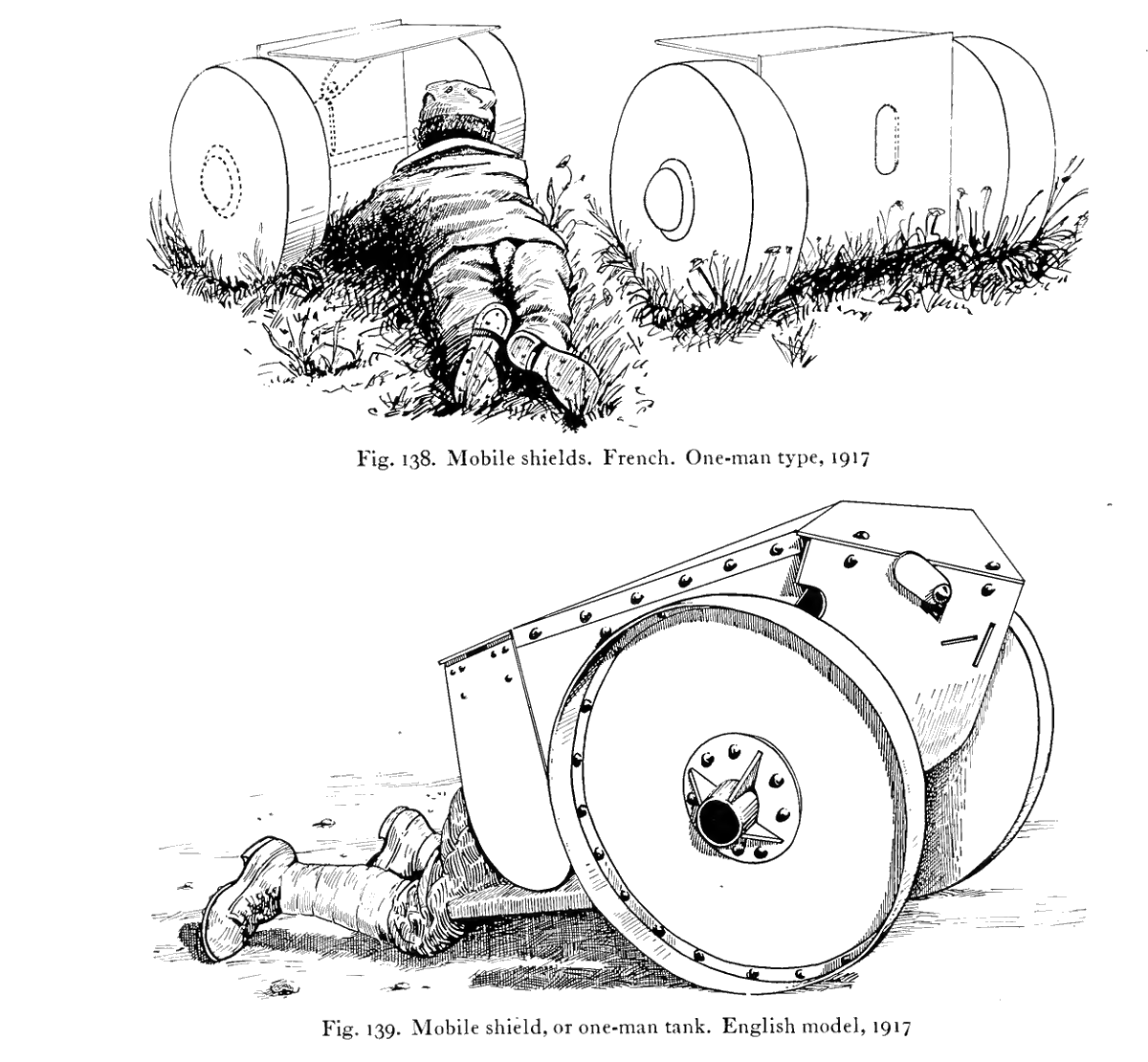
Throughout the war experiments were carried out on man powered individual Shields mounted on rollers or wheels,
Basford Dean p 188
These Shields were designed to protect individual soldiers operating a No Man's Land undertaking such tasks as observation, wire-cutting, or laying mines and booby traps. Although there are some indications that the French may have used them in service their use on the battlefield was fraught with difficulties. They were heavy, making it difficult for one man to push around, and the wheels sank into wet or shell-torn ground restricting their use to flat, dry ground, something of a rarity in No Man's Land. Also, the soldier had no protection for his back and legs and so exposed to shrapnel fire and by late 1915 the concept was practically abandoned as attention became focus on how to cross No Man's Land with machine-powered shields, a concept that led to the development of the tank.
The Development of the Tank.
There are concept drawings by Leonardo da Vinci of armoured vehicles. Over the intervening centuries many similar vehicles, some quite fanciful, have been proposed inside and outside the military, including in some very influential fiction.[2] The block to putting any of these ideas into practice was the absence of the appropriate technology but, by 1914, it was just possible that advances in the technology of specialised steels, and the internal combustion engine, could turn the fiction into a reality. When we come to look at the involvement of Louis Jackson and the Trench Warfare Department, we start with three individuals critical to the story.
The first, Lieutenant-Colonel Ernest Swinton R.E., had a flair for writing and an even greater flair for self-promotion and making unjustifiable claims about his role. During the Boer War he became interested in armoured fighting vehicles while in command of an armoured train, an interest reinforced in 1910 when he was appointed to the Historical Section of the Committee of Imperial Defence to write the Official History of the Russo-Japanese War, which gave him an insight into the challenges of infantry attacking an entrenched position protected by artillery and machine guns. In this post, Swinton formed a firm friendship with our second individual, Maurice Hankey, an officer in the Royal Marines Artillery who was the powerful and influential Secretary to the Committee of Imperial Defence. Following the outbreak of war Hankey rose to become a very influential figure at the centre of Government when, through his political and administrative skills, Cabinet Secretary, a position he held under successive governments for twenty two years.[3]
The third person, not as well-known as Swinton or Hankey, was Captain Tom G. Tulloch, another Royal Engineer and an authority on explosives and munitions who had been Chief Experimental Officer at the Royal Laboratory, Woolwich Arsenal, before resigning from the army in 1903 to join the Board of the Chilworth Gunpowder Company, itself a subsidiary of a German explosives combine. This gave Tulloch, a fluent German speaker, unprecedented access to the German munitions industry. Between 1903 and 1914, he provided the War Office with an almost continual flow of intelligence and commercial information, which was mostly ignored.
The intelligence coup that appears to have stimulated Tulloch’s interest in armoured fighting vehicles occurred soon after his appointment to Chilworth in 1903. During a familiarising tour of the Company’s German partners and contacts, he discovered that the German munitions industry was about to replace the traditional snub-nosed ammunition for rifles and machine guns with a pointed bullet. Realising the impact this innovation would have upon the range and penetrating power of small arms ammunition, he reported his findings to the War Office, who were sceptical about his findings because the military attaché in Berlin knew nothing about the proposed change. Even when he showed them one of the new bullets that he had purloined from one of the companies they would not alter their view, suggesting he had misunderstood what he had seen and heard.[4]
Frustrated and angry at this response Tulloch let off steam by telling his story to his friend Swinton, now working for the Committee of Imperial Defence, who took him to meet his boss, Maurice Hankey. As the three officers discussed the implications of the new bullet, Tulloch grabbed a piece of paper and crudely sketched out an armoured tracked fighting vehicle, suggesting that it would be the sort of machine necessary to protect infantry against the improved ballistics of the new German bullet. Tulloch’s idea was not followed up, but neither was it forgotten.
At the beginning of the war, Kitchener, the Secretary of State for War, firmly believed that journalists could not be trusted to report on the fighting accurately and forbade their access to the battle zone. However, aware of the public’s thirst for information he appointed Swinton, who he knew from South Africa, as the official war correspondent authorised to report from the front.[5] It was Swinton’s interviews with officers and men wounded in the trench fighting on the Aisne in September that convinced him that some new, radical approach was required to combat the combination of German trenches and machine guns. When home on leave in October, he called upon his old boss, Maurice Hankey, and during their discussions about the fighting, the idea of an armoured fighting vehicle resurfaced. The two men agreed to meet the next day with Tom Tulloch for lunch in the United Services Club, where they hatched a concerted plan to get the military establishment interested in armoured fighting vehicles by all three using their contacts to raise awareness of the issue of German firepower and their proposed solution. Hankey would try to engage the government by talking to Prime Minister Asquith, Swinton would tackle GHQ when he returned to France, and Tulloch had contacts on Lord Kitchener’s staff.[6]
The response from all three authorities was tepid, each putting up a barrage of objections against allocating scarce military and commercial resources to research such a radical idea as an armoured fighting vehicle.
With apparent deadlock developing on the Western Front, Hankey, over Christmas 1914, mulled over the options flying around military and government circles about what the army should do in 1915 and prepared a memorandum to clarify his thoughts and provide an analysis of the options for the Prime Minister. This document has come down to us as the Boxing Day Memorandum, dated 26 December 1914, in which Hankey offered an appraisal of several pressing issues for the government, such as the Middle East as an alternative strategy to fighting the war on the Western Front.[7]
He also looked for ways to break the deadlock of trench warfare by the application of modern technology. While the machine he proposed as a trench destroyer was unrealistic in engineering and military terms, his robust analysis of the need for such a machine brought the question of developing an armoured fighting vehicle into the centre of the political arena. While Lloyd George and Churchill told the Prime Minister that they strongly supported Hankey’s analysis, only two members of the Cabinet had access to the resources to develop something like Hankey’s armoured vehicle: Kitchener and Churchill. Churchill, who had already demonstrated his enthusiasm for armoured vehicles by supporting the creation of the armoured car squadrons by the Royal Naval Division, made the first move.[8]
One may ask why the Admiralty, whose proper business was the sea and all that sailed upon it, was interested in armoured vehicles that travelled on land. The answer is that they are an early manifestation of Winston Churchill’s enthusiastic, if not always helpful, desire to prosecute the war actively. On the outbreak of war, the Royal Navy Air Service’s aeroplanes (R.N.A.S.) went to France to support the BEF and provide a forward defence line against Britain being attacked from the air by German Zeppelins. Churchill, concerned about the safety of the aircrews, ordered the Air Service to take motor cars to Dunkirk to be available to rescue downed pilots, and, shortly after arriving in France, the crews responsible for these cars started to bolt on armoured plates and mount machine guns to deal with any enemy cavalry patrols they may encounter. This was the genesis of the R.N.A.S Armoured Car Squadron which, in addition to picking up the odd pilot, spent much of its time harassing German units in the still mobile fighting in northern France and Belgium. With the onset of winter and the destruction of roads through heavy wear and tear by the army, the heavy armoured cars demonstrated their unsuitability for off-road work and withdrew to their base in Brixton. With time on their hands, the highly innovative and inventive members of the armoured car squadron began to investigate alternative methods of providing traction over rough or muddy ground. At about the same time Churchill ordered the purchase of 15-inch Howitzers from the Coventry Ordnance Works to support his new Royal Naval Division and William Tritton, Managing Director of William Fosters of Lincoln, one of only two British companies with experience in building vehicles with caterpillar tracks, was given the contract to build the giant tractors necessary to transport these guns.
Appreciating the potential of Tritton’s tractors to cross rough ground, several of the armoured car squadron became very interested in mounting guns on tracked vehicles as a means of attacking enemy trenches, and persuaded Churchill to approve funding for the Admiralty to invest in a research programme to design and develop an armoured Landcruiser.
The War Office Involvement.
Lacking the drive and commitment of an individual at the top, such as Churchill, adopting the principle of armoured warfare by the War Office was more complex than in the Admiralty, and the opinions and egos of some middle-ranking officers, who should have known better, killed the idea almost as soon as it was put forward.
On 4 January 1915, at the end of his short leave, Swinton went to the War Office to see Major-General Scott-Moncrieff, Director of Fortification and Works, responsible for providing mechanical and engineering devices to the BEF and urged him to devote resources to develop ‘an armoured car with caterpillar traction manned by a small crew sufficient to work two machine guns to counter the German machine guns’.[9]
Scott-Moncrieff gave Swinton a sympathetic hearing but said his hands were tied, as he had no authority to research new inventions unless requested by GHQ, but suggested that there may be a way around this restriction if he submitted his proposals to Colonel Jackson, who was responsible for supplying unorthodox machinery to the BEF. As Swinton could not extend his leave and was due to return to France the next day, a hastily arranged meeting with Jackson and Tulloch agreed that Tulloch would write up a proposal laying out the concept developed by Tulloch, Swinton and Hankey of a Machine Gun Destroyer, and forwarded it to Jackson, who would pass it to Scott-Moncrieff with a covering letter of his own emphasising the importance of the concept and the desirability of designing a large armoured vehicle capable of crossing trenches and other obstacles.[10]
At the same time, unknown to Jackson and Tulloch, the idea of the War Office developing an armoured fighting vehicle was about to receive a political boost through Asquith discussing Hankey’s Boxing Day Memorandum with Lord Kitchener. The concept of the trench destroyer aroused Kitchener’s interest, and he wrote to General von Donop, the Master-General of the Ordnance, suggesting that the War Office should begin experiments on mechanical devices for taking trenches so when Scott-Moncrieff presented Tulloch’s memorandum, along with Jackson’s letter of support, to von Donop he found he was pushing at an open door.
They agreed to set up a small ad hoc committee comprising the Director of Fortifications and Works (General Scott-Moncrieff), the Director of Artillery (General Guthrie-Smith), the Assistant Director of Transport (Colonel Holden), along with Colonel Jackson who was to arrange the necessary technical support if the committee wished to conduct experiments to evaluate the proposals.[11]
Neither Swinton nor Tulloch were informed officially of the existence of this committee or its deliberations. Tom Tulloch told Jackson that he was not happy with the composition of this committee, for, in his opinion, it was too ‘establishment’ and made up of War Office staff, such as Guthrie-Smith and Holden, who, from his own past experiences, were more likely to stifle innovation than encourage it. Importantly, Tulloch’s ideas on the form and development of an armoured fighting vehicle were beginning to deviate from those of Swinton and Hankey, who, as insiders within the military establishment, were to have significantly more influence on the committee than anything Tulloch could bring to bear.
Tulloch had done his homework and looked at the capabilities of the different caterpillar and pedrail machines available in Britain and the USA and concluded that as they were designed for agricultural use, their engine capacity and general design made them unsuitable for conversion into an armoured vehicle that withstood the rigours of a battlefield.
In a letter to Jackson, Tulloch suggested the way forward,
The quickest way to tackle the problem is to enlist the interest of a thoroughly sound professional automobile engineer and designer who has at his disposal the facilities for designing offered by a well-equipped drawing office, along with a factory to build the design when approved. An artillery and explosive expert, in committee with the engineer, should not take long in getting out a general design of the whole at small expense for ultimate approval for the building of a series of vessels if the design is considered likely to be a practical tactical success.[12]
Jackson strongly agreed but could make little headway with Colonel Holden, the most influential opponent of Tulloch’s ideas on the committee and who, no doubt influenced by his experience of the leisurely way which the pre-war War Office went about considering the adoption of motor vehicles, argued that it would take too long to implement Tulloch’s ideas for the war would be over before a machine was ready. In his professional opinion, the only proper action that the committee could take in support of the army was to evaluate the capabilities of machines already in existence, a proposal strongly supported by Swinton, who lobbied vigorously behind the scenes in favour of the American Holt Caterpillar. However, when it came to deciding on whether to base the Land Cruiser on an existing machine or invest in Tulloch’s idea of an entirely new type of machine, the committee failed to reach a consensus. It referred the matter back to the Master-General of the Ordnance. Here, Swinton’s lobbying paid off for von Donop instructed that a trial of the Holt caterpillar should be conducted ‘before going further’.
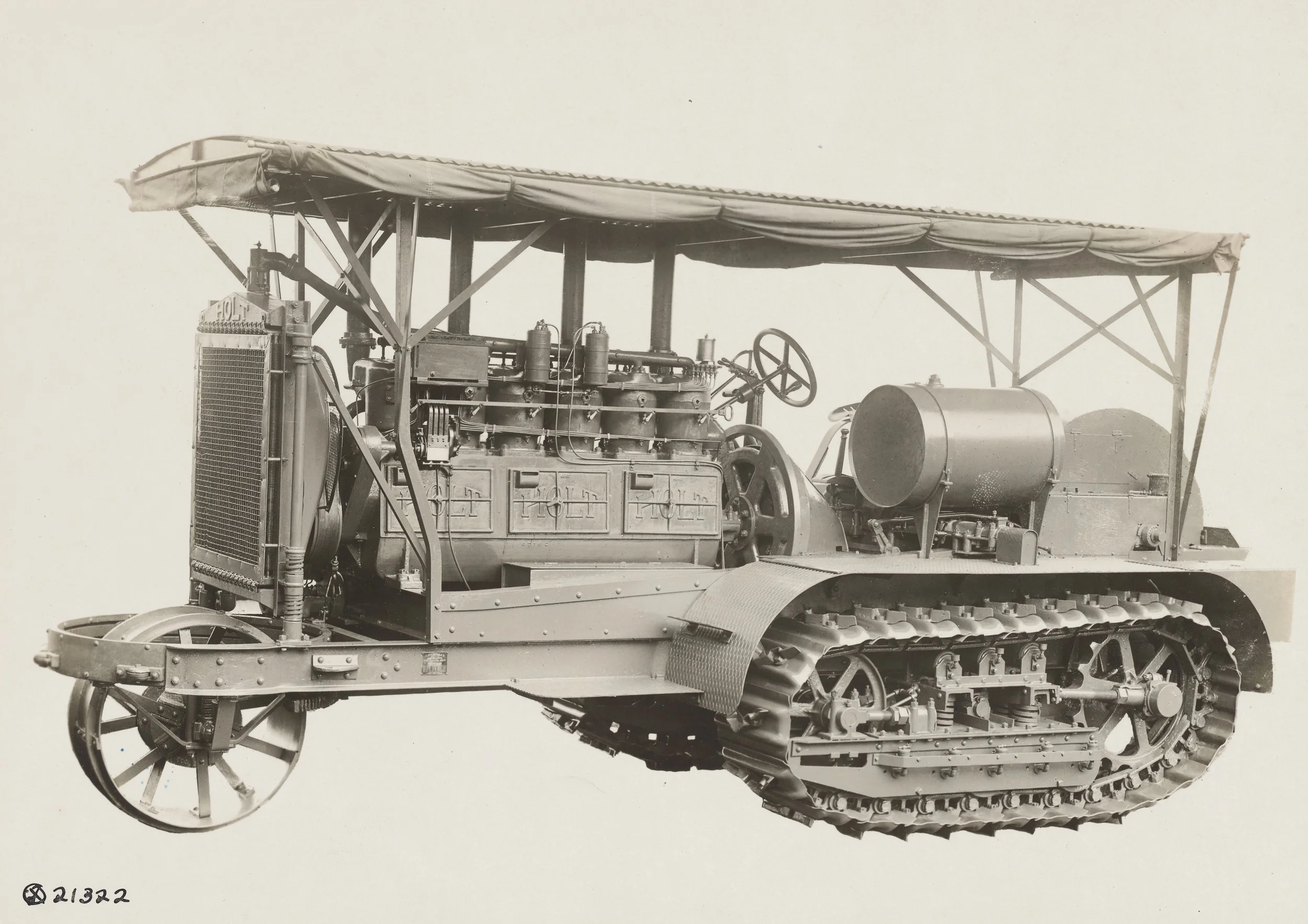
On 15 January 1915, Colonel Jackson instructed the Commander Royal Engineers, Shoeburyness, to prepare an obstacle course consisting of a 24-foot wide belt of wire in front of two parallel fire trenches 2 feet wide and 12 feet apart, behind which were support trenches up to 12 feet wide.[13] The trial took place on 17 February 1915 with a 120 bhp Holt tractor pulling a chain linked trailer loaded with four tons of sandbags to represent the armour, the two 2-pounder QF guns, ammunition and a crew of six. It was a day of heavy rain that turned the mud of Shoeburyness into a quagmire, an unexpected touch of realism for the Western Front in winter, and to meet these conditions.
The Holt 120. 120hp 3.27 mph. https://en.wikipedia.org/wiki/Holt_tractors_of_the_First_World_War
The Holt tractor was poorly prepared for the conditions. The engine was not running properly, no extensions had been fitted to the tracks to improve grip in the wet conditions, and the heavy trailer continually jack-knifed when crossing the wider trenches so that the tractor became stuck.[14]
Nobody was pleased.
Neither of the two originators of the idea, Swinton and Tulloch, was invited to the trial, nor would they be informed officially of the outcome. In the ‘wash-up’ after the trial, Jackson made a valiant attempt to save Tulloch’s project, suggesting that they had carried out the wrong trial with the wrong machine, emphasising that Tulloch had always argued against the Holt and suggesting that an entirely new type of machine was required. Holden, as the technical expert, disagreed, stating that in his opinion the demonstration had shown that the concept of an armoured fighting machine was impracticable, no matter what improvements were made to the Holt, or any other existing machine. The Director of Artillery, no authority on mechanical vehicles, agreed with Holden, and when von Donop asked Holden if there was a company in the country that could develop Tulloch’s ideas, he replied that he could not think of anyone suitable and, influenced by the opinions of Holden and Guthrie-Smith, the Master General of the Ordnance let the matter drop.
The abortive trials with the Holt caterpillar temporarily ended Jackson’s, and indeed the War Office’s, involvement with Tank development, leaving the field clear for the Admiralty’s Landship Committee, which continued to make good if moderate progress. Tulloch remained in contact with Jackson over the succeeding months and, always concerned that the attitude exhibited by Holden, that the war would be over before a machine could be developed, might deter the development of any type of new munition counselled Jackson that it was ‘more than dangerous to assume that the war would only last for another year.’[15]
In March 1915, Winston Churchill instructed the Landship Committee to focus on two proposals: an armoured vehicle with wheels or caterpillar tracts and the other utilising the Pedrail system, which was the only track made in Britain at that time.[16] The pedrail project was directed by Colonel R.E Compton, who had experience in the military applications of steam traction going back to the 1870s. His concept was for an armoured vehicle that would carry a raiding party of 70, complete with weapons, across No Mans Land to smash through the enemy wire to deposit the raiders in the enemy trench. Jackson knew about the deliberations of the Landships Committee through Albert Stern, Secretary of the Committee, who had first approached him to discuss the practicalities of mounting grenade throwing catapults and light mortars on one of Compton’s creations.
At the beginning of June 1915, Jackson was requested, at the behest of the War Office, to investigate mobile flame projectors, an interest stimulated by an intelligence report that Krupp was developing an armoured flame-projecting vehicle. In June, Jackson received approval from Scott-Moncrieff and von Donop to proceed with the project. Unable to access caterpillar tracks from the Tank development project, which was just getting off the ground, he approached Compton to design a suitable vehicle using the Pedrail system. Compton came up with an egg-shaped armoured car 40 by 13 feet that overhung its tracks back and front, powered by two six-cylinder engines driving two separate Pedrail units designed to develop a speed of six miles an hour over rough ground. For flame projection, petrol and compressed air tanks were required, and for defence, it would be fitted with three machine guns. The total weight, fully armed and crewed, was 35 tons.
When FW3A transferred to the Ministry of Munitions in July, Jackson not only received a budget to continue with the flame-projecting caterpillar but also an increase in staff. Arthur Balfour, who replaced Churchill as First Lord of the Admiralty, was divesting the Admiralty of any involvement in land warfare and agreed with Lloyd George to provide a home for the R.N.A.S. Squadron 20 at Wormwood Scrubs. This had been created under Churchill’s regime as the experimental team responsible for research into all aspects of armoured vehicles and was transferred to the Trench Warfare Department’s Experimental Ground at Wembley where they would continue to provide technical support for the development of the Tank, and the design and construction of Jackson’s flame projector project.[17]
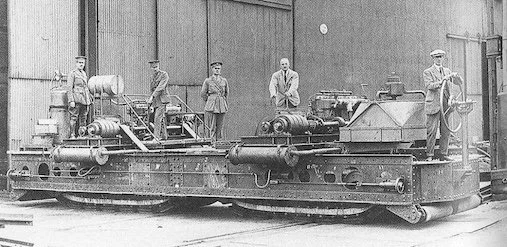
With the successful development of the caterpillar system for the Tank, interest in the pedrail system waned, but a great deal of time and money had been invested in various aspects of Compton’s designs and with Jackson’s flame projector yet to be tested, the Ministry of Munitions authorised the construction of one-half of Compton’s design for evaluation. The Pedrail Company in London had already manufactured many of the components and the base and motor components were taken to Stothert and Pitts of Bath to be assembled to form one half of Compton’s design, commonly referred to as the Trench Warfare Caterpillar or Tank.
The Chassis of the Trench Warfare tank at the works of Stothert & Pitts Bath. (https://en.wikipedia.org/wiki/Pedrail_Machine).
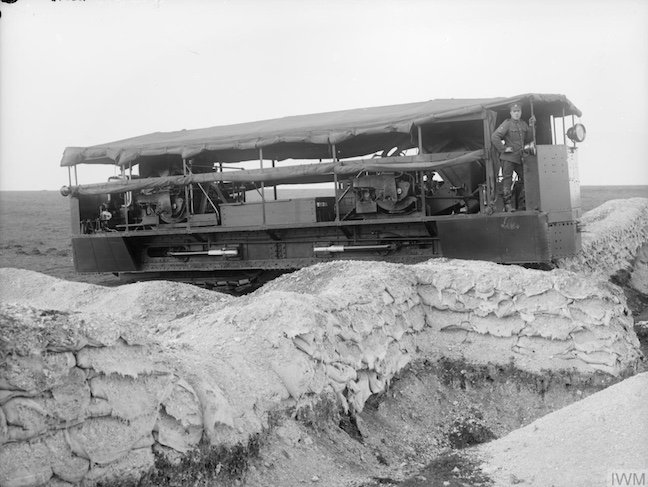
For trials, rather than being armour plated, the chassis was fitted with a light metal tram-like superstructure to protect the crew and machinery from the weather.[18] This rather strange looking machine left Bath in July 1916, and drove, under its own power to the Trench Warfare Department proving ground at Porton Down. Here, several successful trials were conducted in which the machine attained a maximum speed of 16 mph over rough ground. However, the War Office decided not to proceed with Jackson’s flame thrower, and his Tank was stored at Porton until the end of the war, when it was driven down to Bovington in Dorset to become an exhibit in the embryonic Tank Museum. Unfortunately, the members of the Royal Tank Regiment assembling the Museum did not want it, perhaps because it was not an authentic Tank, and had it scrapped.
Jackson’s Experimental Pedrail Tractor, Crossing a Trial Trench and Parapet. Salisbury Plain 1917. Q14613 Imperial War Museum.
[1] Gilbert, Winston S Churchill. Companion Volume III Part I, Churchill to Sir John French, 8 December 1915
[2] H. G. Wells, The Land Ironclads. (London, The Strand Magazine, 23 (156), 1903), pp. 751-769
[3] At this time, minutes were not kept on the discussions or decisions of the Government in Cabinet meetings. The only official record was the Prime Minister’s letter to the King, and as this was confidential, it could not be shared with the rest of the Cabinet. On Hankey’s appointment as Cabinet Secretary, a proper agenda and minutes of Cabinet meetings were kept for the first time.
[4] TNA: MUN 5/210.1940/27: Tulloch interview for History of the Ministry of Munitions
[5] He signed his published reports’ Eyewitness’. They were such an important propaganda tool for the War Office that Kitchener read and approved each before they were submitted for publication.
[6] Hankey, The Supreme Command 1914-1918 2 Vols. (London: George Allen & Unwin Ltd, 1961), Chaps. 21-23
[7] Gilbert. Winston S Churchill. Companion Volume III. Part 1. August 1914-April 1915, pp. 337-343 [
8] This may have been an idea copied from the Belgian army, which was equipped with a small number of armoured cars before 1914
[9] The Official History of the Ministry of Munitions. Vol. XII. Part III. Tanks, p. 4
[10] TNA: T 173/34B Part 3: Tank Enquiry. General Correspondence Tulloch to Jackson, Memorandum by Captain T. G. Tulloch on Land Cruisers and Destroyers. 15 January 1915
[11] Holden was appointed as the technical expert. He was a motor enthusiast and, before his retirement in 1912, was Chair of the War Office Transport Committee that was overseeing the mechanisation of the army. Despite this, he had minimal and restrictive views on the military applications of the petrol engine.
[12] TNA: T 173/34B Part 3:Tank Enquiry. General Correspondence Tulloch to Jackson
[13] TNA: T 173/34B Part 3: Tank Enquiry. General Correspondence. Jackson to CRE Shoeburyness.
[14] According to Major Hayes, superintendent of experiments at Shoeburyness, they were not attached as “they took too long to fit”. <https://en.wikipedia.org/wiki/Pedrail_wheel>
[15] The Official History of the Ministry of Munitions. Vol. XII. Part III. Tanks, p. 21
[16] Richard Ogorkiewicz, Tanks. 100 years of evolution. (Oxford: Osprey Publishing, 2015)
[17] The History of the Ministry of Munitions, vol. XII, Part III, Tanks, p. 24: https://tanks-encyclopedia.com/ww1/uk/jacksons-pedrail/
[18] Andrew Jones, The Pedrail Landship. < http://www. bath-at-work.org.uk/the-pedrail-landship/ >