Flame Projectors.
4. And Samson went and caught three hundred foxes, and took firebrands, and turned tail to tail, and put a firebrand in the midst between two tails.
5. And when he had set the brands on fire, he let them go into the standing corn of the Philistines, and burnt up both the shocks, and also the standing corn, with the vineyards and olives.
Book of Judges. 15. vers. 4&5.[1]
Introduction.
Fire, as a weapon to induce terror, damage and death dates from the earliest periods of organised warfare as indicated from the passages quoted above, and although we do not know the incendiary mixture Samson used military technology had reached a stage that gave him a choice of several for one of the regional superpowers, the Assyrians (2400-612 BC), were surprisingly advanced in the application of chemistry and chemical engineering in the service of warfare, developing several incendiary devices based on mixtures of crude oil, pitch and sulphur. The Greeks, always on the lookout for a good idea, extended the scope of incendiary weapons into the realm of naval warfare by heating large cauldrons filled with mixtures similar to those developed by the Assyrians and, once they caught fire, hurled the burning cauldrons at enemy ships employing an on-board catapult, a somewhat dangerous weapon to carry on a wooden ship.
The next significant breakthrough occurred sometime in the seventh century AD, with the development by the Byzantines of a new revolutionary mixture called Greek Fire, which spectacularly kept burning under water and could only be extinguished by covering it with a deep layer of earth. In the nineteenth century, scientific advances in chemistry stimulated a renewed interest in flame as a weapon, but despite many wonderful and weird suggestions, no successful inflammatory mixture or method of delivery was developed that met the needs of the army or navy until the growth of militarism in the new German Empire. In his excellent history of flamethrowers in World War II, Lieutenant-Colonel Leonard McKinney recounts a story, perhaps apocryphal, of how the German army first became interested in this technology.[2]
As the story goes this was sparked by an incident during army manoeuvres at the beginning of the twentieth century when a young officer was given strict orders to hold his position at all costs. When it looked as though the opposing forces might overrun it, he took drastic action, driving them off by spraying them with a fire hose. When challenged about his unorthodox defence during the post-manoeuvre analysis, he explained that he was defending his position by spraying the attackers with burning oil. This concept appealed to the higher command, which organised a competition to design an effective flame thrower, which engineer Richard Fielder won with what he termed his Flammenwerfer, the first modern flame thrower. By 1907, the German army had a small number of specialised Pioneer (Engineer) units trained in their use.
In Prussian military doctrine, the Flammenwerfers were specialised weapons attached to the artillery siege train to be called upon if required to attack fortress positions. We owe the extension of this doctrine to include flame throwers as a shock-effect weapon in close support of an infantry assault to a Landwehr officer, Bernhard Reddeman, in civilian life Chief Fire Officer of Leipzig who, after mobilisation in 1914, persuaded his superiors to allow him to create a specialised flame projector unit, composed of reservists who were also firemen, to be employed supporting the infantry.[3]
Reddeman’s experimental unit was first used against the French at Malancourt Wood, in the Verdun sector, on 26 February 1915 and was considered effective enough for Reddeman to be authorised to create additional units. This resulted in the French, and to a lesser extent the BEF, experiencing attacks when, in the initial assault, flamethrowers accompanied the German infantry, aimed at disrupting the defence rather than inflicting casualties. Later, flammenwerfer were used in the consolidation of captured positions by clearing dugouts and fortified positions, although their use in such conditions was constrained by the difficulty of manhandling heavy equipment among the damaged trenches and detritus of battle.
The Weapons.
Irrespective of nationality, the pattern of all early flame projectors, irrespective of type, had several standard design features.
1. One container, not under pressure, filled with a mixture of heavy and light oils. The heavy oil was necessary to obtain a reasonable distance with the oil spray, and the light, usually petrol, ensured that the oil mixture burned with a powerful flame.
2. Strong metal cylinders containing air, carbon dioxide, or nitrogen under high pressure were connected to the oil tank to expel the oil mixture.
3. A discharge tube, or lance, terminating in a suitable nozzle through which to spray the oil mixture.
4.A means of igniting the oil mixture. This was either by an ignition system at the nozzle, or by spraying the oil at an area already ignited with an incendiary grenade or similar. The more complex projectors were fitted with a trigger that allowed the flame to be switched on and off to avoid wasting oil when changing targets.
Portable Flame Projectors.
These are essentially short-range weapons, shorter than most hand grenades, and the first patterns, developed by the Germans in 1915, had a two-man crew, one to carry the projector lance and who was connected to his partner with the cylinder of compressed propellant gas and the oil tank on his back, using a flexible hose. This was the weapon employed in the attack against the BEF at Hooge on the night of 29 July during the Second Battle of Ypres.
This event has become so embedded in the British mythology about their experiences of the war that it is difficult to distinguish fact from fiction. In contrast to the mythology, the casualties attributed to the direct effects of the German flamethrowers were insignificant. Still, their impact on the inexperienced British troops was to cause widespread panic and demoralisation, resulting in high casualties inflicted by the German infantry using their personal weapons. The early German experiences led to the recognition that portable flamethrowers were particularly useful in the mopping up of captured positions by clearing bunkers, and in assisting their consolidation by securing the flanks. However, their use remained limited until 1918, not so much through the obvious limitations in technology, but rather due to a poorly developed tactical doctrine defining the combined use of portable flamethrowers and infantry. A particular weakness was infantry support of the Flammenwerfer troops, as experience had shown that when used in combination, the infantry tended to avoid them as they attracted large volumes of fire, leaving the unfortunate Flammenwerfer troops easy prey to the enemy defence.
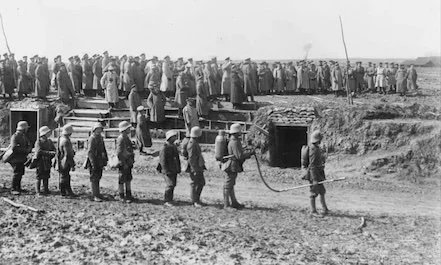
A German flamethrower team prepares to lead a simulated attack. They are using a Kleif-style flammenwerfer. IWM Q 44155
The Menchen Flame Projector.
The beginning of the British interest in flame projectors was a letter from General Fowke, the Chief Engineer to the BEF, to the War Office in November 1914, requesting a flame projector,
Make preliminary enquiries for a force pump, hand worked, such as Hall’s Distemper Spraying Machine or similar pumps, which can be used in a trench to send a jet of oil 60 or 50 yards or more, for incendiary purposes. (after firing incendiary bombs, burning rags, etc)[4]
The letter was passed to Colonel Jackson in FW3, and on the copy in the National Archives, there is a note in his hand against this paragraph stating that it was his authorisation to develop flame projectors.
Over the winter of 1914/15, he developed a portable flamethrower with a range of about 20 yards, which the Ordnance Board rejected because its range was too short to be useful. Still, it was a start.[5] Then, in the spring of 1915, the development of British flamethrowers received a significant boost by the appearance of an American, Mr Joseph Menchen.
Joseph Menchen was something of a polymath. At the end of the nineteenth century, he started his career working with recently developed technology for installing electric lights and machinery in theatres. From this, he developed a very successful career as an industrialist. This gave him the resources to indulge his other passion, for he had become enamoured by the invention of moving pictures, and by 1914, he had made several hundred films, making some significant innovations in cinematography, such as using camera angles and lighting for special effects. Able to finance his own films, he also invested in those of others, often acting as producer and scriptwriter, an activity that led him to become a significant literary agent; his clients’ stories provided the storylines for many of his films. On top of all this, Menchen was an inventor of note, holding dozens of patents, including many of military interest, such as a tracer bullet, fuses for mortar and aerial bombs, and the Menchen flame projector.[6]
Menchen introduced his concept of a petrol-spraying flame projector to Colonel Jackson in February 1915. We do not know if he had built a machine to demonstrate to Jackson or just explained his ideas with the aid of drawings. Whatever it was, Jackson saw potential in his ideas. He commissioned the production of two machines for further evaluation, one suitable for employment in a heavy battery embedded in a front-line trench and designed to throw the flame as far as possible, the other a light man-portable version along the lines suggested by General Fowke. Menchen’s portable version was available for testing in April, a couple of months before the German attack at Hooge. The prototype performed well, projecting the flame about 20 yards, but, as with Jackson’s prototype, the Ordnance Board considered this too short a range and no further development work was carried out.
The Menchen long-range projector was to have a more chequered history. Only one or two were built for evaluation and experimental purposes, but the War Office did not adopt the machine, and its importance lies in the number of significant innovations Menchen incorporated into his design that were essential to the successful development of later machines. The original Menchen machine was large and heavy, consisting of several large tanks containing 160 to 200 gallons of oil laid along the floor of a trench connected, in series, by flexible metal pipes.[7]
A similar number of propellant tanks were attached to the oil tanks and charged with air at a pressure of 250 lbs/square inch. They were connected in series and rechargeable from cylinders of compressed air. The firing nozzle, attached to the end of the discharged tube, could be elevated, depressed, and traversed by an ingenious invention of Menchen’s, powered by compressed air that allowed the operator to manipulate the nozzle from a safe distance, an invention modified and incorporated into all future heavy flame projectors. Menchen’s flame projector was an entirely new type of weapon for which little, if any, information was available on how it might perform, but all went well and, in trials, achieved an outstanding range of over 100 yards. The Ordnance Board thought the machine was overcomplicated to use, and too clumsy and heavy to manoeuvre in a trench where space was limited.
The Vincent’ Quad’ Flame Projector.
After the surprise German flamethrower attack at Malancourt Wood in the Verdun Sector, the French embarked upon an intensive research programme that quickly led to the development of several effective flamethrowers, including the Hersent Flame Projector. Constructed of four steel tanks connected in series, the first three contain the inflammatory mixture, with the front tank fitted with the delivery tube and nozzle. The last tank serves as the reservoir for the propellant gas, which is topped up as required from gas cylinders. These flame projectors were designed to be employed in defending trenches by being installed in bomb-proof dugouts situated in the front line, which had several outlets in their roofs pointing in different directions through which the nozzle could be raised just before firing, permitting the nozzle to be trained on other targets. A notable feature of the Hersent projector was its mobility; once dismantled, the components, including the compressed gas cylinders, could be transported on a single wagon.
To build on the knowledge gained from the experiments with the Menchen projector, Jackson sent one of his research staff, Captain Vincent to France to study the Hersent projector and, on his return, set about designing his projector with the assistance of Captain F. S. Hay and the staff of Alley and MacLellan of Glasgow, a company with extensive experience in building equipment and machines powered by compressed gasses.[8] His projector, the Vincent or Quad, incorporated the best features of the Hersent and Menchen designs.
Constructed of four vertical round steel tanks 16 inches in diameter and 4 feet high, the top of each fitted with a combined stop and non-return valve of Menchen’s design that connected the tanks in series by short lengths of flexible steel pipe. A syphon tube that reached the bottom of the tank passed through the centre of these valves, ensuring the efficient expulsion of the oil mixture, a concept borrowed from Hersent. Each oil tank was strapped to an air tank filled with air or nitrogen at 250 pounds/square inch and recharged from high-pressure gas cylinders. This group of four tanks, or Quad, gives the device its name and was compact enough to stand in a small emplacement carved out of a trench, or concealed and protected in a dugout in the French manner. The discharge tube was fitted to the last oil tank in the series, and between its nozzle and the oil tank was fitted a rapid on-off valve that acted as a trigger which, when pulled, activated a sparking plug to ignite a cup filled with petrol situated at the base of the nozzle that in turn ignited the oil mixture released by the trigger opening the on-off valve. In the original Vincent design, the nozzle rested on the trench parapet protected by an armoured shield, soon replaced by Menchen’s compressed air device that raised, lowered, and traversed the nozzle, an arrangement referred to as the Monitor.
To prepare the Vincent for firing, the oil tanks were three-quarters filled with the oil mixture, and the gas tanks were connected to admit the gas slowly into the space above the oil to achieve a pressure of 250 lbs/square inch just before firing. The petrol cup at the end of the nozzle was ignited and, on the command, the trigger valve was opened, forcing the oil out. The flaming oil was projected about 90 yards, decreasing as the gas pressure in the oil tanks fell as they emptied. Each tank contained 25 gallons of the oil mixture, and without an effective off/on valve to act as a trigger, all 100 gallons were consumed in a single shot. In later models, a special Monitor designed by Captain Hays and Lieutenant Tribe replaced the nozzle, allowing operation from an underground gallery, the Monitor rising 3 feet 5 inches above the ground before firing, an arrangement adapted for other large experimental flame projectors, most notably the Livens’ Large Gallery Type.
Like the Hersent, an essential feature of the Vincent was that it could be quickly taken to pieces and moved with each piece so designed that one man could carry it. At a demonstration at Wembley on 13 June 1916, a crew of 5 dismantled the Monitor in three and a half minutes after a few hours of training and re-erected it, ready for firing in 7 minutes. In another trial a crew of 10 dismantled a complete battery, including the oil tanks, and carried them a short distance in four and a half minutes before carrying them back to the original position to reassemble the projector, charge it with oil and fire it, all in fourteen and a half minutes, an unbeaten record of the time taken to dismantle and reassemble any type of battery flame projector. An experimental modification of a Vincent by Captain Hay established another record, projecting the flame 134 yards, the furthest distance any British projector achieved.[9]
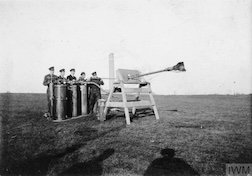
Demonstration of Vincent flamethrower that was used by HMS Vindictive during the Zeebrugge raid. Q64463 Imperial War Museum.
Lord Kitchener approved its development and requested that an order for 50 machines be placed with the Ministry of Munitions. On 30 September Addison authorised the funding, estimated at £250 for each machine, at the same time sanctioning the expenditure for Jackson’s experiments with flame projectors mounted on tanks, noting that if the Vincent did not work in the trenches, it could be mounted on Jackson’s tractors.[10] Components for the machines were constructed in various workshops throughout the country and brought together at the Shrewsbury works of Alley & MacLellan for assembly. Flame testing was carried out at the Trench Warfare Experimental Ground at Wembley.
The development of flame projectors was not without its lighter moments. During September 1915 extensive trials of the Vincent were carried out at Wembley and, on 20 September, Lloyd George asked Addison how they were preceding, and on being told that they had a very effective machine projecting a flame about 100 yards asked for a demonstration that afternoon, as he wished to invite the Prime Minister, who had an unexpected gap in his diary. With Jackson away at Reigate, Alexander Roger pulled out all the stops to organise the demonstration, which was no easy task as the men had been working hard all weekend and had been given the day off. By 5 o’clock, they had all been rounded up and everything was ready to go. Meanwhile, a largish procession was organising itself in Downing Street and, as the Prime Minister had decided that his wife should see the demonstration, the convoy of cars was filled with Asquith, his wife Margo and their young schoolboy son Anthony, along with his Spanish nanny, followed by Lloyd George, Generals Du Cane and Phillips, Dr Addison, and a bevy of minor individuals from Asquith’s political office and even some his household staff. Jackson was furious when he found out about a miscellaneous group of civilians seeing a demonstration of their latest secret weapon and, arriving home to the flat in Pimlico he shared with his son Cecil and daughter-in-law, raged all evening about the breakdown in security, and the fact that no one had recorded the names of those that had turned up with the Prime Minister. As Addison later remarked, Jackson’s outburst was a wake-up call about taking security seriously, and the Ministry was much stricter regarding the development of the Tank.[11]
GHQ maintained an ambivalent moral attitude towards the employment of flamethrowers. As none were requested, each completed Vincent was put in storage, where they remained until the beginning of 1916, when the Russian Government asked to purchase flame throwers and the War Office, seeing the opportunity to get rid of a weapon not wanted by GHQ, offered them the Vincent. As the only organisation with experience in firing the Vincent, the Trench Warfare Research Department released Captain Hay and Lieutenant Tribe to train 300 selected Russian soldiers at Wembley, with the first Vincents dispatched to Russia early in May 1916. Twenty more were sent by the end of the month. A further fifteen in September, making 35 in total.[12] On arrival, they were extensively modified to meet the conditions of active service on the Russian Front. However, it is unlikely that any saw action due to the deteriorating political situation in the Russian army.
Of the remaining 14 Vincents, three were fitted with the new style monitor and sent to the Special Brigade in France for evaluation during the Battle of the Somme, the remaining eleven remaining in storage to be wheeled out now and again for experiments or demonstrations. In 1918 the Admiralty asked for flamethrowers, and seven were fitted on HMS Vindictive for the attack on Zeebrugge in April, with the Trench Warfare Research Department training volunteers from the Admiralty Experimental Station, designated the Experimental, or Pyrotechnic Party, to operate the Vincents, and Hay Flame Guns, that were to support of the naval and marine personnel storming the strong German positions on the Mole at Zeebrugge.[13]
The Livens Large Gallery Flame Projector.
It is not my intention to recount the history of the Livens Large Gallery Projector, of which there are many conflicting and partisan accounts, but to provide a summary of the Trench Warfare Research Department’s contribution to its development.
William Howard Livens (1889-1964) was the son of Frederick Livens, Chief Engineer and later Chairman of Ruston and Hornsbury of Lincoln, a major manufacturer of a wide range of machinery such as traction engines, boilers and steam-powered excavators. William Livens attended Oundle School, where he was a sergeant in the Officers Training Corps (OTC) and, in 1908, went up to Christ’s College, Cambridge to study engineering, again serving in the OTC. He was an exceptional shot with rifle and pistol and the Captain of the University of Cambridge Rifle Team. On the outbreak of war, he was commissioned in the Royal Engineers in September 1914 and posted to the Royal School of Military Engineering at Chatham, where he was primarily employed in administrative duties. In his spare time, he experimented with designing weapons that may be useful in trench warfare, including flame throwers and a simple trench mortar. It is unknown whether Livens was aware of the activities of Jackson and Section FW3, who were working on the same projects, but it is highly probable.
Livens was among the first officers recruited by Jackson into the Special Companies in the summer of 1915, one of the few who was an engineer rather than someone with chemical knowledge. While preparing for the gas attack at Loos in September, he started to think of improvements to the method of chlorine discharge developed by the Castner Kellner Company and, enlisting the assistance of his father, redesigned the technique of gas discharge. His first trials were carried out in late September and were successful enough for him to be dispatched to England to explain his modifications to the Trench Warfare Department. The chlorine was discharged from the cylinders through flexible metal pipes that were unwieldy to handle in the trenches, difficult to place in position and, if not handled with great care split, releasing gas into the trenches among the infantry waiting to attack. Livens’ improvement was to substitute flexible rubber hoses, which were used successfully in the second gas attack of October 13th.
After the Battle of Loos, the War Office decided to increase its commitment to chemical warfare and approved the expansion of the Special Companies into the Special Brigade consisting of 21 Companies, 16 of which dealt with cylinder release, four responsible for the one hundred and ninety-two 4-inch Stokes mortars, and the remaining Company of four special sections, Z Company, was commanded by Livens. A distinguishing feature of Z Company was that, unlike the other companies in the Special Brigade, where many of the officers and men had chemical knowledge, Livens appointed individuals with engineering experience. This, with the Company’s extensive workshop capabilities, gave him the facilities to carry out much of the original developmental work on his many inventions, including the flame projector.
Z Company had a very close relationship with Jackson’s Trench Warfare Department to develop and improve equipment that was essential to the functioning of the Special Brigade, and which provided it with the chemicals and other items of equipment necessary to conduct its experiments, received reports on their outcomes, and officers from Jackson’s research staff were frequently seconded to Z Company to collaborate on projects that had support from the Ministry of Munitions.
In December 1915, Levins accompanied Foulkes to a demonstration at the Wembley Experimental Ground of the Trench Warfare Department’s experimental flame projectors. When Foulkes expressed an interest in the Vincent machine, Livens said that he could develop a superior machine, persuading Foulkes to give him a budget of £450 and permission to use the resources of Z company to develop a large flame projector. Livens proposed to work independently of the Trench Warfare Department, collaborating with his father on the design and using the resources of Rushton and Hornsbury for engineering work that Z Company’s workshops could not undertake, an arrangement that put Foulkes in a rather delicate situation,
It was a somewhat delicate matter, and I arranged that he should be given a free hand from the Trench Warfare Department in order to employ himself upon the production of the Flammenwerfer which he had suggested to me.[14]
Although the collaboration with his father continued and proved very successful, Livens’ independence from the Trench Warfare Research Department was short-lived, as his project relied on their experience with the Menchen and Vincent machines and Livens’ proposal became a tri-patriate project with the Trench Warfare Department providing the funding as well as expertise.
Based on the ranges obtained with the Vincent machines, Livens recognised the impossibility of operating a large flame projector, with a maximum range of about 100 yards, close to enemy positions unless completely protected. He believed this could be achieved by placing the Projector underground, setting himself the challenge of designing a machine that could operate from an underground gallery 10 to 20 feet below ground. The principles of the machine were relatively straightforward, incorporating many of the successful features of the Menchen and Vincent designs: his greatest challenges were engineering. How to create a machine weighing about two tons that could be assembled in its underground gallery from many individual components bolted together in sequence in a narrow tunnel in near darkness, with no single component so heavy that it could not be carried and manoeuvred in a confined space by one man. Livens collaborated with his father to solve this massive engineering challenge.
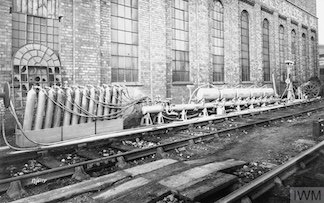
In its final form, the Livens Large Gallery Projector consisted of a firing pipe constructed from seven short lengths of 9-inch diameter steel piping bolted together to form a continuous pipe laid horizontally along the floor of the underground gallery. This held about 80 gallons of the oil mixture. Above were five additional steel tanks, connected to the firing pipe by short lengths of steel tubing fitted with valves and filled with oil to form a reservoir for recharging the firing pipe. This allowed the Projector to fire a second, or even a third, shot, all fired within four minutes, significantly adding to the surprise and shock experienced by the enemy.[15] Unlike other flame projectors, in which the compressed gas required for discharge was in direct contact with the oil mixture, the oil was driven out of the firing pipe under pressure by an ingenious piston arrangement invented by Livens Senior. This separated the oil from the compressed gas stored in high-pressure cylinders at the rear of the discharge pipe.
The Livens Large Gallery Projector. National Archives MUN5/385/1650/2
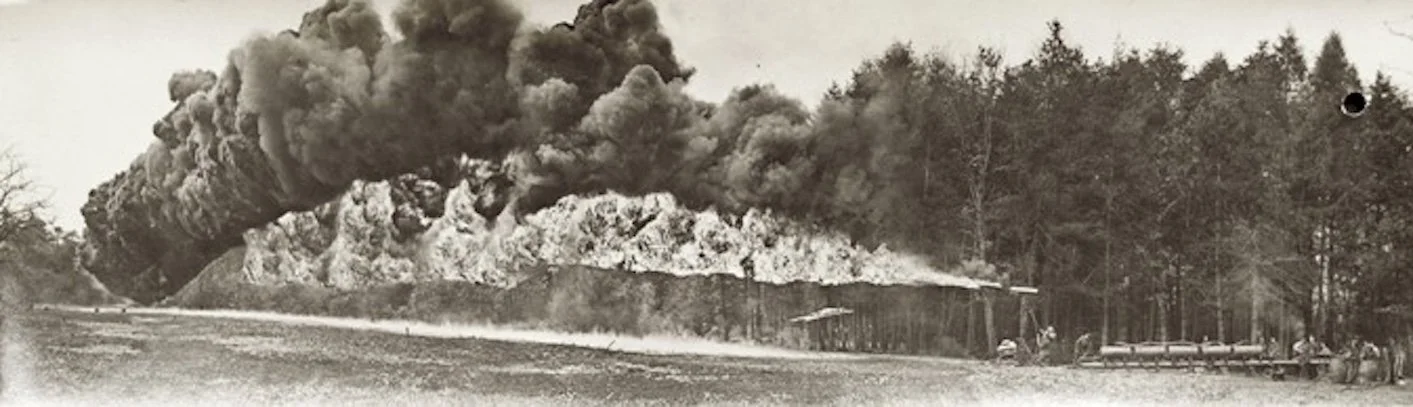
Demonstration of Livens Projector. Trench Warfare Department Test Ground Wembley. National Archives MUN5/385/1650/2
The Livens Large Gallery Projector held 250 gallons of a mixture of petrol and heavy oil. When ready to fire, the valves to the gas cylinder were opened, driving the piston forward to compress the oil, and the hydraulic pressure raised the firing monitor up its vertical shaft, breaking through the surface and reaching a height of several feet. The nozzle facing the enemy was opened, and the oil ignited, projecting about 100 yards into the enemy position. Each shot took 20 to 30 seconds, using up all 80 gallons in the discharge tube. As the oil pressure fell towards the end, the Monitor collapsed back into its shaft, ready for the next shot. However, this was rarely attempted due to suitable secondary targets within range. From July to October 1916, the large flame projectors, mainly the Livens type, but on occasion the Vincents, were fired on fourteen occasions, but even before the last discharge, they were redundant, superseded by a more straightforward and cheaper weapon, another invention of Captain Livens, his oil drum mortar or Projector.
The Employment of Large Flame Projectors on the Somme 1916.
The Livens Large Gallery Type were employed on the first day of the Battle of the Somme, July 1st, 1916, an event that has almost attained legendary status in British mythology about the battle. They, and the Vincent, were employed on several other occasions throughout the battle, but it is difficult to unravel how many, and which types of projectors were used on each occasion, as the unit War Diaries, where entries exist, are brief and uninformative, while other accounts, both official and personal, some dating many years after the events described, are often partisan and contradictory. The analysis of the validity of such reports is outside the remit of this article, but it is helpful to know something about how these large flame projectors were employed in battle. What follows is, a generalised account to give a flavour of events, and not a definitive history of each firing.[16]
The deployment of smoke and gas delivered by the troops of the Special Brigade were integral to the detailed planning of General Rawlinson’s Fourth Army offensive on the Somme in the summer of 1916, but there is nothing to suggest the deployment of flame projectors figured in the planning until Lieutenant-Colonel Foulkes, always extolling the tactical merits of his Special Brigade, suggested that their new experimental weapon, the large flame projector, could be added to the mix, albeit in a minor role.
In the month leading up to the Battle, Livens and the men of Z Company were still experimenting with their Large Gallery Projector, either at the Trench Warfare Research Department’s ground at Wembley or the more secure location of Hatfield Park, where the development of the tank was also taking place. It was not until the June 24th, a week before the start of the battle, that the sappers of Z Company, with four large and 24, semi-portable flame projectors, all designed by Livens, travelled from Southampton for Le Harve, then by train to Corbie, sixteen miles from the front in the Fourth Army area. Here they established their main Depot, followed by a forward Depot at Bronfay Farm, near Bray-sur-Somme. With less than a week before the offensive was due to start, their choice of targets was limited to those already in range of shallow tunnels (Russian Saps) driven into No Mans Land by the tunnelling companies to assist in the assault.
To set up the flame projectors the men of Z Company were divided into three sections.
Section I. Install one large flamenwerfer for 7th Division, XV Corps.[17] (Throughout the War Diary the machines are always referred to be their German name)
Section II. Two flamenwerfer for XIII Corps.
Section III. Divided into small detachments with semi-portable projectors for X, VIII and XV Corps Fronts.
June 27. Section I. Bronfray Farm, 10 am-8 pm. Sorting and loading one large flamenwerfer onto three 3-ton lorries supplied by XV Corps. Completed supplies of oil and compressed gases.
8:00 pm the convoy moved off Lieut. Bansall and one section proceeding with it
9:00 pm. Meet 10 G.S. waggons and transfer.
10:00 pm proceed towards Ludgate circus via Waterloo Junction
11:00 pm arrive behind Ludgate Circus, continuation of road proved impossible for transport, unloaded there. Delay in bringing infantry carrying party, 200 strong (8/Devons 20 Inf. Bde) from the rendezvous at Ludgate Circus.
June 28th. 2 am. Long and heavily loaded carrying parties of RE and Devons moved slowly through Communication Trenches, collided with a party of Pioneers with picks & shovels in 71 Street. Heavy hostile bombardment of trenches occurred at this point. Parts of flamenwerfer dropped & men took cover.
5am. Most important parts of the flamenwerfer collected & placed in in Sap 14: this was done chiefly by the small R E Party who worked exceedingly well.
6 am. Heavy shell sealed up end of Sap to a length of 20 ft, burying the projector and damaging it beyond repair.[18]
Noon. Party withdrawn through deep gallery. Circumstances reported to C.O. of Devons and B.M. 20th Inf. Brigade. No casualties. Returned to billets.
Section II. They were to have slightly better luck with the other projectors. The site chosen was in front of the 18th Division, where the width of No Mans Lan was about 200 yards and penetrated by numerous shallow Russian Saps, all about 10 feet underground. It was the existence of these galleries, rather than gaining any significant local tactical advantage, that determined where the Large Gallery Projectors were to be employed. Three galleries, Nos. 7, 10, and 13, were identified by the mining company as suitable.
Two were astride the Carnoy-Montauban road and penetrated 160 and 175 yards into No Mans Land, while the third (No13) stopped 60 yards from an enemy strong point known as Casino Point. An important factor in selecting these saps was that the headroom was just sufficient to allow the men to assemble the projectors, an arduous task achieved with incredible difficulty. Components for three projectors were transported to the saps on the 27th and assembled on the surface in the correct order, before manoeuvring along the narrow galleries with minimal free headroom to be bolted together. On June 28th, No. 13 sap was blown in during a heavy bombardment and was abandoned.
On the 29th No.10 sap was blown in but on clearing the debris there was only slight damage to the minenwerfer. The same thing occurred to No. 7 sap on the 30th.
Night of June30/July1. The monitors of both machines were pushed to the surface and their associated machine gun positions cleared for action.
7.15 am, July 1. Both minenwerfers fired a single shot, the flames reaching well over the enemy trenches. At 7.30 am the infantry attacked suffering few casualties in the areas blasted by the minenwerfers. After that attack 2/Lieutenant Stewart went forward to assess the damage. He found a few charred bodies and rounded up about 50 enemy prisoners. He then set about setting up an aid post and started to collect the wounded, all under heavy enemy fire. For these acts of bravery his Company Commander recommended him for the Victoria Cross, which was not awarded.
Section III. Small detachments took semi portable flame project the various parts of the line. None were ever brought into action as it was found impossible to negotiate trenches with these weapons as they were too heavy.
After July 1. The next planned deployment was the capture of High Wood, planned for August 18th. Two Livens projectors were assembled in open saps. Both were severely damaged by enemy artillery fire and abandoned before the attack. However, sufficient usable components were salvaged to rebuild a single machine to support an attack on the Leipzig Salient planned for the 21st, but on the morning of the attack, the infantry decided that the position was so lightly held that they could capture it without the Projector's help. It was dismantled and returned to the advanced Depot at Bronfay Farm. In the meantime, several replacement projectors arrived from England and on August 28th, one of these was assembled in Arrowhead Copse, southwest of Guillemont, and fired successfully on September 3rd. On the same day, three Livens and one Vincent came into action supporting yet another attack on High Wood, and, as the infantry attack failed to clear the wood, the machines that had survived were refilled and fired again at the start of the assault on September 8th.
Captain Hay’s history of the large flame projectors prepared for the Historical Section of the Ministry of Munitions states that 24 Livens Large Gallery Type were sent out to France during July 1916, and later, the equivalent of 10 more were sent out as spares, numbers that are difficult to reconcile with the surviving reports of the number fired. This may suggest that many were damaged or destroyed before coming into action, or the machines were never used but stored at the Depot, as insufficient targets and locations were identified to justify the labour required to bring a Livens Large Gallery machine into action.[19]
The last occasion the large flame projectors were used in anger was on October 5th, when both Livens and Vincent projectors were installed in French trenches at Neuport, where they were fired, in conjunction with a gas attack also mounted by the Special Brigade, in support of a combined French and Belgian attack.
The British army was not the only one interested in the Livens Large Gallery Projector. The Russian Government ordered 50, and Rushton, Proctor & Co. were given special authorisation by the War Office to deal directly with the Russians and succeeded in delivering all 50 machines towards the end of 1916.
Effectiveness of the Large Flame Projectors.
Foulkes, who encouraged Livens to develop his Large Gallery Projector, was not a fan of their use in battle, The large projectors weighed two tons and required two to three hundred ‘men-journeys’ to carry them to their destination. Both Vincent and Livens type machines proved disappointing. The latter was a horizontal structure consisting mainly of a 9½ inch steel tube 12 feet long and made up of portable lengths that were bolted together in the emplacement. The Vincent was of the vertical type, its four separate containers being connected up as a group, so it took up less room. The containers however were 4 feet 6 inches high and 14 inches in diameter and weighed over 200 pounds so that they could only be moved at night across the open. The machine could be assembled more quickly than the Livens, 5 hours against 6, the range much the same but was only capable of a traverse of 45 degrees as against 90. The Livens had the further advantage that three shots could be fired against one for the Vincent.[20]
Foulkes’ coolness towards flame projectors, and the judgement of GHQ that the purely local effect they produced did not justify the significant expenditure of labour and effort required to bring them into action, were no doubt factors that contributed to their demise, but they were no loss to British offensive capability for even before they had been employed in action for the last time, the inventive Captain Livens had developed a cheaper, more flexible, and effective alternative, the Livens’ Flame Projector.
This weapon is discussed in detail in the chapter on chemical warfare, and only its original use as a flame projector is mentioned here. Livens’ Z Company improvised the first drum projectors as an emergency measure to suppress the numerous German machine gun posts around the village of La Boisselle by drenching them with burning oil. They consisted of simple mortar-like tubes formed by removing the tops from the standard-issue oil drums that were 20 inches high and 12 inches in diameter, half-buried in the ground at an angle of 45 degrees, to fire an incendiary bomb. These consisted of a standard Army Service Corps lubrication oil can filled with the heavy oil and petrol mixture used in the flame projectors, and wrapped around the cans were strips of sacking soaked with the oil mixture and were fired from the drum using a small propellant charge of black powder, very similar to the first trench mortars produced by the Indian Corps. The flash of the propellant ignited the sacking, and when the cans impacted the ground, the force was sufficient to break them open, scattering the area with a mixture of blazing oil and petrol. A range of 200 yards could be achieved, twice that of the Large Gallery Projector. Although not accurate, this was not important, as their primary function was to saturate the target area with a large area of burning oil. After the successful deployment of the projector drums at La Boisselle, Livens was seconded to the Trench Warfare Research Department, where he developed several improvements and refinements to his original projector, including the adaptations necessary for chemical delivery and electrically discharging dozens of the drums simultaneously.
The Semi-portable Flamethrowers.
In addition to the Large Gallery Type, Z Company took 24 semi-portable flamethrowers to France in July, and, although the type is not identified in the surviving reports, it is probably safe to assume they were the pattern developed by Captain Livens and not the Vincent Quads. These machines consisted of a vertical tank 12 inches in diameter and 44 inches high with a total capacity of 17 and a half gallons, but in practice were filled with 10 gallons of oil mixture to leave an air space above the oil to be occupied by the propellant gas, in this case deoxygenated air, at a pressure of 250 lbs/square inch, a pressure maintained as the oil was used by topping up from a separate high-pressure gas cylinder.[21] A rigid discharge tube reached to the bottom of the oil tank acting as a syphon that extended about six feet above the top of the tank to act as the discharge tube, or lance, fitted with the nozzle and ignition gear, and a rapid on-off valve as the base of the discharge lance acted as a trigger to turn the flow of oil on or off. Like the early German portable flamethrowers, it had a crew of two, one with the oil tank strapped to his back and who controlled the flame by manipulating the lance, the other carrying the cylinder of high-pressure propellant gas. It had a range of about 35 yards, and the trigger valve permitted it to be fired in short, quick bursts or as one continuous jet of flame that lasted until the oil ran out.
The Livens semi-portable projector had the simplest design, was cheap and easy to manufacture, and was perfectly safe in operation, but entirely unsuitable for the battlefield conditions of the Western Front. On July 1st, all 24 flamethrowers were distributed in various positions along X, XV and XIII Corps sectors. Although many of the crews got their cumbersome machines out of the jump-off trenches, they just could not keep up with the advance of the infantry, and none came within range of a suitable target. On July 10th, five were to assist the 36th Brigade in their attack on White Trench, but due to the churned-up state of the ground, they were unable to approach close enough to the enemy’s positions to come into action. On the same day, two were moved into Pommier’s Redoubt, a German strong point close to Trones Wood captured on July 1st but destroyed by enemy shellfire while waiting for zero hour. Two seem to have been used successfully in the 48th Division attack of July 17th, but after that, we hear no more of them, suggesting that they had been withdrawn from the battle.[22]
The Portable Flame Throwers.
Throughout the war, the Trench Warfare Research Department and independent civilian inventors were confronted with several serious design issues as they struggled to develop an effective portable flamethrower. There were significant engineering issues in devising a machine of two containers, one for the maximum volume of the oil mixture, the other for the compressed gas to expel it, that was portable enough to be carried by one man. Then there was the firing lance that not only had to be light enough to be handled by the soldier already encumbered by the weight of the tanks, but capable of rapid change of target in the confined and debris-strewn battlefield. The next consideration was the chemistry and physics of the oil mixture. The medium and heavy flamethrowers fired a mixture of a heavy oil and a light oil, usually petrol, in an approximate 50:50 mixture, the heavy oil necessary to ensure that the projected oil would remain as a stream, and burn longer, and not dissipated from the nozzle as a fine spray, which occurred when petrol was used alone.
The other problem, never satisfactorily resolved, was that all oil mixtures tested burned too quickly; the volume carried by one man was consumed in about seven seconds. Attempts to make the oil mixtures more sticky so the burning oil adhered to its target, making it more effective, all reduced the range of the burning jet of oil. It was not until the next World War that a suitable mixture, in the form of napalm, was developed. The Trench Warfare Research Department generally referred to portable flamethrowers as ‘flame guns’ as they were carried and operated by one man, and in the last two years of the war, developed and investigated several prototypes. The smallest was a light steel tube, four and a half inches in diameter and 3 feet long, holding one and a half gallons of oil, with the syphon tube inserted into the tank extended to form the discharge lance. A sparklet-like carbon dioxide container strapped to the side of the oil tank provided the propellant gas. The whole apparatus was slung under the arm on a sling, pointing downwards at an angle of about 30 degrees. While this little gadget was light enough to be easily manoeuvrable in confined spaces, its small payload of oil was considered too small for active service, and only eight were manufactured for experimental purposes.
Examples of the other machines investigated, or developed, by the Trench Warfare Research Department are:
The Menchen Knapsack Projector.
One of the first portable flamethrowers developed with several unique features, all inventions of Joseph Menchen, and incorporated into later machines. For example instead of having a separate cylinder to provide the propellant gas a small bottle of liquid carbon dioxide was placed in the oil tank and when ready to fire the seal on the bottle was perforated, as in a soda-water sparklet bulb, and the released gas filled the void above the oil as sufficient pressure to push the oil into the discharge tube, which in turn was fitted with a quick-acting valve that allowed the operator to fire the flamethrower as a continuous flame, or in a small number of intermittent shots. Another Menchen invention was a special match and mechanical striker assembly at the mouth of the nozzle operated by the trigger to ignite the released oil. This Menchen machine performed well in test firings, but the War Office considered it too complex to use in the trenches, and it did not progress beyond the experimental stage.
The Norris Projector.
In its earliest form, the Norris differed from other portable flamethrowers in that it carried the maximum volume of oil, leaving no headroom in the tank for the propellant gas, which was contained in a separate cylinder attached to the oil tank. Opening a valve allowed the propellant gas to pass into the oil tank, and, as there was no trigger valve, all of the oil discharged in a single blast of flame. Later, Norris’ designs were more conventional, with the tank three-quarters full, and the discharge of oil controlled by a trigger valve, allowing intermittent shots. Fifty Norris machines were sent to France for evaluation, but were rejected by GHQ because, weighing 100 pounds, they were too heavy to be portable on the battlefield, while the relatively small volume of oil made them too small to be operated as a semi-portable machine.
The Lawrence Projectors.
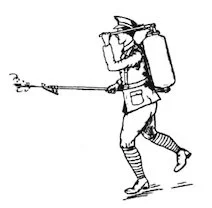
The operator fires the flamethrower by pulling down on a lever with his left hand, aiming the rigid, swivelling lance with his right.
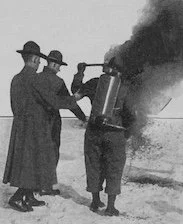
Men of the Chemical Warfare Service use a British Lawrence Knapsack Flame Projector Model 1917 to melt snow off the sidewalks in New York City, winter of 1920.
Lieutenant Lawrence, of the Trench Warfare Research Department, invented two types of portable flamethrower, one in Britain, the other in Russia, where he had been sent to train and supervise the Russians in the use of the Large Pattern Flame Projectors. His original design was a complete departure from those proposed by others and was capable of discharging flame and poisonous gas, either separately or together. The oil tank contained a mixture of turpentine and carbon disulphide in which was dissolved white phosphorus that produced a very hot flame of relatively long duration. This tank was carried on the man’s back while strapped horizontally across his waist were three small high-pressure cylinders, one containing liquid carbon dioxide as the propellant to discharge the turpentine mixture, another phosgene, or another poisonous gas, and the third oxygen to ignite and sustain the burning of the turpentine mixture when released at the nozzle. In trials, this machine performed well but had two significant drawbacks. With its multiple cylinders containing different gases, it was considered too complex to operate effectively under the stress of combat, and the ignition system could be put out of action if it became damp.
While in Russia, Lieutenant Lawrence modified this machine, so it operated just as a flamethrower, and in the process produced a machine of outstanding performance with some significant innovations. It could throw its jet of burning oil 45 yards, 10 to 15 yards further than any other machine then in use, and 18 single shots could be obtained from a single charge of three and a half gallons of his turpentine mixture. Using the machine to deliver multiple shots sacrificed some of the range. However, it made the machine suitable for both defensive and offensive actions. In most other designs for portable flamethrowers, the range fell rapidly as the gas pressure in the oil tank fell as the oil was used up. In his design, Lawrence overcame this problem by admitting the propellant gas into the oil tank only when required to fire, which ensured that the gas pressure was maintained no matter how little oil remained in the tank. Another innovation was that the in and out valves on the oil tank automatically closed when the trigger was released. This switched off the flame if the operator became a casualty or had to drop the equipment for some reason. For its time, mid-1916, the Lawrence model was probably the most successful knapsack flamethrower available. The Russian Government ordered several thousand to be manufactured by the Trench Warfare Supply Department, but by the end of the year, the Ministry of Munitions stopped production and forbade the export of completed machines on account of the deteriorating political situation in Russia.
The Hay Flame Gun.
This was a light and portable flamethrower developed by Captain P. S. Hay of Section 5 of the Trench Warfare Research Department in December 1917. It was cheap and straightforward to manufacture and had a maximum range of 30 yards and was considered so safe and foolproof that it could be operated with the minimum of training. It consisted of a single steel cylinder holding three and a half gallons of oil, with an inlet valve for the propellant gas and a syphon tube connected to the discharge lance ending in the nozzle and ignition system. Deoxygenated air, released into the oil tank from a separate cylinder strapped to its side, discharged the oil, and the operator slung the flame gun from a shoulder strap so that the oil tank hung in front of his chest. To fire he pressed a button that activated a dry-cell battery mounted on the lance igniting a port-fire at the nozzle to light the oil released by squeezing a release valve at the base of the lance.[23] Two of these machines were taken to France in May 1918 to demonstrate to General Perishing, but the American army did not adopt them and neither did the BEF. However, the Hays Flame Gun had its moment of glory when fired from HMS Vindictive during the assault on the Mole at Zeebrugge.
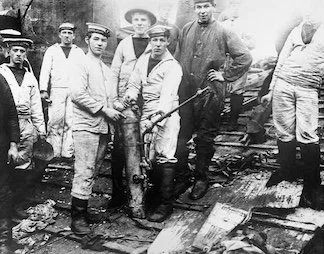
The Hays Flame Projector. HMS Vindictive 23-24 April 1918 Image: IWM (Q 55569)
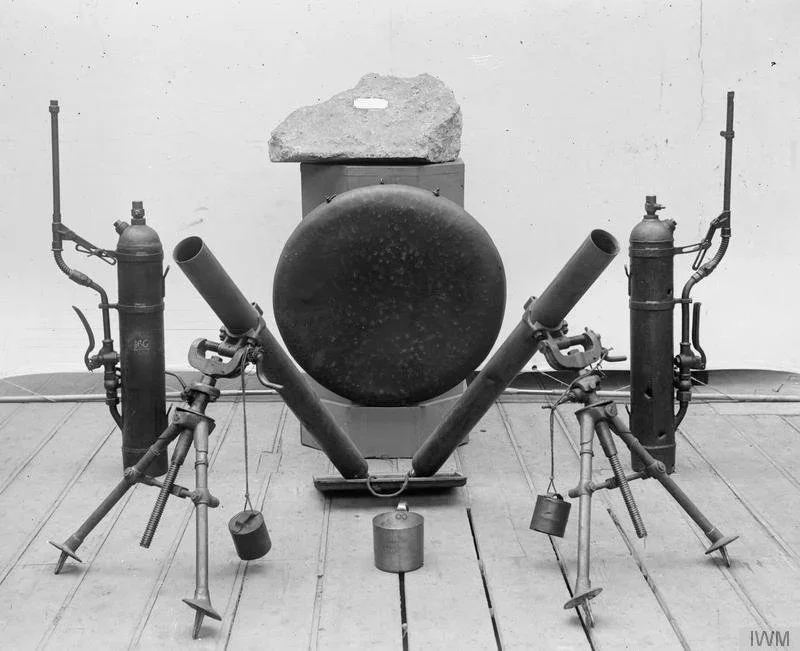
Flame throwers and Stokes mortars used by a landing party on the Mole at Zeebrugge. Also shown in then photograph; a piece of the Mole brought back by HMS Vindictive after an attack on 23rd April 1918, a rum measure and an alarm gong from the Jetty. IWM (Q20549)
In early 1915, in addition to the efforts of Jackson and Section FW3, several individuals in authority had an interest in developing flamethrowers, the most notable of whom was Maurice Hankey, an officer in the Royal Marine Artillery who was Secretary to the Committee of Imperial Defence, and soon to be the first Cabinet Secretary in the history of the British Government, and the most important and influential civil servant at the heart of Government. Somewhere along the way, Hankey picked up on the concept of flame projectors, probably from Jackson, and as a Royal Marine artillery officer with knowledge of a certain amount of chemistry, in particular the chemistry of explosives and incendiary mixtures, he decided to have a go at developing one himself. His first experiments were attempts to recreate Greek fire, that mysterious substance that burned on water. His mind filled with ideas of floating such a substance down rivers, or into harbours to destroy enemy installations, or throwing it into enemy trenches using catapults or mortars. Collecting what he thought were the essential ingredients, he embarked on a series of experiments in his garden, but the only outcomes were that he burned down a neighbour’s hedge with his primitive flame projector and contaminated the local stream with his chemicals so that all animal and plant life was extinguished. After these personal disasters, he approached Prime Minister Asquith about moving his research onto a more official plane. He was given the assistance of the petroleum chemist Boverton Redwood, Professor Fowler, and a Territorial engineer officer, Major Wilson. From the Admiralty, who were to sponsor the research, he acquired the use of a desolate piece of land they owned close to Chatham, and after several weeks of experimentation, succeeded in producing a liquid that floated on the River Ore, burned with intense heat and flame and generated dense clouds of black smoke. This was as far as the Admiralty was prepared to go, as they could see no use for an incendiary mixture in their type of operations, and already had adequate means of generating smoke. After the withdrawal of Admiralty funding Hankey persuaded Colonel Jackson to put some of his mixture in canisters to be thrown by catapult but that seems to be as far as his experiments went for, to Hankey’s great disappointment, the Army did not take up his inflammatory substance.[24] He did, however, revived the idea at the beginning of World War 2 when he had been drafted in from retirement to help out in Churchill’s wartime administration and became responsible, in part, for the creation and installation of the static flamethrowers that were a component of the coastal defences against invasion.
Film of Flame Projectors: https://www.youtube.com/watch?v=j6eiv13gSHs (00-1.54) German portable flamethrowers. Stormtrooper tactics, (1.54-2.06) One man pack flamethrowers, (2.07-2.30) USA troops with captured German flamethrowers, (2.30-7.20) Demonstrations of French projectors, (7.43-14.20) Demonstrations of Vincent Quad, (14.20-18.30) Livens Large Gallery, (18.30-20.00) British pack flamethrowers, (20.00-27.00) Troops with Hays pattern.
The British Attitude Towards Flamethrowers.
Flame projectors were used in combat by the French, German, Italian and Austrian armies, with the French providing flamethrowers to support the Americans, and Britain supplying the Russians. The Trench Warfare Research Department produced, or acted as midwife, for several effective flamethrowers, ranging from the Livens Large Gallery type to man-portable individual weapons such as the Lawrence machines. Still, the Army Council never adopted any for issue to the army. Although the Vincent and the Livens Large Gallery type were brought into action several times during the Somme battles of 1916, they were viewed as experimental weapons undergoing evaluation. From the very first machines experimented on by Colonel Louis Jackson over the winter of 1914, the attitude of the War Office and GHQ in France was very ambivalent about the adoption of such weapons by the army. Having them available was seen as necessary for the morale of the troops, particularly in counteracting the folklore and mythology that had grown up around the German use of flamethrowers in their attack at Hooge in 1915. GHQ wanted to assure the troops that they had a similar weapon, and if the enemy tempted to use flamethrowers again, they were in a position to retaliate in kind.
The most crucial factor obstructing the issue of flamethrowers to the army was the moral and philosophical stance taken by a significant number of the senior officers in the War Office and GHQ, compounded by doubts about their tactical utility. Many British officers tended to view flamethrowers plainly and simply as a terror weapon against which there was no defence, and as such had no role to play in warfare conducted by the army of a civilised country. Interestingly, such moral scruples did not extend to the greater devastation caused by chemical weapons. With the results achieved by the heavy flame projectors on the Somme so disappointing they encouraged GHQ to discontinue their development.
The refusal of GHQ to adopt mobile flamethrowers was a significant tactical error which, in the last year of the war, cost many infantrymen their lives. GHQ were aware of the effectiveness of these weapons in inducing panic and disruption of the defence as early as 1915 following the German attack at Hooge, and their subsequent use against the French in the Verdun Sector. Knowledge reinforced in 1918 by the devastating impact of mass flamethrower attacks supporting the stormtroopers during the German Spring Offensives. The critical role mobile flamethrowers were playing in mopping up operations, such as the clearing of captured trench systems, bunkers and other defensive structures seems to have been beyond the comprehension of the British High Command. It was not as though they did not have an effective flamethrower available. The machine developed by Lawrence in Russia was superior to any comparable flamethrower in use by either the French or Germans, and following the decision to stop supplying the Russians with munitions in late 1916, not only left the Ministry of Munitions with several hundred completed weapons in storage, but also ensured that the Trench Warfare Supply Department had the facilities, and experience, to restart manufacturing large numbers of the Lawrence flamethrower if the War Office ordered them.
The French recognised this and developed specialised flamethrower squads that supported their infantry, and that of the Americans, in conducting such operations. At the same time, the BEF sustained many unnecessary casualties conducting the same tasks with infantry alone.
[1] < https://www.bibleserver.com/text/KJV/Judges15 > (Last accessed October 2018)
[2] Leonard McKinney, Portable Flame Thrower Operations in World War II. Chemical Corps Historical Studies Number 4 (Office of the Chief, Chemical Corps, 1949). <http://www.allworldwars.com/Portable-Flame-Throwers-Operations-in-World-War-II.html> (Last accessed February 2025)
[3] The Landwehr were volunteer military units for home defence, a sort of cross between the British Territorial Army and Home Guard.
[4] TNA: MUN5/196/1600/18: Copies of Correspondence from General Jackson’s Files
[5] Nothing of this prototype has survived, nor do we know who Jackson’s collaborators were.
[6] < https://en.wikipedia.org/wiki/User:MinorProphet/Joseph_L._Menchen >
[7] Components connected in series are connected along a single path, in this case to allow the oil mixture to flow through all the tanks.
[8] TNA: MUN5/385/1650/6: Captain P. S. Hay, History of the Supply of Flame Projectors. June 1915-March 1918
[9] TNA: MUN5/385/1650/6: Captain P. S. Hay, p. 17
[10] £14,750 in 2016 values.
[11] As Jackson’s daughter-in-law records in her privately produced memoir of her husband, ‘Security in those days was practically non-existent, and when a year later my father-in-law went to Russia on a secret mission at the personal invitation of the Russian General Staff, he did not even tell his wife of his destination, but she heard of it through the casual conversation of a politician’s wife.’ Private communication from her grandson, Charles Jackson, November 2015.
[12] TNA: MUN5/385/1650/6: Captain Hay, p. 26
[13] History of the Ministry of Munitions. Vol. XI. Part I. p. 96
[14] Donald Richter, Chemical Soldiers. British Gas Warfare in World War One (London: Leo Cooper, 1994), p.150
[15] This raises an intriguing question not answered in the accounts of the battle. Each projector was only fired once so were the projectors assemble underground without the “header” tanks containing the reservoir of oil? This would made assemble underground easier.
[16] TNA: WO95/122/6: General Headquarters Troops. Special Brigade. Special Section RE; TNA: MUN5/385/1650/6: Captain P. S. Hay, History of the Supply of Flame Projectors. June 1915-March 1918 and Donald Ritcher, Chemical Soldiers, Leo Cooper, London 1992 pp. 148-158
[17] In the War Diary the large projectors are referred to as flamenwerfer to distinguish them from the semi-portable machines.
[18] TNA: WO95/406/1. None of these events is recorded in the War Diary of the 183rd Tunnelling Company R.E.
[19] TNA: MUN5/385/1650/6: Captain Hay
[20] C. H. Foulkes, “GAS!” The Story of the Special Brigades. (Uckfield: The Naval & Military Press Ltd, n.d.) p.164
[21] The nature of the propellant gas was important. In the early flame throwers, compressed air or carbon dioxide was used, but air, because of its oxygen content, created the possibility of an explosion and carbon dioxide, in the quantities required for the large projectors, was too expensive. The solution was to use deoxygenated air, a by-product of extracting oxygen for industrial use, and it was available at a low cost in large quantities. It contained less than 1 per cent oxygen.
[22] Foulkes, Gas, p. 164
[23] TNA: WO 188/143: Special Weapons
[24] Lord Hankey, The Supreme Command. Vol. I, pp. 228-233