Body Armour.
Introduction.
One of the areas that interested the Trench Warfare Department throughout the war was the search for the infantryman’s Holy Grail: wearable body armour that would let him fight effectively while protecting him from his enemies' blows. At first, the concept of soldiers encased in body armour in 1914 to protect against modern munitions may seem counter-intuitive, but there were good practical reasons for doing so, and the rewards for success were worth almost any effort. As soon as trenches became a feature of the battlefield, the medical services noted that most soldiers who survived long enough to reach a casualty clearing station had been struck by missiles of low velocity, that is, less than 1,500 feet per second. These represented 60 to 80 per cent of all casualties with upper body wounds inflicted by flying objects, such as shell fragments, grenade fragments, shrapnel balls, stones and other debris thrown up by explosion, and three-quarters of such wounds would not have occurred if the soldier had been wearing armour.[1]
Given such statistics, it was apparent to the military authorities that, even in modern industrial warfare, there was an essential role for body armour, for, if effective, it protected from minor injury and fighting morale was improved by reducing serious wounding, or even death, which in turn would reduce the pressures on the medical services seen during battle.[2]
The Search for a Solution.
Body armour falls into two main categories: yielding and rigid. Yielding armour corresponds to the chain mail and the thick quilted, or cushioned, garments employed throughout the Middle Ages by soldiers of all ranks, while rigid describes the more familiar plate armour of the aristocracy. Yielding armour is made of soft materials, man-made or natural, and probably used in various guises for personal defence long before the development of metallurgy and the advent of metal armour. Its function is not to stop the penetration of high velocity missiles, or pointed weapons such as a sword or bayonet, but to provide a pad of material sufficiently thick to prevent the penetration of lower velocity objects and absorb and deaden the consequences of a high velocity impact.
Yielding armour.
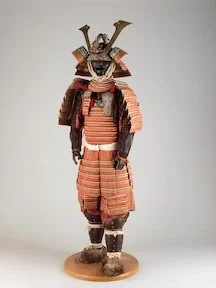
In its quest to protect its soldiers from injury, the War Office in early 1915 requested that Colonel Jackson research the ballistic performance of soft materials when exposed to modern weapons. The rationale behind this request appears to have been the assumption that soldiers outfitted with soft body armour would be comfortable to wear, light enough for him to move around during combat, and, if shot, would slow bullet penetration so that on impact it did not become deformed, or mushroomed, resulting in less extensive injuries. Jackson had the tests carried out in the fragmentation hut that Section FW3 used to investigate the fragmentation of grenades, in which various fabrics were exposed to shell fragments and shrapnel balls after the static explosion of an 18-pdr shrapnel shell containing known amounts of high explosive, to estimate the velocity of the fragments. The tests were comprehensive, encompassing a wide range of fibrous materials such as wool, cotton, silk, and flax, woven in different ways, or stuffed into small bags much like quilting. To their surprise, silk was the most effective fabric tested, although perhaps it should not have been, for it had served for centuries as the essential material in quilted Chinese and Japanese armour.
Armor (Gusoku) - Japanese - The Metropolitan Museum of Art https://creativecommons.org/publicdomain/zero/1.0/
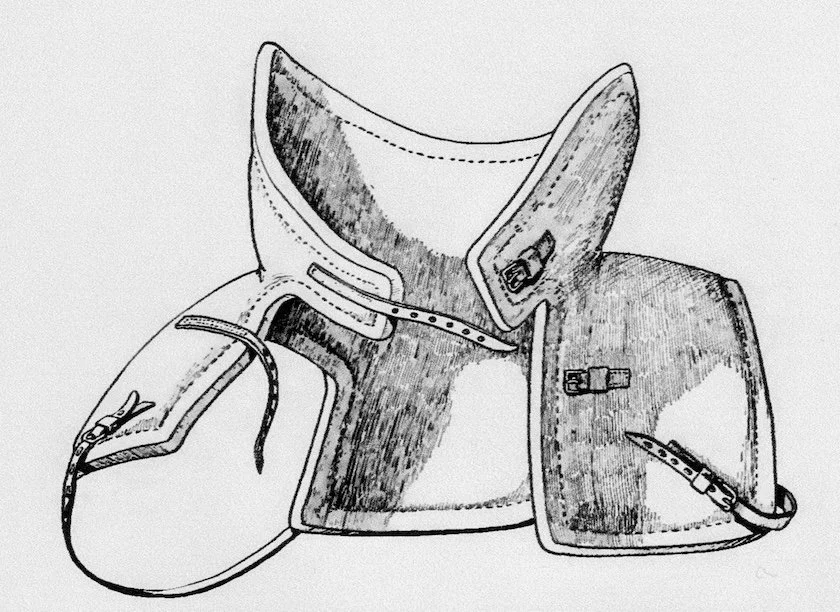
Although silk does not immediately spring to mind as a suitable raw material from which to develop body armour to protect soldiers fighting on the Western Front, Jackson’s experiments demonstrated that silk pads were superior at preventing the penetration of shrapnel balls travelling at 600 feet per second to plates of helmet steel. Pure woven silk provided better protection than manganese steel against shrapnel balls travelling with velocities up to 900-foot seconds, with the distinct advantage that it was only half the weight of steel for the same level of protection.[3] From these experiments, the Trench Warfare Department designed a practical piece of yielding body armour, known as silk necklets, that was issued to troops in the front line to protect the head and neck.
British silk-lined necklet. Bashford Dean. Helmets & Body Armour p. 111.
The necklet consisted of shoulder pads supporting a high collar made of silk, nearly three inches thick, padded with about twenty-four layers of Japanese silk of six mommé, thickened with pads of waste and flock silk stiffened by wire hoops and covered with khaki coloured canvas to blend in with the uniform.[4] They weighed about three and a quarter pounds and were as protective as steel helmets in stopping a bullet. They were first introduced in July 1915 and manufactured in small quantities until June 1917. They were issued as trench stores at a rate of 400 per Division but were never widely adopted because of several intractable problems. The silk quickly rotted under the conditions of trench warfare; manufacturing required a great deal of skilled labour on the part of seamstresses, and there were difficulties in securing sufficient raw material amid competition with the large quantities of silk required to make cartridges for the big guns of the artillery and the Admiralty.
Rigid Armour.
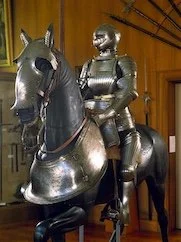
Rigid Armour for man and horse. © Fitzwilliam Museum, Cambridge.
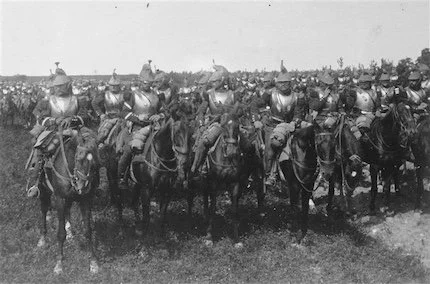
This is what first springs to mind when we think of armour. Expensive and skilled to make, it was worn, in various forms, as protection for the most high-status individuals in medieval society. As a form of battledress, its use slowly declined after the introduction of gunpowder, as it was not possible, with the technology available, to develop metal alloys that protected against the penetrative power of gunpowder weapons while remaining light enough to wear in battle. The rigid armour worn by elite cavalry regiments in 1914, usually in the form of breastplates, was a relic of historical nostalgia and ineffective in providing the wearer with personal protection.
French Cuirassiers 1914.
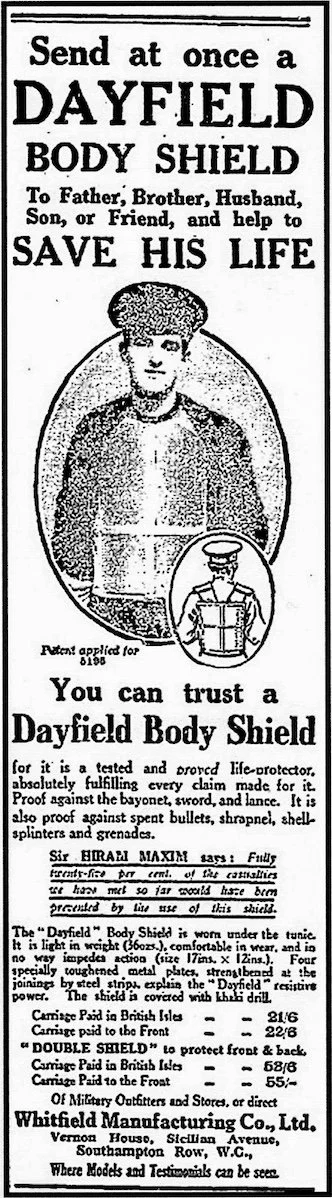
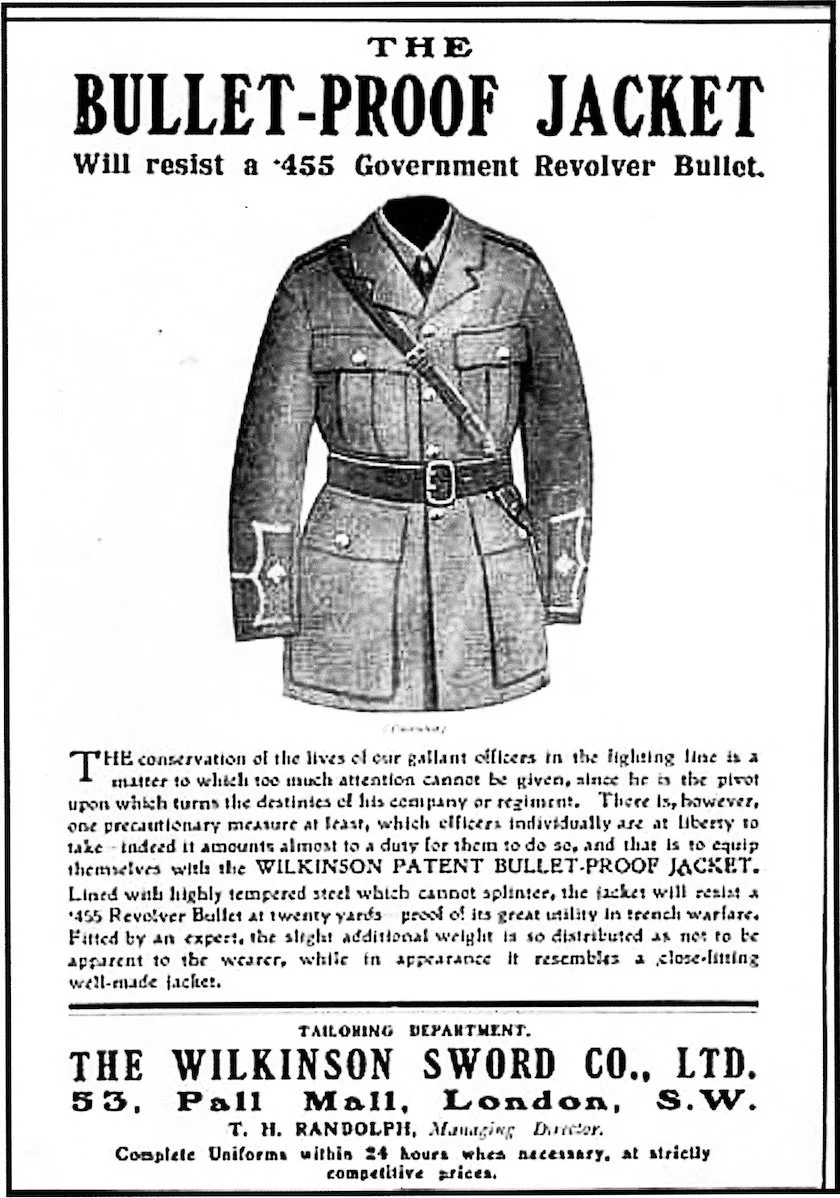
Surprisingly, wearing rigid armour underwent a renaissance in early 1915, not driven by the military, but by canny manufacturers sensing a marketing opportunity. With the citizen volunteers of Kitchener’s New Armies, Britain probably had, for the first time in its history, a fighting force containing the sons of sections of society that traditionally spurned the army. With this new market, many companies mounted extensive advertising campaigns, not aimed at the virgin soldiers, but at their parents and loved ones, for it was relatively easy to convince them that there were many essential things, not provided by the army, that their sons needed for their comfort and safety. For comfort, there were canvas baths, patented trench stoves, cosy weatherproof sleeping bags, and numerous unnecessary items of clothing. For their safety, there was a selection of body armour, commonly constructed of metal plates stitched into the fabric of the uniform or in various forms of vests and gilets worn over or under the uniform jacket.
Examples of British Body Armour. The Times. 30 December 1915
The Dayfield Body Shield was marketed as proof against the bayonet, sword and lance, a rather old-fashioned choice of weapons. However, the manufacturer also claimed protection against spent bullets, shrapnel, shell splinters and grenades. Derived from the traditional breastplate, it consisted of four metal plates moulded into flexible breast- and back-plates that fitted over the uniform, which was perhaps its appeal to the War Office, in that all ranks could wear it without modification, for they purchased thousands of them. In contrast, the Wilkinson bullet-proof jacket was only available as an officer’s tunic. Both were available by mail order.
Such advertisements attracted the attention of Mr Lloyd George, the Minister of Munitions, who sent a memorandum to Dr Christopher Addison in November 1915,
I want to consider the question of breastplates for our soldiers. I understand that the Junior Army and Navy Stores are selling steel waistcoats. One of these might be bought and tested, and if they are of any use, I can bring that matter before the War Council.[5]
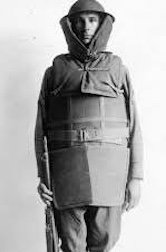
As previously mentioned, the search for suitable body armour for the individual soldier occupied the research interests of a section of the Trench Warfare Research Department until the end of the war, with special emphasis placed on protecting against chest and abdomen wounding, for in those pre-antibiotic days, even minor wounds could become rapidly fatal. The Drayfield body shield was issued to infantry particularly exposed to enemy fire while discharging routine trench warfare activities such as patrolling in No Mans Land, maintaining the wire, and serving as trench sentries, but it was rarely worn in more active activities, for they were pretty heavy, 14-18 lbs, clumsy to wear and disliked by the soldiers. Nevertheless, in 1917, over 20,000 were issued to units in France.[6]
The British Dayfield Body Shield, with silk necklet 1917. Bashford Dean p 116.
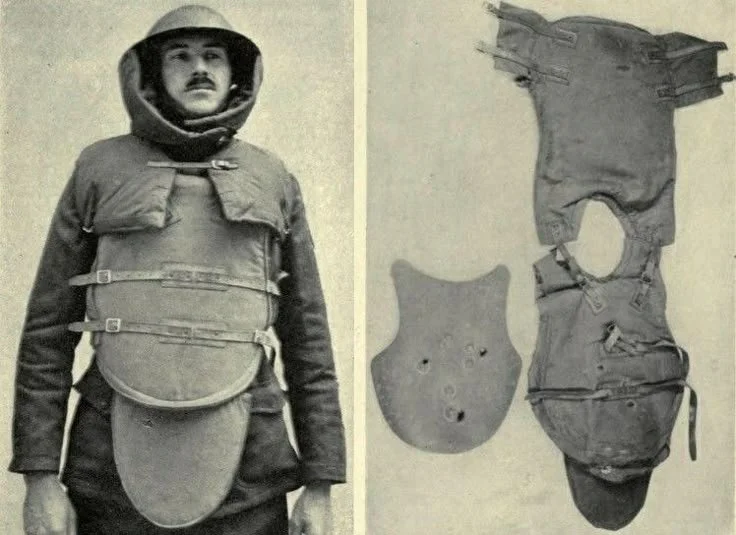
A more useful form of personal body armour was developed by the Munitions Invention Department in 1918 and known as the E.O.B. Standard Armour, which consisted of a breastplate, backplate and sporran piece of manganese steel plates sewn into a close-fitting khaki drill tunic that slipped over the head like a poncho. It weighed nine and a half lbs, and was not penetrated by shrapnel, grenade fragments and small arms ammunition at the ranges typically encountered in battle. In 1918, they were issued to the army in ‘pretty large quantities’.[7]
The EOB armour. Basford Dean
[1] Bashford Dean, Helmets and Body Armour in Modern Warfare (New Haven: Yale University Press, 1920) pp. 69-70. Dean had access to much wartime material no longer available to us and corresponded with the staff of Trench Warfare Research on developments in body armour.
[2] Modern infantry wear light and effective body armour constructed of materials not available in 1914-1918.
[3] Bashford Dean. p. 288
[4] The mommé is a traditional Japanese unit of weight for silk. 8 mommé is silk that weighs 24.72 grams per square meter.
[5] Ms Addison c72 folio 336.
[6] Bashford Dean, pp. 118-119
[7] Bashford Dean, pp. 125-126