The War Office Approved Bomb Throwers.
In late 1914 and early 1915, the War Office received many suggestions on weird and wonderful mechanical devices that may be useful for throwing bombs at the enemy. Most were rejected, with Colonel Jackson’s FW3A only supporting the development of two, the Leach Catapult and the West Spring Gun, which, after the briefest of trials, were sanctioned by the Army Council for issue to the army.
The Leach Catapult.
In October 1914, Mr Claude Pemberton Leach called, by appointment, on Colonel Jackson to demonstrate a catapult he had designed, which threw a golf ball over two hundred yards with amazing accuracy. Impressed by the model Jackson asked him to scale it up to throw a 2 lb weight the same distance and carry out endurance tests on his rubber ropes to see how long they retained their elasticity when throwing such a weight.[1]
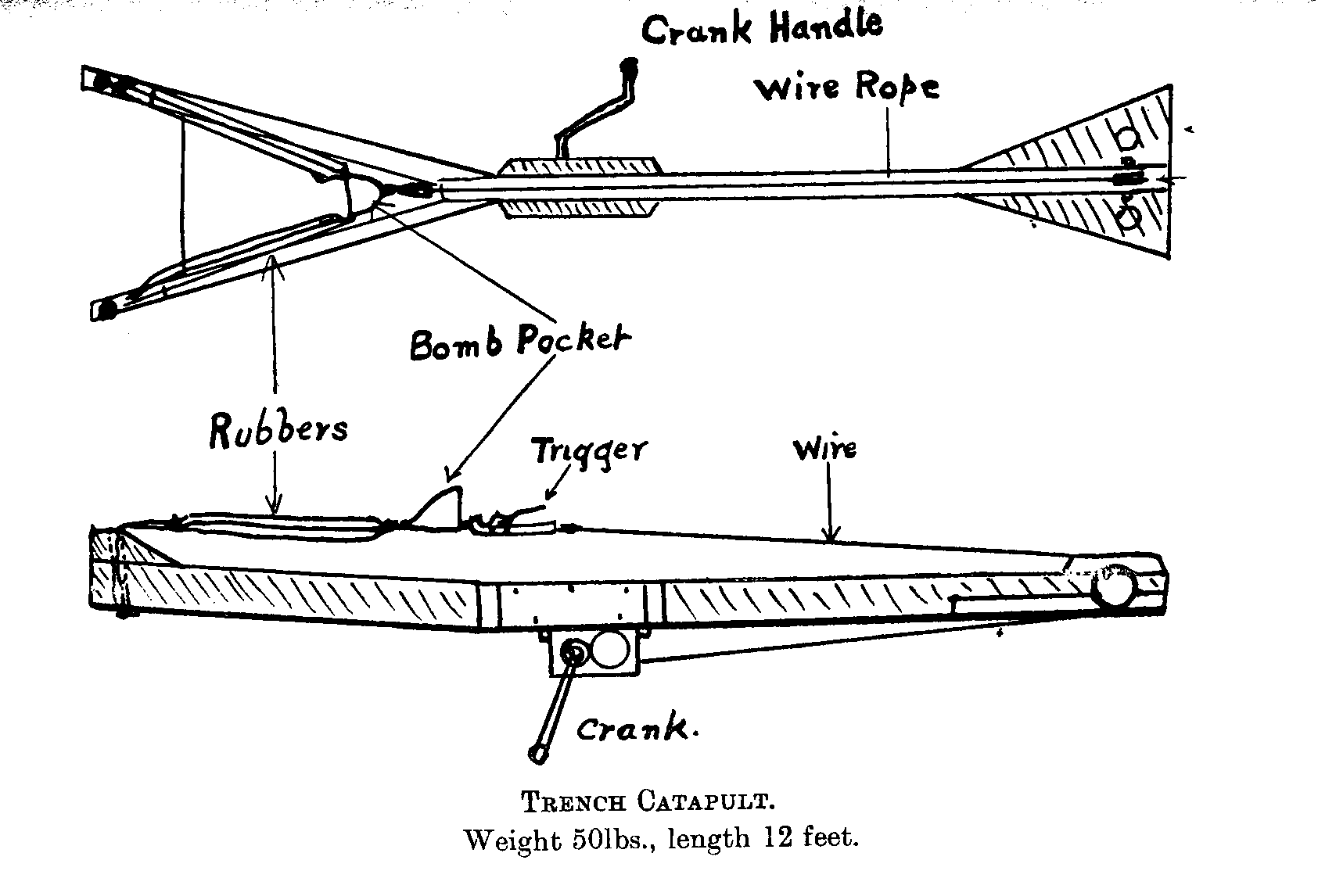
Lacking workshop facilities Mr Pemberton Leach entered into a business relationship with Gamages Departmental Store in Holborn, London,particularly well known for its toy and hardware departments and equipment for a wide range of outdoor and sporting activities that it primarily manufactured in its well-equipped factory staffed with skilled craftsmen. They contributed significantly to the development of the catapult, with Gamages appearing as co-patentee on Pemberton Leach’s submission of May 1915.[2] For his catapult, Mr Leach ignored the complexity of Roman and Medieval weapons, drawing inspiration from the simple Y-shaped catapult powered by elastic bands known to generations of schoolboys.
A contemporary (1915) Newsreel of grenade throwing, a Ball grenade, and firing a Leach catapult can be found at: https://www.youtube.com/watch?v=c_I40boqXYg
Manual on Grenades and Their Uses
Published "By Authority" Alfred J. Mullett, Government Printer, Melbourne
Description.
A solid wooden spine supports the Y frame, which was about 7 feet long with 22 inches between the tips of the arms of the Y. To these were attached rubber ropes, about 1 inch in diameter, typically 6 to the bundle but occasionally 8, the lower ends of which were tied into the canvas pouch that held the bomb. Attached to the bottom of this pouch was a length of steel rope used to stretch the elastic ropes back, under tension, by wrapping around a simple hand-driven windlass until held in place by a restraining paw that also acted as the trigger. The bomb, with the fuse lit, was placed in the pouch, and the tension in the rubber bands was released by pulling on the trigger, discharging the bomb with great force. The range was adjusted by varying the number of rubber ropes and the amount of stretch applied to them, with each catapult individually calibrated to develop an approximate scale of ranges related to the tension produced in the ropes. New range tables were determined with each new set of rubber ropes. A catapult with new rubber ropes achieved a maximum range of about 220 yards, although if fired frequently at this range, the rubber ropes soon snapped, and, as the Leach catapult was most accurate between 150-160 yards, this was the recommended range. Also crucial in determining range and accuracy was the elevation, or angle of the catapult, determined by a simple dial clinometer attached to the central beam, and the condition of the rubbers, which had to be kept dry and clean under all conditions, no easy task in a wet Flanders trench! Even under the most favourable conditions, they had to be replaced regularly and were classified as a replacement item, stocks of which were usually maintained in the Brigade bomb depot.
A significant improvement to the safety and operation of the catapult was contributed by the Hythe School of Musketry. In early 1915, some of the first Leach catapults were sent to the Southern Command School of Musketry for training purposes, and here a potentially lethal fault was uncovered: If not placed carefully in the throwing pouch, the bomb fell out as soon as the tension on the elastic ropes was released, dropping a live bomb into the trench among the crew. As this fault was identified in a training school for musketry it was not referred to Gamages but to Captain Todhunter, Experimental Officer at the School of Musketry at Hythe, who became intrigued by the problem and spent a considerable amount of time identifying the cause before collaborating with Gamages to design a safer pouch that also improved range and accuracy.[3] Todhunter’s work demonstrated that compatibility between the design of the bomb and the pouch was a critical safety feature, and that ball-shaped bombs were superior to the cylindrical pattern, which did not fit snugly into the standard throwing pouch so had a tendency to drop out just as the pouch moved forward when the tension on the ropes was released. As the chemical and smoke ammunition for Leach catapults were cylindrical, they required a special pouch, with accidents frequently occurring when the wrong bomb and pouch combination was used.
The West Spring Gun.
The second of the approved mechanical bomb throwers was the West Spring Gun, developed by Captain West, a reserve cavalry officer in late 1914 or early 1915 and approved by the Ordnance Board on 23 March 1915, entering service almost immediately. It is widely stated that the Reason Manufacturing Company of Brighton manufactured the West Spring Gun, although another company, A West & Co of Brighton, may also have been involved, assertions repeated by a number of authors, and in the Wikipedia entry for the West Spring Gun, but this is not quite accurate.[4]
The Reason Manufacturing Company was established in the late nineteenth century in Gloucester Road, Brighton as a manufacturer of toys and fancy goods, and by 1910 had relocated to Lewis Road and was listed as an electrical engineering firm and it is the relationship of this Company with Allen West (1877-1957), the inventor of the gun, that may be the source of the confusion. He started his working life in the high technology sector of his day, joining Ferranti’s in 1894 and staying until 1899, when he volunteered to fight in the Boer War. Either through wounds or illness, he was invalided out of the army with the rank of Lieutenant and sent to Hove, Sussex, for convalescence, where he met his wife and probably the reason he settled in that part of the country. In 1910 he leased part of the premises of the Reason Manufacturing Company as Allen West & Co, manufacturer of electrical control equipment and in 1914, when the Reason Company was in financial difficulties, the principal shareholders invited West to take over the company, which became a subsidiary of Allen West & Co.[5]
During the war, this Company manufactured the West Spring Gun, received orders from the Ministry of Munitions for its electric motors, and manufactured a wide range of munitions, including the Mills grenade and Stokes mortar bombs, thousands of which were stored under the main grandstand at Brighton racecourse. In design, the West Spring Gun was a hybrid of the Roman Ballista and Medieval Trebuchet and was not a weapon employed in the daily harassment of the enemy but used to deliver grenades and satchel charges in support of cutting out operations and trench raids, primarily conducted at night.[6]
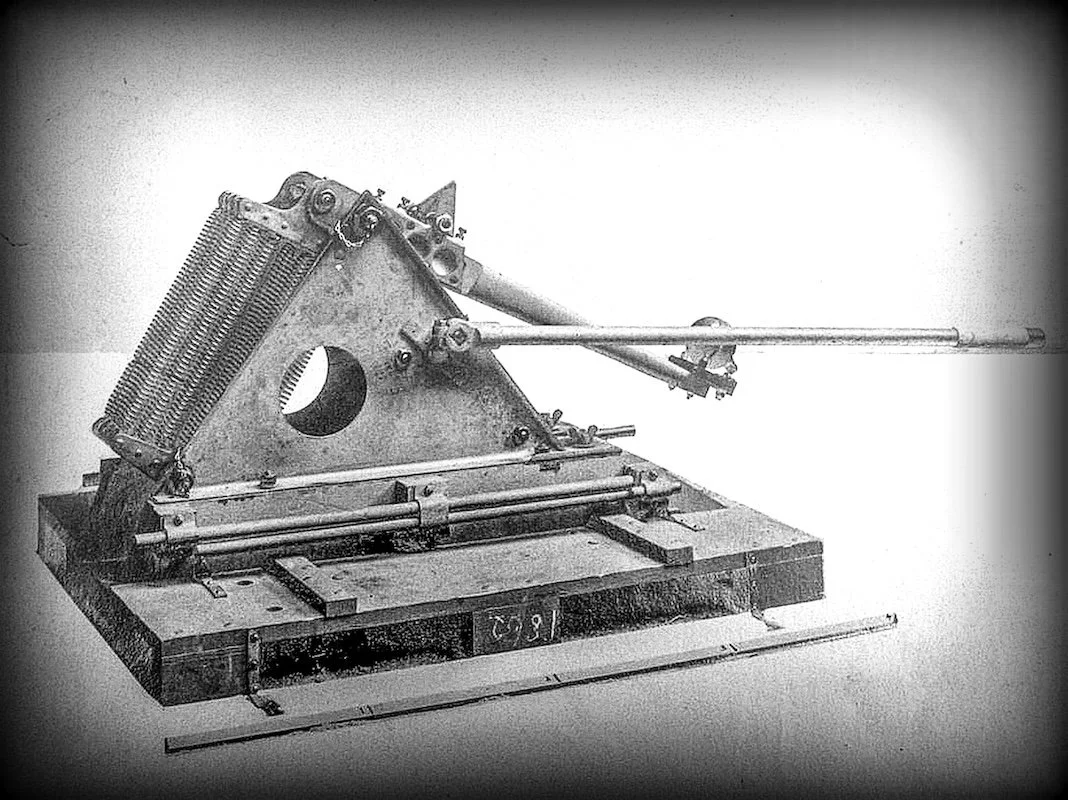
West Spring Gun. Photograph Brig.-Gen. Jackson. Courtesy of Charles Jackson & Family
The West Spring Gun was large and bulky, requiring a firing pit that was at least 8 feet square, much larger than that required for a trench mortar, the base of which had to be absolutely level to take the wooden base that came in two sections, onto which the gun was firmly bolted before weighing down the base with at least fourteen sandbags to prevent movement during firing.
The body was a wrought iron and steel “A” frame which, without the throwing arm fitted, could be carried by two men stretcher fashion. The power to throw the bomb was two banks of strong coiled springs, normally 24 as the standard configuration, but up to 28 if it was necessary to increase the range, which could also be altered by moving the trigger, mounted on a slide, up and down to increase or decrease the maximum tension developed on releasing the springs. There was a crew of five, three required to push down the long cocking handle that compressed the springs, which forced the throwing arm downwards and backwards to be held in place by a hook attached to the trigger. Of the remaining crew, one lit and placed the bomb, and the crew leader operated the trigger.
Once the throwing arm was in position and the cocking handle removed, the gun was ready to fire by pulling on the trigger, releasing the springs, the throwing arm swinging upwards, very much like bowling an overhand ball in cricket, to discharge the bomb from its holder at the top of the swing. With the standard configuration of 24 springs, the gun could throw a Mills, or similar grenade, about 240 yards, and a 7lb bomb or satchel charge about 80 yards. For its time and place, the West Spring Gun had great potential as a weapon to pound nearby enemy positions, but this was never realised for it had several disadvantages. It was difficult and expensive to produce, too heavy to move freely around the trench system, and as it was fired from a fixed position the number of targets within range was limited.
It was also restricted to night firing for, release the bombs clear of obstructions, the top of the throwing arm appeared above the parapet exposing the gun position to enemy observers. These limitations defined its major tactical role, to provide fire support for trench raids, or other forms of planned assault. The large, carefully constructed gun emplacements were always prepared at night and extensively camouflaged as they were easily spotted from the air. The night before the attack, the Spring Gun would be carefully placed in position and ranged on the target. However, we do not know how this was done for the use of ranging shots in daylight, or incendiary grenades at night, risking identifying the gun position.
The preferred method was probably to carefully determine the range and direction of the target from the gun’s position and then use the range tables, although this method requires a great deal of faith in the accuracy of the range tables and that the characteristics of the springs did not change much with factors such as temperature. The throwing arm could be fitted with two types of bomb holder, one designed for percussion grenades that was hardly ever used due to lack of suitable ammunition, the other was a V-shaped block of wood attached to the top of the throwing arm, the sides of the V acting to prevent the bomb rolling off. This probably originated as a local adaptation so that the Spring Gun, in the absence of specialised ammunition, could be adapted to throw Ball grenades, and later the Mills, for although it had always been the intention of the Trench Warfare Department to design special ammunition that would be compatible with the action of the throwing arm, this had a low priority. By the time something useful had emerged, GHQ was withdrawing the Spring Gun from Service. The West Spring Gun was also accident-prone.
The trigger was in an awkward position, and if the member of the crew operating the gun did not remove his hand quickly after releasing the trigger, there was a high probability of it being caught in the springs as they expanded, and this could result in the loss of one or more fingers, as happened to Captain West during one of his demonstrations. It also shared with the Leach catapult the tendency for a misplaced bomb to fall back into the gun pit among the crew when the throwing arm reached a vertical position. 2/Lieutenant John Donal Forbes, 10th Lancashire Fusiliers, died of his wounds from such a misfire in trenches near Ypres on 29 September 1915.[7]
The most common cause of death and injury occurring in a firing pit for the West Spring Gun was not the bomb falling out of the pouch, but in the act of operating the gun. These weapons were always fired in the dark, often in very muddy conditions, in a fire pit crowded with men required to cock and fire the gun while simultaneously struggling to keep the gun and its ammunition free of mud. The wooden gun platform would quickly become slippery, increasing accidents during the act of firing, not only the loss of fingers but, as Captain G S Tomkinson pointed out, the majority of accidental deaths operating the West Spring Gun are a result of individuals close to the gun slipping on the muddy conditions in the dark to activate the trigger and being killed by the swing of the throwing handle. Accidents that would not occur if a guard were fitted to prevent accidental activation of the trigger.[8]
[1] TNA: MUN 5/382/1600/8: It is possible that Jackson and Mr Leach were acquainted, as he was a member of a well-known Royal Engineer family. The English census of 1911 identifies only one individual with the name Claude Pemberton Leach, an architect living in South Kensington. He was the son of Sir George Archibald Leach, Royal Engineers, had a brother who served in the Royal Field Artillery, and was a nephew to Sir Pemberton Leach, VC, Royal Engineers, and cousin to Brig.-Gen. Harold Pemberton Leach DSO, Royal Engineers.
[2] Saunders, Weapons of the Trench War, p. 52. For this reason, the catapult is referred to as the Leach-Gamage, or just the Gamage catapult. For this reason, the catapult is referred to as the Leach-Gamage, or just the Gamage catapult.
[3] TNA: WO 140/14: Reports on Trials. Hythe. No 1140. Different pouches were required for the cylindrical jam pot and the ball bombs.
[4] Saunders, Weapons of the Trench War, p. 65
[5] Graces Guide to British Industrial History. Allen West & Co. <http://www.gracesguide.co.uk/Allen_West_and_Co> (Last accessed August 2017)
[6] TNA: MUN5/385/1600/14: Trench Engines. The West Spring Gun
[7] TNA: WO95/2012: 10th Batt. Lancashire Fusiliers. War Diary September 1915
[8] Ms Addison c39 folio 371-372.