The Deployment of the Leach Catapult in Combat.
The Leach catapult was an essential weapon in the trench warfare that characterised much of the fighting on the Gallipoli peninsula, where trench mortars were in short supply, and it is from this campaign, particularly in the War Diaries of ANZAC units, that we have the most detailed accounts of the use of catapults in combat.
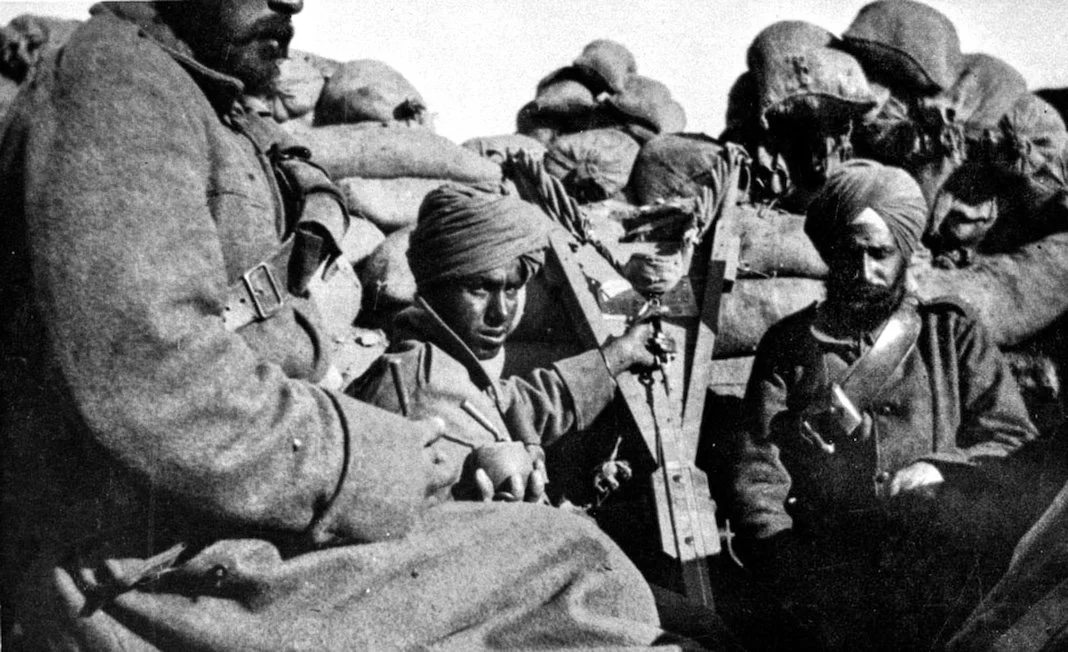
Troops of 29th Indian Infantry Brigade in the trenches, Gallipoli, 1915. From an album of photographs compiled by Lieutenant (later Lieutenant-General Sir Reginald Arthur Savory, 14th Sikh Regiment
Our most detailed account of the training of crews and setting up a Leach catapult in a trench is the training document issued by the 4th Australian Infantry Brigade.[1]
Weighing only 50 lbs, one man could carry a catapult along a trench, and although it did not need a specially prepared emplacement, arranging a catapult for accurate firing required skill and judgement. Depending upon the range to target, the catapult was placed against the trench wall at an angle between 35 and 45 degrees, the optimal angle being 42 and a half degrees, as determined by the clinometer. The catapult was then securely fixed in place by placing sandbags under, and against, each arm of the Y frame and, to prevent them moving when the catapult was fired, the arms were either weighed down by suspending sandbags from eyebolts screwed into each arm, or attached securely to the trench wall with wire rope, and the fishtail forming the bottom of the frame was firmly fixed to the ground by smothering it in sandbags. During this fixing, great care was taken to ensure the catapult remained at the correct angle, for if it tilted, even a fraction of a degree, range and accuracy were significantly affected, just like the effect of tilting the backsight has on the accuracy of a rifle. Once in position, the catapult should be invisible to the enemy, including during the firing cycle, to prevent the rubbers, when released, from exposing the empty pouch over the parapet. Experience had determined that the catapult should be placed some 2 feet away from the trench wall and one and a half feet below the parapet while ensuring that the elevation remained sufficient for the bomb to clear the top of the parapet and any obstruction, such as wire, in front.
The Brigade bombing officers were responsible for the catapults. They were organised in batteries of four guns with a complement of 1 officer and 13 men, with each catapult having a crew of three; the No 1 was in charge and responsible for laying the catapult and lighting and firing the bomb, No 2 was the observer, and No 3 loaded the catapult and was responsible for its stability in use. These crews were highly trained, and to pass out of the training course, they had to complete several manoeuvres, including landing five out of six bombs in an enemy trench 3 feet wide at 150 to 160 yards. The 13th man in the battery was the officer’s servant who, in action, acted as messenger, ammunition carrier and replacement crew.
The advantages of a catapult over trench mortars were their invisibility, silence and accuracy, characteristics that are even more outstanding when compared to contemporary mortars using black powder as the propellant. The lack of flash and smoke on firing made it difficult for enemy observers to pinpoint their position, or spot the small bomb in daylight, although that was easier at night as the burning fuse left a trail of sparks. Their major disadvantages were the rapid wear and tear on the rubber ropes, short range, and that they could not be upgraded to throw a heavier bomb without sacrificing range.
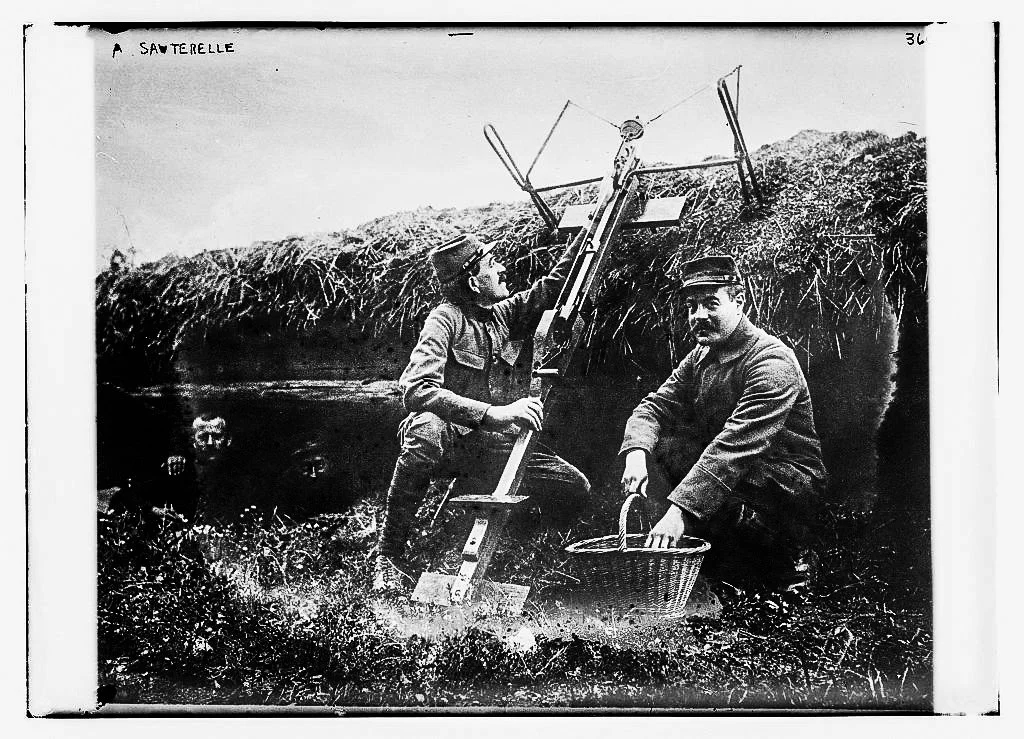
The first catapults were sent to France for trials in January 1915, with GHQ requesting, on 18 February, an immediate delivery of 100, later modified to 20 per Division. By June, 200 had been issued, and positive reports on their performance led to an order for 3,000, soon followed by an additional 1,000. By October 1915, three thousand one hundred and fifty-two had been issued to the BEF and the Dardanelles.[2] In December another large order was placed, then almost immediately cancelled, except for the manufacture of spare parts, following a decision by GHQ to replace the Leach catapult with one of French manufacture, the Sauterelle A, an adaptation of a large medieval crossbow that was lighter and more mobile than the Leach and threw a larger bomb but a shorter distance.[3]
French soldiers with a Sauterelle (grenade launcher):
Bain News Service, Library of Congress Prints and Photographs Division, Washington, D.C. 20540 USA.
Around the same time, Captain G. H. Wicks of the Trench Warfare Department produced a smaller version of the Leach catapult that could be handled by one man and threw a 2 lb. bomb, the weight of the Mills grenade, 200 yards. This catapult could have been developed as a very useful and mobile close support weapon for infantry delivering the Mills or other suitable grenades, but the army thought along more conventional lines, and neither Wick’s catapult nor the Sauterelle entered service, both displaced by the 3-inch Stokes mortar in early 1916. Of the remaining stocks of the Leach catapult, a hundred were sent to Serbia, others were sent to the mortar training schools, presumably to inculcate basic skills such as teamwork that would be important in the functioning of the trench mortar crews that were just coming into existence, while a few continued to be issued to the army in France until 15 February 1916. Their use was abandoned in March 1917.[4]
Accounts of the deployment of Leach catapults on the Western Front are rare, which is surprising as over 3,000 had been issued by early 1916, but this may be a consequence of the brevity of many of the after-action reports in the surviving war diaries. An exception is the account of a local assault carried out by the 8th Division on September 25, 1915.
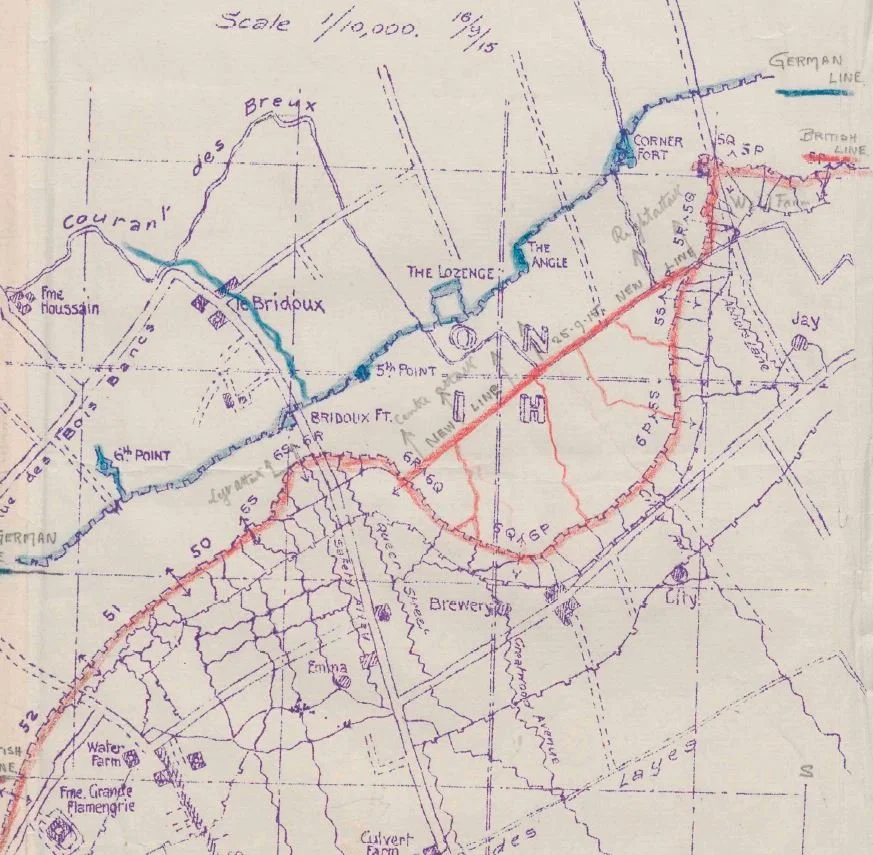
The Division held the line from Neuve Chappelle to the vicinity of Éstaires and, close to the village of Bois Grenier it bulged inwards, distorted by a large re-entrant dominated by the enemy on all three sides and it was decided to eliminate this bulge with the dual aim of straightening the line, and providing assistance to First Army’s offensive by preventing the Germans removing troops from the Division’s front south to the Loos sector.
The assault was to be carried out by the 25th Infantry Brigade and, to protect the attacking infantry from machine guns and the trench garrison, the flanks of the re-entrant were to be masked with a dense smoke screen mixed with chlorine gas released from cylinders.[5]
Short of both artillery and its ammunition, the best the Division could provide in the way of preparation was four days of intermittent bombardment of the German positions, converted into five minutes of intense bombardment on their front line at 4.25 am on 25 September, lifting at 4.30 when the infantry assault started, to create a wall of fire along their support lines. At the same time the smoke screen would be laid down with 1,000 smoke candles and a hotchpotch of munitions, one 4-inch Stokes mortar, one 2-inch medium trench mortar, and the Leach catapults supplied with 2,500 Threlfallite grenades.[6]
To obtain sufficient catapults, they were stripped out from the Brigades not participating in the assault, with twenty allocated to each attacking battalion distributed at 10-foot intervals opposite the German trenches on each side of the re-entrant. At most points, the German front line was out of range of the catapults, but it was anticipated that the fire and smoke from the Threlfallite grenades landing just in front, combined with the smoke and gas, would spread confusion among the German trench garrison, reducing the volume of their defensive fire.
The assault was to be led by C and D Companies of the 1st Battalion Royal Irish Rifles, which started badly and rapidly worsened. At 4.30 am, there was no wind, so the use of chlorine gas and the smoke candles was abandoned, but the infantry attack went ahead. In the face of murderous fire, the Irish Rifles gained a lodgement in the enemy front line, but within minutes of this achievement, a German shell struck a stack of smoke candles, setting them alight to wreath the British front line in dense smoke and visual contact with the Irishmen was lost. Given the positioning of the German trenches, the left flank of any lodgement gained in their front line was most vulnerable to counterattack from that direction, and the two trench mortars were positioned to assist in breaking up any counterattack that may develop.
Unfortunately, just after the destruction of the smoke candles, the 2-inch medium mortar broke down, soon to be followed by the destruction of the 4-inch Stokes mortar through the explosion of a bomb stuck in the barrel, which not only destroyed the mortar but set fire to the Threlfallite grenades stacked in the firing bay. This thickened the pall of smoke along the British front line, obscuring the view of the 18-pounder field gun and the four machine guns, all carefully positioned in the front line trench to support the infantry on the other side of No Mans Land.[7] The survivors of the attacking companies were soon involved in intense grenade fighting for control of the German trenches, beating off several local, uncoordinated counterattacks, but were fighting under two serious disadvantages.
The morning was wet, and the matches and fuses for their grenades became damp, making them difficult to activate, and they were out-thrown by the Germans, who, armed with their lighter disc and egg grenades, could throw from about 40 yards away, well outside the throwing distance of the heavier British grenades. By 6.30 am, the situation was desperate, and 2/Lieutenant Wallace, of the 2nd Lincolnshire Regiment, was sent forward with 24 men of the Brigade bombing company loaded down with buckets of bombs to provide support. Once he was aware that he was being out-thrown, Wallace re-crossed No Mans Land, collected his eight catapults and crews and took them back across into the battle, distributing them among the communication trenches to use as grenade launchers, successfully preventing the German infantry from recapturing their front line.
Map from 8th Division HQ War Diary (WO95/1673) showing the straightening of the British line.
The list below of the munitions available to the 8th Division on 25 September 1915. It provides us with a benchmark of the trench warfare munitions available to support an infantry assault.
Various Accessories and Their Uses. 8th Division September 1915.[8]
1. Stokes Mortar.[9] Very handy and portable; has the longest range (400 to 500 yds.) of any implement for throwing smoke bombs. Useful for making a barrage of smoke at a distance from our trenches. The bombs are filled with 2 lbs red phosphorus and burn for about 10 minutes giving off smoke, Useful also for incendiary purposes but less so than the 2-inch mortar.
2. 2-inch Trench Mortar. Has a maximum range of 400 to 450 yds. Useful for clearing trenches, setting fire to localities and strong places. The bombs are filled with about 11 lbs red or white phosphorus and burn for about 20 minutes after detonation. These bombs may be exploded in the air with fuze carefully timed, thus sprinkling a trench or locality with burning phosphorus.
3. 95-mm Trench Mortar. Has a maximum range of 300 to 400 yds. Useful against trenches and localities. The bombs measure 7⅝ by 3⅝ inches and are filled with about 2 lbs red phosphorus. Can also be used for incendiary purposes. These bombs can also be used as hand grenades in the same way as No 5 below.
4. Gamage Catapult. Useful for making a smoke barrage on the flanks of an attack; can throw bombs at varying ranges up to 150 yards. Phosphorus or Threlfallite grenades No 1 (under the heading No. 5 below) are the grenades to be used with the catapult.
5. Phosphorus or Threlfallite hand grenades No1. Contains about 1 lb red phosphorus and measures 5 by 3 inches. Useful for smoke barrages on flanks of attack and for making a curtain of smoke all along the fronts on which no attack is being launched. Smoke lasts about 10 minutes. To make an effective curtain of smoke, use one hand grenade every 4 minutes at intervals of 10 yards along the front. These hand grenades are also for use with the Gamages catapult.
6. Threlfallite hand grenade No 2. Contains about ¾ lb. white phosphorus and measures 3⅛ by 3 inches. (See notes on phosphorus below.)[10]
7. Pans of free phosphorus (red). About 5 lbs in an open pan or biscuit tin, fired with detonator and fuse, will burn for about 20 minutes. Useful for making curtain or barrage of smoke.
8. I.S.K., or Lachrymator hand grenades. Much the same in appearance as any ordinary hand grenade. Total weight about 1 lb. and measuring 5½ by 3 inches. Exploded with detonator and fuze. Gives off fumes which irritate the eyes but no smoke. Useful for use in enclosed ground and buildings.
9. Candles. Ordinary-smoke. Triple-dense smoke. Smoke mixes well with gas; forms a good screen under cover of which to form up for attack. Candles are portable and can be easily carried forward in an attack so as to form a screen of smoke where and when required. One candle, either single or triple, burns for about 2 minutes.
We also owe to the Royal Irish Rifles, this time the 9th Battalion, for an account of the employment of at least one catapult during the 36th Division’s near successful attack on the Schwaben Redoubt on 1 July 1916. The War Diary records that the right-hand company carried a catapult forward that provided support all morning, as no Stokes mortars had kept up with the infantry. In the afternoon the Germans mounted a powerful counter-attack against the remnants of the battalion who were in danger of being overrun, as the German grenadiers could throw their ‘stick’ grenades further than the Mills bomb and it was only through use of the catapult that the German attack was blunted and the survivors able to escape.[11] The battalion commander, Lieutenant-Colonel E P Crozier, commented that this day’s fighting demonstrated the usefulness of the catapult and in his opinion it was a weapon that no infantry company should be without, and if the men were taught to look after one with the same degree of care they lavished on their Lewis guns their value would be more readily appreciated.[12]
[1] AWM4 23/4/3: 4th Australian Infantry Brigade. War Diary Sept-Oct 1915. Brigade Order No 306
[2] History of the Ministry of Munitions. XI. Part I, p. 91
[3] Sauterelle is French for Grasshopper
[4] History of Ministry of Munitions. XI. Part 1, p. 92
[5] TNA: WO95/1725: 25th Infantry Brigade, War Diary 1-30 September 1915. Plan for Attack
[6] TNA: WO95/1673: 8th Division. General Staff, War Diary.1 August-28 December 1915. Appendix E. Operations 21 to 28th September 1915. The Stokes 4-inch mortar fired phosphorus bombs to create the smoke screen. Threlfallite was a mixture of white phosphorus and petrol used in incendiary grenades and mortar bombs, although it also generated clouds of poisonous white smoke.
[7] TNA: WO95/1730: 1st Royal Irish Rifles, War Diary 1 January 1914 – 30 April 1918
[8] TNA: WO95/1673: 8th Division. General Staff 1 Aug.-28 Dec. 1915. Appendix E. Operations 21st to 28th Sept. 1, 1915
[9] These notes refer to the 4-inch Stokes mortar operated by the Special Brigade.
[10] Burning phosphorus, whether red or white, cannot be extinguished except by smothering with sand or dry earth and gives very bad burns that are difficult to heal and while red phosphorus fumes are not poisonous, white phosphorus fumes are. The phosphorus bombs and hand grenades can generally be distinguished, white from red, since the former is liquid and the latter is solid. These notes, and the table above them, appear to have been compiled by a staff officer with little scientific knowledge as they contain several mistakes and transcription errors. Both red and white phosphorus are solids, but as white phosphorus spontaneously bursts into flame on exposure to air it is kept under oil or petrol, the reason for the sloshing sound when a white phosphorus bomb is shaken.
[11] By this date the catapults had been withdrawn from service, the ammunition used would have been the Mills bomb.
[12] TNA: WO95/2503: 9th Battalion, Royal Irish Rifles, War Diary 1 March 1915 – 30 August 1917. Narrative of Operations 1st to 3rd July 1916.