The Early Bomb Throwers.
The BEF’s experience and interest in mechanical bomb throwers dates from their earliest encounter with trench warfare on the Aisne in September 1914, when they were on the receiving end of a new type of weapon employed by the Germans.
On the afternoon of September 27, the 2nd Infantry Brigade recorded that their trenches were heavily bombarded for over an hour by a new high explosive projectile that was slow enough to be observed in flight, cylindrical in shape, and tumbled over and over before hitting the ground to burst into small pieces with a horrendous explosion but did little damage. The troops exposed to these shells noted that they were silently fired from no more than 200 yards away, suggesting that the Germans were using a pneumatic gun or catapult.[1]
A second example, also from the 1st Division, occurred almost a year later. During the preparation for the Battle of Loos in September 1915, troops of the 1st Division were subjected to noiseless shells or bombs that exploded with lots of flame and noise but did minor damage, in contrast to another type of enemy bomb, also fired silently from about 800 yards, which was very accurate and did a great deal of damage. Given the range and accuracy, it was concluded that they were fired from a pneumatic gun.[2]
The earliest attempt to produce a bomb thrower in the BEF appears in the War Diary of the 3rd Division Engineers for November 24, 1914, referring to experiments with a bomb thrower designed on the principles of the Roman Ballista, but there is no evidence to suggest they produced a usable weapon.[3]
The most extensive accounts of the trials and tribulations in developing extemporised bomb throwers in the BEF are the accounts by Major Russell Brown, Commander 23rd Field Company RE, attached to the 1st Division. He provides a window through which we can glimpse some of the thinking current in the BEF as it struggled to come to grips with the tactical realities arising from the unexpected appearance of static trench warfare in late 1914.[4]
There was an increasing acceptance across the BEF that they were now engaged in operations that approximated traditional siege warfare, and, with the enemy remaining securely within their trenches, there was little that they could do to defeat him with the resources currently available. The strength of the German field fortifications presented the infantry with new and complex tactical challenges; to defeat the enemy, they must be driven out of their trenches into the open, where they could be dealt with by conventional means and to achieve this Russell Brown was prepared to use any, and as many, means as possible including raining missiles onto the enemy day and night until the garrisons abandoned their trenches.
In his search for solutions, Russell Brown had visited the Indian Corps to examine their trench mortars but, having seen them in action, was not overtly impressed, fearing that the noise and smoke on discharge would alert the Germans that a bomb was coming, giving them sufficient time to take cover.[5]
Something silent was needed, and he favoured a spring-powered bomb thrower. He must have been successful in selling his ideas to his Divisional Commander, for, in early December, he was allocated a car and driver, along with authorisation to scour the towns around Ypres in a search for suitable springs. He was aware that springs came in two patterns: the familiar coiled or spiral spring and the flat spring made from one or more leaves of thin steel commonly used in vehicles, and of the two, coiled springs were more suitable for bomb throwers.
In Poperinghe, he found a factory still in business with a manager who was more than willing to help. He informed Russell Brown that no one manufactured coiled springs in the region and doubted that the carriage springs he manufactured would be suitable, as they were not designed to withstand sudden and frequent releases from high tension and, if subjected to such stresses, would soon break. Fortunately, there was a French Military Engineer officer visiting the factory at the same time and, in a discussion about the design of bomb throwers he informed Russell Brown that his unit had carried out extensive experiments with flat springs and found that large ones were unsuitable, but he had come here to acquire some smaller sizes for his men had carried out a few experiments with smaller flat springs that looked promising and, if he could find the right size, he had high hopes of having a workable bomb thrower completed by the end of the week. Encouraged by this, Russell Brown tested all the small and medium springs that the factory had in stock and found one that threw a quarter-pound weight just over forty yards, twice as far as could be thrown by hand and, worried that he might lose out to the French, he bought up all the suitable springs in stock to be picked up by lorry at the end of the week. On his way back to his Field Company, he called in at the local archery club and acquired a crossbow, his alternative means of developing a bomb thrower.
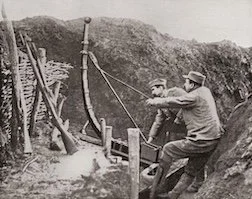
French Soldiers firing a single flat spring catapult. The Times History of the War. Vol 4 p. 376
We are fortunate that we know the outcome of some of Russell Brown’s endeavours to produce a spring-powered bomb thrower, for, after the war, his successor as commander of the 23rd Field Company, Major R. L. Bond, wrote a history of the Company’s war experiences, published in The Royal Engineers Journal.[6]
After his visit to Poperinghe, Russell Brown harnessed the inventiveness of his command by dividing them into three teams, each tasked with developing a serviceable trench catapult, one using the crossbow principle, another the coiled, and the third flat springs. The team with the crossbow demonstrated their skill as archers by regularly shooting their small arrows over 200 yards, but their hopes of converting this potential into a bomb thrower by building a larger crossbow came to nought, let down by the Royal Flying Corps, who were unable to provide strong elastic rope. The coiled spring-powered gun was fashioned after the principle of a child’s popgun, and, as helical or spiral springs were unobtainable locally, the officers involved thought they were onto a good thing as they lobbied Russell Brown for permission to go to Paris to purchase the required springs. History does not record if they were successful in achieving every junior officer’s dream of visiting Paris, but they must have acquired springs from somewhere. However, their design was unsuccessful, having a range of only 50 yards.
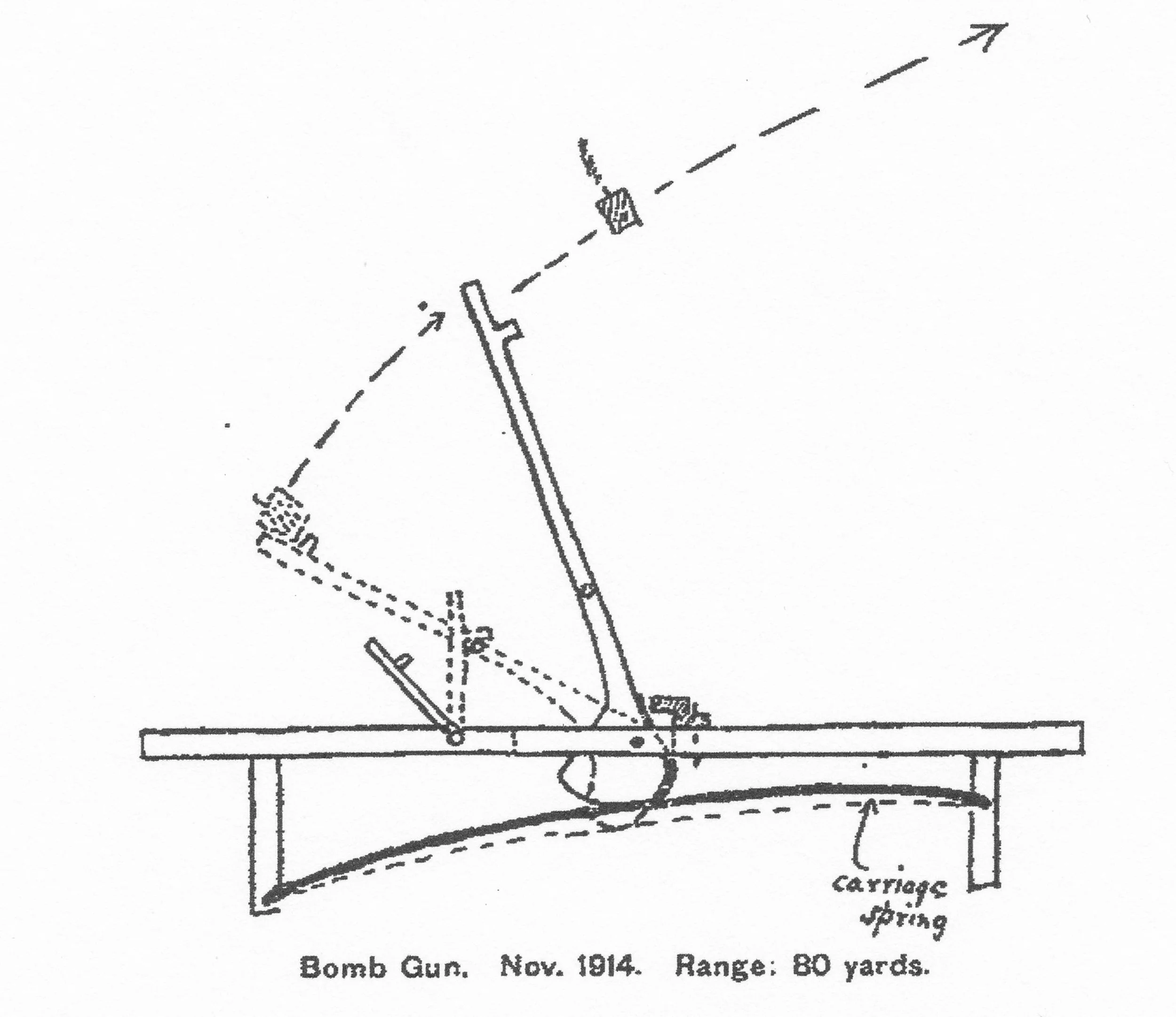
The third group, led by Russell Brown, was the most successful, developing a model powered by a thin flat spring weighing about 30 lbs and throwing a bomb accurately over 80 yards. It was first fired at the enemy on Christmas Day, and although it is unknown whether this took place before or after the company’s Christmas lunch, it is not without its dark humour.
Major Russell Brown’s Flat Spring Bomb Thrower. The Royal Engineers Journal. Vol. XLIII. Dec. 1928
Once the bomb thrower was installed in the trench, Russell Brown’s excited crew set about preparing to fire their first bomb in anger. Unfortunately, the fuse was difficult to light in the damp conditions, and while his men coaxed the unwilling fuse into life, Russell Brown bent forward towards the gun, inadvertently moving his head into the arc of the movement of the throwing handle. At that moment, the fuse spluttered into life and, as the bomb was placed in position, the excited gunner immediately released the trigger, and the throwing arm swung upwards, giving the hapless Company Commander a powerful blow to the head that stretched him out, unconscious and bleeding, beside the gun. The shot, however, was a success, the bomb landing in the German trench, but the crew decided, in view of the wound on their officer’s face, to abandon the remainder of the shoot until the next day. On returning the next morning, they found their beloved gun had disappeared, cannibalised by the infantry who had used the wood to cook their breakfast.
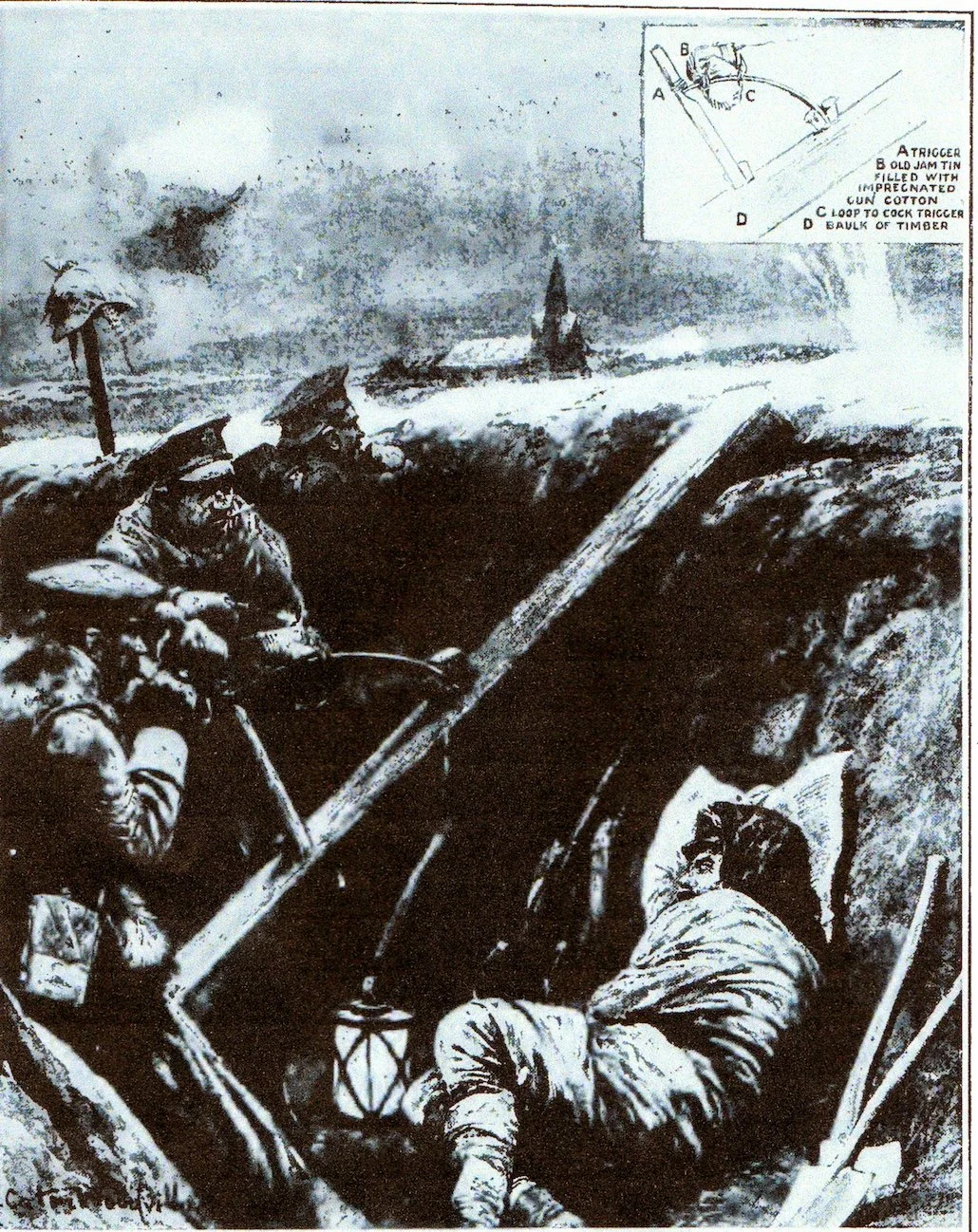
Drawing by Caton Woodville on how such a catapult may appear in the trenches. The Times History of the War. Vol. 4. p.377
Given the success of their single shot, Russell Brown had high hopes that his catapult would be a useful addition to the infantry's firepower. He handed his design over to the bomb factory in Bethune with a request to have two or three manufactured for further testing, but, unfortunately for the future of his bomb thrower, the Bethune factory thought they could improve on his design, converting it into a clumsy machine weighing 90 lbs that could scarcely throw a bomb 50 yards. This disaster appears to have been the death knell for the project, for there are no further mentions of spring guns or any other type of catapult in the War Diary of the Field Company.
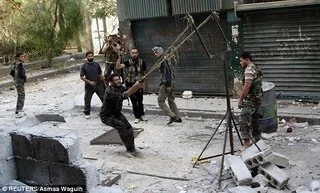
Major Russell Brown’s Sappers are not the only combatants who found it necessary to press extemporised bomb throwers into service, for almost a century later, in 2012, we find members of the Free Syrian Army using bomb throwers based upon the trebuchet and catapult, to fire home-made grenades at Government forces in Aleppo in 2012.
Improvised bomb thrower, members of the Free Syrian Army, Aleppo in 2012. © Reuters. Photographer Asmaa Waguih
[1] TNA: WO95/1267: 1st Division. 2nd Infantry Brigade, HQ. War Diary 4 August 1914-31 December 1916. Entry for 27/9/14
[2] TNA: WO95/1229: 1st Division. General Staff. War Diary Tactical Progress Report. 20 August 1915
[3] TNA: WO95/1397: 3rd Division HQ. Commander Royal Engineers, War Diary 4/8/14-28/10/19. Entries for 24 Nov.1914 and 26 Jan.1915. The Ballista, a giant crossbow, using the energy derived from twisted sinews, fired heavy darts or metal balls of great destructive power.
[4] TNA: WO 95/1397: 1st Division HQ. War Diary. Commander Royal Engineers, 4/8/14-30/4/15. Various entries. December 1914-March 1915. Major Russell Brown’s Field Company was attached to the 2nd Infantry Brigade on the Aisne, so he had already experienced the German deployment of catapults and pneumatic guns.
[5] This visit illustrates that the Field Companies of I Corps were aware of the Indian Corps developments in grenades and trench mortars before their demonstration at GHQ and Haig’s instructions that they develop their own bomb factories.
[6] Major R. L. Bond, The 23rd (Field) Company R.E., in the Great War 1914-18. Part III. November 1914-September 30th, 1915. The Royal Engineers Journal. Vol. XLIII, December 1928