(iii) Vignette. Jackson and the Introduction of Ammonium Nitrate Explosives.
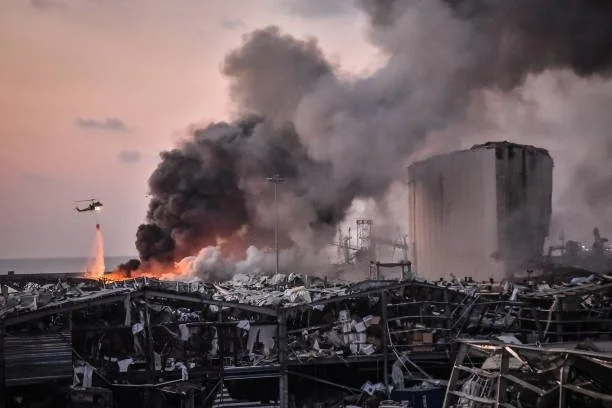
The largest non-nuclear blast in modern history took place on August 4, 2020, at 6:07 PM in Beirut, Lebanon, after an estimated 2750 tons of unsafely stored ammonium nitrate exploded.
(iii) Vignette. Jackson and the Introduction of Ammonium Nitrate Explosives.
Jackson’s first encounter with extemporised munitions used in trench warfare was through the bomb factories developed by the Field Companies in late 1914. On campaign, Field Companies were issued with a small supply of high explosives, for part of their job was to blow things up, such as bridges, houses, etc., that may be useful to the enemy. Field Regulations specified the amount and type of explosives to be carried, and the normal supply process involved the Directorate of Artillery issuing the explosives to the Directorate of Fortifications and Works, which in turn supplied the Field Companies with the approved amount and maintained the stocks for replenishment. By December 1914, this established supply chain was under strain, as the emergence of bomb factories significantly increased their demand for high explosives.
The Directorate of Fortifications and Works recognised that the large replenishment orders were for quantities far above requirements for engineering purposes, separated such orders from the normal resupply processes, and passed them to Jackson. By now, he was recognised as the individual who handled the varied and unpredictable requests explicitly related to trench warfare, and to fill these large orders, Jackson had to apply to the Directorate of Artillery for his own supply of high explosives. Unfortunately, his request for a separate supply coincided with a crisis in the general provision of explosives, consequent on the unexpectedly high consumption of artillery ammunition by the BEF.
Just before the outbreak of war, and after several years of internal debate, the Ordinance Board agreed to follow the German practice and introduce trinitrotoluene (TNT) as the high explosive of choice for artillery shells. Under peacetime conditions, the replacement process would have been leisurely, with the new shells replacing the old ones filled with lyddite as they were used up in training. Accordingly, the military requirements for TNT remained small, so Britain had no incentive to develop a chemical plant specifically for TNT synthesis, relying instead on a complex process that utilised the by-products of other chemical processes. When the war created an unprecedented demand for artillery shells, the Royal Gunpowder Factory struggled to meet the demand for TNT. Attempts to scale up the synthesis yielded only a small additional amount of TNT and were wasteful of intermediate chemicals already in short supply, particularly acetone, which was imported from Germany before the war.[1]
The Director of Artillery saw in Jackson's request the means of gaining control over the Royal Engineer’s bomb factories that he disapproved of as they were developing and issuing munitions outside his control, which, moreover, were probably unsafe. He complained to Master-General of the Ordnance that the large quantities of gun cotton, TNT, and even lyddite, requested by Jackson, were eating into the stocks urgently required for artillery shells, making him a separate customer who had to apply directly to the Directorate of Artillery for the issue of explosives, just like other substantial users such as the munition companies. He further argued that resolving all conflicting demands for the limited supply of explosives could be achieved only through a rationing system managed by the Directorate of Artillery. Recognising that the proposed rationing system could mean the demise of the bomb factories Jackson countered the proposal by arguing that it was the failure of the Royal Ordnance Factories, under the control of the Directorate of Artillery, to supply sufficient service pattern grenades to the BEF that had forced the Field Companies, out of necessity, to develop local bomb factories, and to limit their activities by starving them of high explosives, would reduce the vital contribution they were making to the fighting efficiency of the BEF. Major-General von Donop accepted Jackson's argument and instructed the Directorate of Artillery to keep supplying the engineers, but Jackson, aware that as long as the supply of high explosives remained firmly in the hands of the Directorate of Artillery, his supply was vulnerable, and it would be beneficial for all parties concerned if the bomb factories had an independent supply.
He undertook a review of all available civilian high explosives and settled upon ammonal, a commercial explosive based on ammonium nitrate used in mining and quarrying. He noted that it was cheap, available in bulk, yet powerful enough for engineering purposes and suitable for most explosive ordnance, and that it could be detonated by commercial detonators. Its only significant drawback was that it absorbed water and, once damp, was inactive. A strong case can be made that Colonel Louis Jackson's introduction and advocacy of ammonium nitrate-based explosives was his most significant contribution to the pursuit of victory. However, as often happens to pioneers, his critical role as the first to introduce ammonium nitrate as a military explosive is lost to history even though its use in extemporised trench warfare weapons, such as mortar bombs and grenades, was part of the evidence cited in early 1915 by Lord Moulton and the Committee on High Explosives in overcoming the resistance of the artillery establishment to the introduction of ammonium nitrate-based explosives in artillery shells that provided the Ministry of Munitions with sufficient high explosives to fill the millions of shells required by the ambitious gun programme of Lloyd George.[2]
[1] These matters were not corrected until the Ministry of Munitions adopted the much more efficient French method of synthesis of TNT in late 1915.
[2] The Official History of the Ministry of Munitions. Vol. X. The Supply of Munitions. Part IV. Gun Ammunition: Explosives, p.10