Chapter 4. The Origin of the Trench Warfare Department. Part I.
“….this trench warfare in which we are now engaged is causing a demand for all sorts of things that are not recognised by regulation.”
Major-General Rawlinson to Lord Kitchener, December 1914.[1]
[1] History of the Ministry of Munitions. Vol. XI. Part 1. p. 4
Section 1. Origins.
(i) Introduction.
The rapid development of trench warfare in the latter part of 1914 found all combatants on the Western Front unprepared for the changing nature of the battlefield but were quick to grasp that munitions such as grenades and trench mortars had now become essential weapons in the infantry battle, but while the BEF pressed the War Office to equip the army with such munitions they encounter procrastination on the part of the military establishment. They tended to view the trenches sneaking across the fields of France as a temporary phenomenon, evidence of exhausted armies entering “winter quarters” to rest and refit before normal warfare resumed in the spring when the French Commander-in-Chief, General Joffre, had promised a new offensive. Also, the severity of the fighting in France had decimated Britain’s small professional army, which needed to be rebuilt, enlarged, and re-equipped, but the War Office was struggling to do so, constrained by a shortage of industrial capacity and essential raw materials.
It was also unprecedented for the Commander-in-Chief to request supplies of entirely new weapons during a war, especially one just a few months old, with the outcome still uncertain. As we have seen, in the absence of grenades and trench mortars provided by the War Office, the army began manufacturing its own extemporised versions. However, their resources were limited and unable to produce the quantities required by the army. This gap in supplies was eventually filled by the activities of the Trench Warfare Department. This, and subsequent chapters, recount how this was brought about.
(ii) Colonel Louis Jackson and the Origin of the Trench Warfare Department.
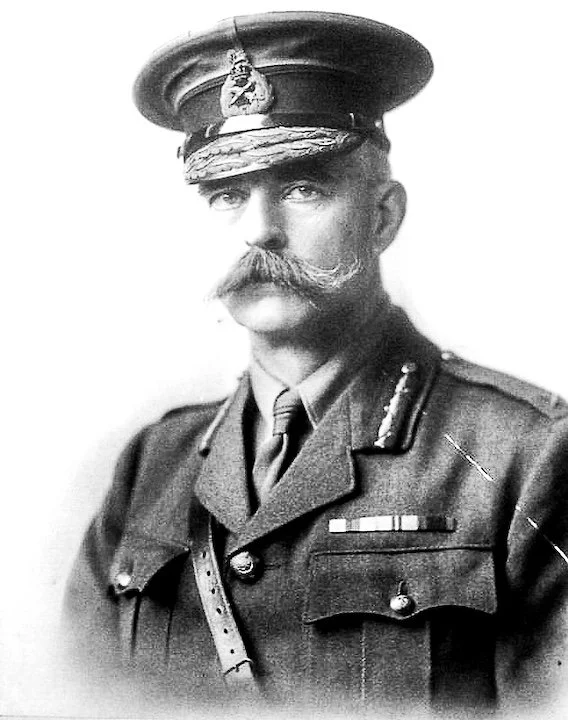
Major-General Louis Charles Jackson, C.B., C.M.G., K.B.E. Courtesy of Charles Jackson & Family.
The Trench Warfare Department had an unconventional birth within Section FW3 of the Directorate of Fortifications and Works in the War Office. This Directorate oversaw all matters related to the Royal Engineers, and Section FW3 focused on the engineering aspects of coastal defences, such as forts and gun batteries protecting harbours and other coastal locations. When war was declared, the Head of Section took up his wartime duties to be replaced by Colonel Louis Jackson R.E., who had retired from the army in 1913. Jackson was an authority on field fortifications and siege warfare and on retirement had been Chief Instructor in Fortifications at the School of Military Engineering at Chatham and, with this skill set he proved to be the right person in the right place at the right time for, in his creation and leadership of the Trench Warfare Department he was one of the catalysts that brought about the revolutionary changes in infantry tactics that redefined how the British Army fought. Jackson’s involvement in trench warfare began not with munitions but with his role as a military engineer, providing specialised support to the Royal Engineer Field Companies attached to BEF Infantry Divisions. When German offensives ended in late October 1914, the Western Front entered trench warfare, increasing the need for field engineering. The Directorate of Fortification and Works received many orders for equipment from these Field Companies. Most requests were for standard tools already assigned to the Field Companies, such as pickaxes and shovels, which local suppliers in France and Belgium could no longer provide in needed quantities. Among these were also new requests for items never previously issued, such as mining equipment, trench-digging machines, and water pumps. Before the war, the mechanism for reviewing the suitability of new or unusual equipment proposed by the Field Companies lay with the Engineers Committee, a group of three experienced officers who submitted their recommendations to the Director-General of the Directorate of Fortification and Works. At the outbreak of the war, this committee disbanded as its members assumed their allocated wartime duties, and to fill the resulting gap, Section FW3 took on its role. Jackson’s duties now included evaluating such requests and, if justified, arranging for their special purchase and dispatch to France. As many of these items could be bought from specialised civilian suppliers. Jackson, after assessing their suitability for military use, submitted orders to the War Office Purchasing Department, where, to his surprise and annoyance, they were rejected. Strange as it may seem, the resolution of the issues around procuring unusual equipment for the Field Companies was one of the first steps toward the creation of the Trench Warfare Department. To conform to the strict quality standards imposed by the War Office, everything purchased by the army was manufactured in the Royal Arsenals or by 1,000 civilian suppliers, known as War Office List Companies. Similarly, the War Office's purchasing procedures were strictly monitored to assure the Treasury that the money was being wisely spent on approved items of equipment suitable for the intended task, and the Purchasing Department was forbidden to purchase outside this charmed circle of suppliers, except under the most limited circumstances.[1] It was here that Jackson had run into problems. On enquiring why his orders were not being processed, he was informed that they ran counter to a Treasury regulation that forbade the War Office from spending public money on purchases from firms not on the approved list of suppliers, and to overcome this block, Jackson appealed to the Master-General of the Ordnance, Major-General von Donop, the only person who could authorise unusual purchases. He not only approved Jackson's orders but, appreciating that there would be similar demands in the future, allocated a senior purchasing clerk to Section FW3 to process future orders placed with non-List Companies so they were not delayed by the procedures of the purchasing department.[2] As this arrangement was never rescinded, it was to provide the means by which Colonel Jackson would, in the future, recruit non-approved engineering firms to manufacture his emergency grenades, as well as removing from small firms the burden of spending time and money on what would probably turn out to be an unsuccessful application to become a War Office-approved supplier. It also inadvertently removed Jackson’s munitions-making activities from scrutiny by the Directorate of Artillery.
[1] Although the War Office purchased only from firms on its approved supplier list, the purchasing department maintained a continually updated directory of every company in the UK and its product range.
[2] This individual was also responsible for ensuring the propriety of the orders.