Section 3. The Development of Section FW3/FW3A.
(iv) A Change of Direction. November 1914- February 1915.
As both sides prepared to spend the winter in primitive trenches, the Germans launched limited attacks against the BEF to gain some local advantage. In these rather vicious local scraps, the superiority of the German grenades was clearly demonstrated. The War Office responded by increasing its orders for the number one percussion grenade, although it was not without its problems in trench fighting. The cap of the grenade was a sensitive percussion fuse, and the long throwing handle made it difficult to throw safely in the narrow confines of a trench, for if the percussion cap struck, or even grazed, the sides of the trench, or any other object, it would immediately activate the grenade.

Imperial War Museum (MUN 3204)
Moreover, these grenades were expensive and slow to manufacture, with a weekly output of about 6,000, well below the BEF’s demand for 30,000. Sir John French had written several times to the War Office requesting a simpler grenade that was easier to use, and as the army’s need was urgent, he would accept any pattern that could be produced immediately and in large numbers. Sir John's letters, and similar correspondence from Sir Henry Rawlinson, commander of IV Corps, presented Major-General von Donop, the Master-General of the Ordnance, with a bit of a conundrum. He desperately wanted to support the BEF, but the No.1 Percussion Hand Grenade was the only grenade authorised for issue to the army, and the Chief Superintendent of Ordnance Factories had informed him that it would take several months to develop a replacement. While appreciating the unfortunate necessity of the infantry having to resort to locally produced extemporised grenades by the Royal Engineers, von Donop, imbued with a culture that emphasised high engineering standards and safety in munitions issued to the army, fretted that they might be a source of accidents or fail to work at a critical stage in the battle. Such matters were a frequent topic of conversation within the War Office, and Jackson records how he intervened in one such conversation towards the end of 1914 to suggest to von Donop that, given permission, he was confident that he could produce a safer and perhaps more effective grenade than those currently produced by the army workshops in France. After some thought and further discussion, his offer was accepted. At this point in our story, we need to be quite clear about the circumstances and consequences of von Donop's decision, for it is probably the most important one made in the history of the Trench Warfare Department.
From Jackson's brief account of the incident, it appears that von Donop's authorisation for him to design and manufacture emergency grenades was a casual response to his intervention.[1] I consider this unlikely for von Donop had several sensitive issues to ponder, importantly the attitude of the Director of Artillery. The research and development of munitions was not a function of the Directorate of Fortifications and Works, or within the remit of a Royal Engineer officer such as Colonel Jackson but was the prerogative of the Directorate of Artillery. To prevent the poaching of activities that could develop into turf wars, the War Office adhered strictly to the demarcation of responsibilities between its Directorates and the first surprise about Jackson’s proposal is that there appears to have been no strong opposition from the Director of Artillery, even though Jackson was nibbling away, albeit ever so slightly, at one of its traditional areas of activity. We can only speculate why this may have been so but the Directorate of Artillery was, at the time, distracted by many important matters: the shortage of artillery shells, meeting the demand for guns for the Field Artillery and accelerating the introduction of the heavy howitzers. As for grenades, there were ongoing problems with the Cotton Powder Company over the production of percussion grenades, but the Directorate of Artillery had just acquired the rights to the Mills bomb and had high hopes that it would be ready for service before the summer, when all such problems would disappear. Jackson's activities seemed to be the least of their problems, especially as it was apparent that his brief was to be limited to developing emergency grenades that improved on the patterns produced in France and that the dispensation would only last until the Ordnance Board approved the Mills bomb.
(v) The Restrictions Imposed on the Manufacturing of Trench Warfare Munitions.
Another problem was the resources available to Jackson. It was already clear that none were available in Woolwich Arsenal, and von Donop was acutely aware that the combined resources of the civilian munitions industry and the Royal Ordnance Factories were failing to meet the army's demands, predominantly due to shortages of skilled workers, factory capacity, and essential raw materials. Viewing Jackson's proposal as time-limited, designed to get the army over a transient shortage of grenades, von Donop saw no need for it to impinge on current munitions production. To ensure this did not happen, he imposed severe restrictions on the production of these emergency grenades.
These restrictions were,
· must not use any raw materials essential to the war effort, or in short supply,
· occupy one square foot of factory space required for the war effort,
· employ any labour, skilled or unskilled, required for the war effort,
· Do not access any resources of the Royal Ordnance Factories.
These restrictions prohibited Jackson from accessing the civilian munitions industry or any of its subcontractors and suppliers, and as they remained in place after transfer to the Ministry of Munitions, leaving Jackson, out of necessity, to develop an industrial strategy that relied on workshops, factories, labour, and materials deemed unsuitable for the manufacture of warlike stores. Either by design or accident, von Donop’s restrictions conferred freedom from control and oversight by the Directorate of Artillery, and while it may not have been fully appreciated at the time, one department, Section FW3, for the first time in the history of the War Office, became responsible for all the stages required to produce munitions for the army. Within Section FW3A, it was Colonel Louise Jackson’s responsibility to manage the research and development (vice Ordnance Board) and manufacturing (vice Chief Superintendent of Ordnance Factories) and quality assurance and issue to the army (vice Chief Inspector, Woolwich) for the munitions for which he was responsible.[2] At the same time, given the BEF’s urgent demand for grenades, Jackson’s early emergency grenades appeared to have escaped the full rigour of scrutiny by the Ordnance Board and inspection by the Chief Inspector at Woolwich before issue.
(vi) The Growth of Section FW3/FW3A.
There is little surviving documentation about Colonel Jackson and Section FW3 for the period November 1914 to July 1915, when it became part of the Ministry of Munitions. It is possible that detailed records never existed for when Captain Davidson Prate collated a history of the early days in the development of chemical munitions under Jackson, he commented that reports of experiments and even minutes of the Scientific Committees were noticeably absent.[3] To develop the story of the early history of the Trench Warfare Department, I have woven together the somewhat fragmented evidence, while recognising that this may have to be modified as new information comes to light. When we consider the evolution of Section FW3 into the Trench Warfare Department, one factor is difficult to pin down: Colonel Louis Jackson's personality. He left no diary or personal papers, and the account of his activities while in the War Office, provided to the Historical Section of the Ministry of Munitions, is brief and generally uninformative.[4] There is no doubt that he was a competent and experienced military engineer, but so were many of his contemporaries, so what makes him stand out? In my opinion, first and foremost is his openness to new ideas and new ways of solving the problem at hand. He had the knack of getting to the nub of the problem and could apply technology from one field to solve a problem in another. This is seen in his adaptation of the Ammonal Company’s method of preparing blasting rods for mining to the manufacture of his double-cylinder grenade, and in his development of the fusing system for the Stokes mortar bomb by adapting the Mills grenades’ triggering mechanism. It is also clear that his management style encouraged innovation and invention among his staff and inculcated a culture, even within the constraints of a military unit, that tolerated creativity and eccentricity in individuals who wanted to get things done. By the beginning of 1915, with his increasing knowledge and understanding of the situation in France, he was becoming viewed as the War Office's local expert on trench warfare. This was derived from his professional expertise in siege warfare, reinforced by practical insights into the Field Companies' requests for non-standard equipment and short visits to France. No reports of specific visits have survived, but meetings would have taken place in the bomb factories and with General Fowke, the Chief Engineer to the BEF, who had an intense interest in trench warfare and the equipment and munitions required to fight it. Then there was correspondence demonstrating how personal communication between serving officers was a potent source of new ideas to deal with some aspect of trench warfare, as in the letter below from Holt Wilson, passed to Jackson from General Scott-Moncrieff.[5]
23 November 1914 War Office Whitehall S.E.
My dear General,
I saw General Fowke on Friday at GHQ on the other side, and he sent the following verbal messages:-
1. "Ask DFW to expedite question of supply of earth boring gear as supplied by Islers Co, or other makers. Captain Simon already has the particulars":- [I telephoned this to Simon on my return on Saturday]
2. "Move that instruction is given to infantry, who are detailed for service at the front, in the use of Hales Rifle Grenades, and hand grenades. Considerable use is being made of the former, but beginners often fire them without having set them properly, (removal of safety pin etc)".
3. "Make preliminary inquiries for a force pump, hand worked, such as Halls Distemper spraying Machine or similar pumps, which can be used in a trench to send a jet of oil 60 or 50 yards or more, for incendiary purposes, (after firing incendiary bombs, burning rags etc)."
The above are the messages sent: the following are my own supplementary observations.
1. I gather that some very close quarter trench fighting is in progress, and is likely to be a feature for sometime to come.
2. The Germans have now got a silent machine (?catapult, ballista or air gun) which pitches parcels of explosive out of their trenches so that they fall without a sound or warning. This is not the "minenwerfer" or trench mortar, but some new contrivance. Could we do anything in this line? Big' pigeon traps' or similar article.
3. In trenches where it is impossible to go out in front to hammer in stakes, even at night, the obstacle question is most important to check night assaults. Suggested that a small 'prickly unit', like a miniature 'cheval-de-frise' or large 'crow’s foot', quite light, about the size of a band box, could be thrown forward singly until the aggregate they pile up to a respectable obstacle. It would be an advantage if they packed small and flat ready to be extended in the trenches before throwing out in front.
Yours very truly
Eric Holt Wilson[6]
The copy of this letter in the National Archives is annotated in Jackson's hand in blue pencil. He notes against Holt Wilson's third point that this was the start of research into flame projectors, puts a question mark against the second point referring to mechanical bomb throwers and remarks at the bottom of the letter that it was the beginning of his Section's involvement with chemical warfare; all vital information for it is one of the very few documents that allows us to estimate dates when the BEF expressed an interest in particular munitions such as flame throwers and chemicals.
[1] TNA: MUN5/196/1600/18: Copies and Extracts from Gen. Jackson’s personal papers and correspondence on Trench Warfare Supplies. Nov. 1914-Nov. 1915 [2] Later FW3A submitted its munitions for scrutiny by the Ordnance Board and was receptive to their ideas about improvements. Their relationship with the Chief Inspector in Woolwich remained fraught. [3] TNA MUN5/385/1600/8 Captain T Davisdson Prate. Memorandum on the Organisation for Chemical Warfare Research. December 1914-December 1918. [4] TNA MUN5/382/1600/8. General Jackson. Note on the History of Trench Warfare Research. [5] Eric Holt Wilson was a Royal Engineer officer, very influential with a finger in many pies. He was one of the draftees of the Defence of the Realm Act and would become Deputy Director of MI5. [6] TNA: MUN5/196/1600/18: Copies of Correspondence from General Jackson's Files
(vii) Colonel Jackson Designs Munitions.
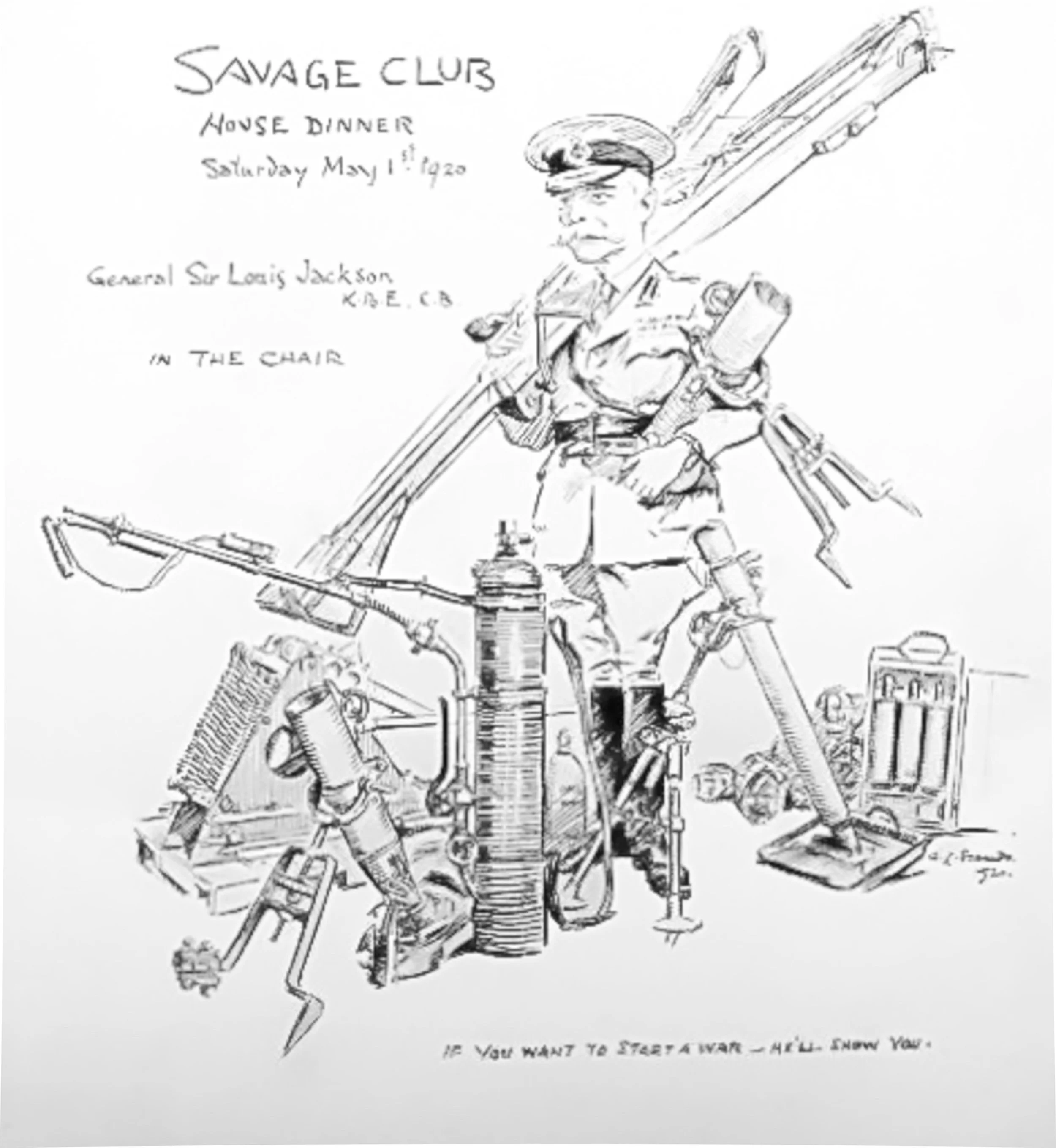
Cartoon of General Louis Jackson with munitions developed by the Trench Warfare Department. From the cover of a dinner menu for the Savage Club. Courtesy of Charles Jackson &Family.
The step-change in the development of Section FW3 was the authorisation to produce emergency grenades. As this was Jackson’s first excursion into the design of a munition, his first step was to contact the bomb factories in France to obtain information on their designs, the types and quantities of explosives used, the ignition mechanism, and any issues encountered in use. With his information, he devised two hand grenades: the double-cylinder and the hairbrush, a box pattern. The development work on his design and manufacturing techniques was carried out by Roburite and Ammonal Ltd.
This company was a major supplier of ammonal explosives to the mining and quarrying industries, and Jackson likely encountered them while researching ammonal. They became the preferred manufacturer of Jackson's grenades, receiving the first order for 108,000 double cylinder grenades on January 7th, 1915. The issue of these grenades to the army must have been approved by the Master-General of the Ordnance, as the Ordnance Board did not approve them for service until May 25th, 1915. Another example of civilian industry's involvement is Jackson's search for a satisfactory fuse for his improvised grenades. Dissatisfied with the simple Bickford fuse used by the Field Companies for their grenades, Jackson invited several companies from the match and fireworks industries to develop a more efficient fuse, a challenge taken up by the match manufacturer Bryant & May and the fireworks manufacturer Brock. Jackson selected the design proposed by Brock, which consisted of the free end of a length of Bickford safety fuse coated with an ignition mixture like that on a normal matchhead and easily ignited by striking it on the roughened surface of a metal brassard attached to the bomber's arm, just as one would strike a match. It was simple and effective, and although it had its faults, it remained a standard method of igniting grenades until the introduction of the Mills bomb.
During this early stage, Jackson appears to have worked alone, collaborating with industrial partners to develop his grenades and other items of ordnance. At the beginning of 1915, he was still Head of Section FW3, recognised that his involvement in an increasingly wide range of trench warfare activities was placing extra strain on the unit. Its authorised staffing was small, comprising two Staff Captains and six clerks and secretaries, who were overworked in discharging the Section's normal responsibilities and could provide minimal support; to meet his other commitments, he had delegated all the routine work to his deputy. He had failed in his bid for additional staff, as the War Office strictly regulated departmental staffing and saw no need to allocate more to support his work on trench warfare. But help was coming.
Sometime in early 1915, Jackson took the first definite step toward the creation of the Trench Warfare Department when he prepared a memorandum, what today we would call a position paper, for the Master-General of the Ordnance in which he mused on the nature of trench warfare and speculated about how it might be ended. Jackson’s concerns revolved around the BEF's weakness in artillery. In his opinion, the number of guns available was insufficient for the artillery to carry out its proper work of dealing with hostile gun batteries and supporting the infantry when it was engaged with the enemy for, as a consequence of trench warfare, it was now over committed having acquired a wide range of additional targets, such as enemy trenches, dugouts, headquarters, mortar positions, bombing stations, supply dumps, communication routes, etc. In his view, this proliferation of targets led to most offensive activity against the enemy being carried out by the artillery, with the infantry quite happy to shelter in their trenches, interfering with the enemy as little as possible. This was anathema to Jackson, who, drawing upon his professional expertise in field fortifications, formed a firmly held opinion that to engage with the enemy in modern trench warfare required an entirely new approach, one in which the infantry in the trenches did their own fighting and not just engaged with the enemy when they undertook an attack on the opposite trenches. He proposed that infantry should be trained in the use of trench mortars and hand grenades so they could hurl thousands of missiles, both explosive and chemical, into the enemy trenches throughout the day, a method of harassment that was reinforced during the hours of darkness with specially designed missiles containing lights and bells to deprive the garrison of sleep. This process continued until the enemy front-line trenches became untenable, and they withdrew, allowing the attacks to be repeated on any second line, until the enemy was forced into the open to be dealt with by conventional means.
Before we dismiss this concept of trench fighting as a crackpot idea, we need to be clear about what Jackson was advocating. If we apply his ideas to the complex and sophisticated trench systems of 1916 and 1917, he is spouting nonsense, or at best naïve, but this is not what he was referring to. Jackson is writing at the beginning of 1915; the trenches are in their most rudimentary state and, as defensive structures, so flimsy that a well-aimed jam-pot grenade delivered sufficient high explosive to blow in a portion of the parapet. At this stage in the development of trench warfare, such ideas were not considered outlandish but were common currency within the BEF as it worked out how to come to terms with it. We see a version of them in Haig's diary of December 24th, 1914, after he held a conference with his senior staff to consider “the best methods of carrying out operations under the new conditions”, when one of the methods considered was to shower the enemy trenches with trench mortars and grenades until they became untenable for the garrison to defend. Similar ideas were the tactical imperative behind Major Russell Brown's search for a spring-powered catapult, and his thoughts should carry some weight, for, as a Royal Engineer officer in daily contact with his own trenches and those of the enemy, he must have known what was feasible with the resources at his disposal. Whatever our modern view of the tactical ideas put forward by Jackson, they impressed Major-General von Donop sufficiently for him to take them to the Army Council, which, faced with a dearth of other suggestions of how to deal with the changing tactical situation in France, incorporated them into its strategy for dealing with the enemy trenches. It is almost impossible to overemphasise the importance of this decision for the future development of the Trench Warfare Department, for funding began to flow in Jackson's direction, giving him the resources to finance the manufacture of thousands of his experimental grenades and develop the mechanical bomb throwers. He was permitted to establish a bombing school on Clapham Common, independent of the Directorate of Artillery, where he could conduct experiments, train the individuals who would become instructors to the troops of the BEF in the deployment of grenades and mechanical bomb throwers, and evaluate suggestions regarding their tactical use.[1]
In recognition of the increased workload, the War Office approved an increase in staff, first Mr E. T. Richmond as Jackson's personal assistant, followed in February by Captain Trelawney, an authority on explosives, and in early March by Captain Moreland, who was on a temporary contract so as not to increase the permanent staffing above the War Office norm for a Section the size of FW3. Independent of these appointments, separate staff were recruited for the new bombing school on Clapham Common, including a fourteen-year-old boy as messenger at three shillings a week.
(viii) The Creation of Section FW3A.
On May 3rd 1915, an event occurred that transformed the importance and status of FW3 within the War Office. Jackson was summoned by Lord Kitchener to be told that he was to take charge of the Nation’s response to the German gas attack at Ypres on 22 April. Furthermore, Kitchener informed him that the Government was on the verge of authorising the use of lethal substances for a retaliatory strike against the German army, and he was to focus his research accordingly.[2] As this represented a significant increase in Jackson's responsibilities, it was no longer practicable for him to remain Head of Section FW3 and, with the agreement of General Scott-Moncrieff, he relinquished that command to be appointed Head of Section FW3A, a new section created by von Donop to assume responsibility for all the War Office's interests in trench warfare except for those munitions, such as the trench mortars and the Mills bomb, that remained the responsibility of the Directorate of Artillery. Section FW3A became a component of the Munitions Division in the Office of the Master-General of the Ordnance, but independent of the Directorate of Artillery, Jackson reporting to Major-General von Donop.
(ix) Financial Freedom.
The move into chemical munitions created an unexpected financial advantage for FW3A. The research conducted into potential chemical munitions in the laboratories of Imperial College of Science and Technology produced chemicals that attacked the metal bodies of grenades, making it necessary for the scientists to have easy access, at short notice, to alternative containers made of glass or ceramic. These were purchased through FW3A, and as many were only obtainable from a unique supplier, presenting a serious challenge to the War Office's Purchasing Department, whose systems were designed to award and monitor contracts for large quantities of a single item, such as a rifle, whose price was known and manufactured by one of the War Office-approved suppliers after a process of competitive bidding. Orders placed by FW3A did not comply with this business model, resulting in severe payment delays and essential suppliers threatening to stop doing business with FW3A, which would seriously delay important research.
Once again, Major-General von Donop came to the rescue by giving authorisation for FW3A to abandon competitive tendering when necessary. This deviation from the War Office's standard purchasing protocols was intended to apply only to purchases for experimental purposes, but it quickly exhibited mission creep. The Supply Officer of FW3A began negotiating directly with individual manufacturers over the price of munitions, arguing that their unique skills and experience in manufacturing extemporised munitions made it unnecessary to seek out other companies, as they might submit high tenders for the work. This practice of direct negotiation was transferred with FW3A to the Ministry of Munitions, to the horror of the civil servants who managed the Ministry, who could not conceive of any Department having the authorisation to place large, high-value orders without going to tender to determine the best supplier and quickly moved to suppress it. Abandoning competitive tendering was not done perversely; with new manufacturers, crucial contract terms, such as pricing, had to be postponed until the Trench Warfare Department had some idea of the actual costs involved. Until then, manufacturers proceeded without a contract, charging the actual cost of production, including labour, staff training, and materials, to which the department added a percentage profit, usually between 5 and 10 per cent. This practice often resulted in different prices being paid for the same product, as manufacturing by the smaller workshops was more expensive. Unlike the larger concerns, they could not achieve economies of scale and tended to have older, inefficient machinery, but this inefficiency was tolerated because retaining the manufacturing capabilities of small workshops was an essential component of the Trench Warfare Department's business model.
This was to have one or two large manufacturers supplying a high baseline output of an item, such as the casings for the Mills bomb, with dozens of smaller companies producing components to even out the fluctuations in demand characteristic of the supply of trench-warfare munitions. For example, the Mills bomb was manufactured by three major manufacturers, whose output was supported by over 200 smaller companies that produced components or even completed grenade bodies to smooth out fluctuations in demand, which could vary by as much as 250,000 units a week. As the manufacturing and purchasing policies operated by FW3A were so far outside the normal precedents by which the War Office conducted its business Mr H T Phillips, the senior purchasing officer dedicated to supporting FW3, was given the additional responsibility of ensuring the financial probity of their contracts and, in discharging this responsibility, developed what became, in practice, a separate purchasing and finance team dedicated to the work of FW3A.[3]
This system worked well and served its purpose until FW3A was transferred to the Ministry of Munitions, when Mr Phillips and his team, all War Office employees, had to return to their home department, taking their extensive and valuable experience with them. In the first six months of 1915, Section FW3A was at the forefront in developing new weapons for trench warfare. With its industrial partners and individual inventors, it was, in British terms, at the cutting edge of science and technology. The Section's priority was chemical warfare, and Jackson was instrumental in persuading the War Office that chlorine gas, as used by the Germans, was the only lethal chemical available and much of his time was devoted to working with the chemical industry in developing new plant to ensure sufficient liquid chlorine would be available for military use. They also had to work out the physics of discharging liquid chlorine from cylinders and ensure that thousands of specially designed cylinders, along with their accessories such as valves and pipes, would be available. Jackson wrote a memorandum to the War Office advocating the creation of a special section of chemical or gas troops and was instrumental in recruiting the first officers and men into what would become the Special Brigade R.E. Other activities at the cutting edge of technology were the development of pneumatic mortars and flamethrowers. Both research projects resulted in potential munitions, but pneumatic mortars were rejected by the artillery as too complex for troops to use, and flamethrowers were rejected by GHQ on the grounds that no civilised army should resort to such terrible weapons. Other projects included improving grenades, developing chemical and incendiary grenades, and bringing into use the two mechanical bomb throwers, the Leach Catapult and the West Spring Gun.
(x) The Transfer to Storey's Gate.
By the spring of 1915, the War Office had managed to increase munitions production across the entire munitions industry. However, this was still failing to keep up with demand. In a further attempt to boost productivity, Kitchener invited several high-powered and experienced businessmen from the munitions industry to support the War Office. The most important of these was Sir Percy Girouard from the armaments company Armstrongs. A highly successful Canadian military engineer, Girouard had made his mark supervising the construction of vital railway links across the desert in Kitchener's Sudan campaign. He later performed similar feats for Lord Roberts in the Boer War, after which he began a more controversial non-military career and demonstrated difficulty bending to the dictates of his political masters. Upon leaving the army, Girouard was appointed Governor of Northern Nigeria, where he oversaw what was considered one of the most enlightened administrations during the period of expanding British imperialism in Africa. However, he was forced to resign after coming into conflict with Lord Milner over Colonial Office policies that he considered detrimental to his area and its native population. In 1912, he became Managing Director of Armstrong's Elswick munition works in Newcastle on Tyne. After taking leave of absence, he responded to Kitchener's request to assist the War Office in increasing munitions production by taking over management of the Armaments Department in the Office of the Master-General of the Ordnance, relieving von Donop of the day-to-day responsibilities of increasing munitions production.
Girouard began implementing changes in how the Royal Ordnance Factories arranged munitions production. Although he left FW3A unchanged, Jackson was apprehensive about what Sir Percy's reorganisation might mean for his Section. He faced a direct threat from the Directorate of Artillery, which supported Girouard's plans. The artillerists saw the expansion of FW3A as a challenge to their authority in munitions development. They launched a strong campaign within the War Office to break up Jackson's department by taking over research and development and moving manufacturing to the proposed Ministry of Munitions. Growing concerned for his department's future, Jackson spoke with Captain Oswald Fitzgerald, Kitchener's aide-de-camp. He asked Fitzgerald to sound out Kitchener's view on making FW3A a new department, independent of Girouard's Armaments Committee, and reporting directly to the Master-General of the Ordnance. Fitzgerald replied that Kitchener recognised the importance of FW3A's work and supported Jackson's desire for an independent department. However, due to interdepartmental rivalries and the political climate surrounding the proposed Ministry of Munitions, Kitchener believed the War Office was not suitable for FW3A. He thought FW3A would face continual conflict with the Directorate of Artillery and would eventually lose. Kitchener suggested that Jackson might have more freedom and resources if his department were located within the new Ministry.[4]
Jackson also had domestic concerns about remaining in the War Office, or at least the Old War Office building. The work of FW3A had expanded, along with its staff, and they had outgrown their allocated space within an already overcrowded building. Jackson, his assistant Mr Richmond, two Royal Engineer officers, and six clerks were all crowded into his office or scattered in odd corners throughout the building, wherever space could be found. Others, such as Mr Phillips and his clerks, staff devoted to meeting the needs of FW3A, were embedded in the Contracts and Finance Department, which was separated from the rest of the Section, thereby slowing communication and decision-making. There appears to have been no room for Dr Beilby and Professors Baker and Thorps, who, although not part of Jackson's establishment, were committed full-time to working with him on the development of chemical munitions.[5]
Resolution to the space problem came in the middle of May when Jackson, or one of his staff, identified some empty offices in Central Buildings, Storey's Gate that belonged to the War Office, and von Donop permitted them to move. FW3A relocated to Storey's Gate on 28 May 1915. During the three or more months that FW3A had been in existence, it had obtained several significant variations from the generally complex commercial approval process operated by the War Office. Still, these had been obtained piecemeal in response to urgent demands for trench stores emanating from GHQ France, and the Master-General of Ordnance’s desire to provide the troops with the novel munitions they requested as quickly as possible, rather than being integrated into a standard method of working. The move to Storey's Gate and the separation from the inter-departmental politics and stifling bureaucracy of the War Office allowed Jackson to rationalise his operational methods and introduce new procedures and an organisational structure into FW3A. A major priority was to create a framework that would enable his relatively small staff to manage the supply chain and ensure output quality across their expanding manufacturing operations, while remaining flexible enough to continually adjust their meagre resources to meet unexpected variations in demand for trench warfare munitions. This is discussed later when we consider the development of the Outside Engineering Branch; here, it suffices to note that Jackson’s achievements were, for their time and place, highly innovative, as they developed a manufacturing model in which all activities associated with the production of each munition pattern were vertically integrated. Research and development were integral to manufacturing processes, with both functions sensitive to change through feedback from further experimentation and prototype trials, which generated new ideas that were immediately incorporated into design and functionality improvements. To oversee this process, one officer became responsible for all aspects of production, from the initial design stage to the identification of suitable manufacturers, supplying the materials, training workers, and supervising production through to the quality assurance of the final product and its delivery, ready for use, to the munition officers on the Lines of Communication. We have no evidence to help us understand how Jackson conceived this efficient method of manufacturing experimental munitions. Still, my speculation is that it stems from that part of Military Doctrine stating that, in a period of uncertainty or changed circumstances, it is the man on the spot who knows best what may be done and has the freedom to act accordingly. In Jackson’s department, the Supply Officer had overall responsibility for producing a particular model of munition and the freedom to act quickly to resolve crises, such as design changes, order sizes, or material or labour shortages, by taking early steps to address them and maintain production. During the few weeks FW3A was at Storey's Gate, Colonel Jackson made changes, both great and small. These changes reinforced their belief that the Section was evolving into an autonomous department within the Directorate of the Master-General of the Ordnance. There is no evidence that Jackson was given official authority to establish a separate department. Still, he and his officers began referring to themselves on their printed notepaper and other stationery as "Engineering Munitions."
(xi) Creation of the Outside Engineering Branch.
One of the most important new ways of working introduced by Jackson following the transfer of FW3A to Storey's Gate was the creation of the Outside Engineering Branch. As the demand for grenades and other trench stores that were the responsibility of FW3A increased, the manufacturing restrictions imposed by General von Donop presented Jackson and his officers with novel problems that did not usually come within the orbit of a Royal Engineer officer. These included the identification and recruitment of engineering workshops and small foundries which, by their nature, had limited capacity, a range of basic tools, and a workforce that required close supervision to maintain agreed standards of workmanship. Balancing these factors against the rapidly increasing demand for munitions presented the manufacturing side of the Trench Warfare Department with significant challenges as it struggled to coordinate the activities of different firms with the flow of raw materials, while simultaneously introducing variations and even new designs into the manufacturing process.[6]
To deal with these diverse activities with only a small number of staff at his disposal, Jackson evolved a system where one of his staff assumed responsibility for coordinating the manufacture of a single munition, such as the Ball grenade or West Spring Gun, from the design stage right through to delivery to the army, and as this work took them away from Storey's Gate Jackson termed them the Outside Engineering Branch. The critical appointment that brought Jackson's concept to fruition was that of Lieutenant Leeming, the result of a conversation between Colonel Norton Griffiths, R.E., and Captain S.T. Cargill, R.E., Jackson’s second-in-command. Norton Griffiths was a Member of Parliament and a successful mining engineer and contractor who had formed the Royal Engineer Tunnelling Companies in February 1915, which had a close relationship with FW3A as it was responsible for organising the purchase and delivery of equipment and specialist supplies for the Tunnelling Companies, which fell outside the standard supply chain for Royal Engineer Field Companies.
Captain Cargill explained to Norton Griffiths the difficulty they were having coordinating the various aspects of their munitions manufacturing. Norton Griffiths suggested that they needed experienced help and should employ Mr J. A. Leeming, a highly skilled engineer and manager, now a Temporary Lieutenant R.E., who had been his assistant in France when developing the Tunnelling Companies and was currently on leave from the Front, recovering from gas poisoning, emphasising that an engineer of Leeming's abilities should not be lost to the war effort. The upshot was that Lieutenant Leeming reported to Colonel Jackson on 1 June 1915 and was given a remit to develop a system that would enable the Section's staff to source raw materials, assess the capabilities of potential manufacturers, accelerate production, and monitor the quality of the final product throughout the supply chain. For his first week, Leeming was responsible for monitoring the output of the only munitions FW3A provided to the army at that time, namely the grenades and the Leach catapult. The following week, Jackson agreed to oversee the production of the West Spring Gun, just approved by the Ordnance Board, and to support Leeming recruited Mr E. V. Haig, whose appointment gives us some insight into the informal means by which FW3A recruited its civilian staff before a more conventional recruitment policy was instigated after transfer to the Ministry of Munitions,
I was advised by my friends on returning from Mexico City, in the Spring of 1915, that a Department of the War Office based in Central Buildings was in need of a mechanical engineer and that a suitable candidate would receive the rank of Staff Captain. My early training was in steam and mechanical engineering, and after some years, in factory management. I went into the service of Messrs. J & P Coats as an Assistant Manager. Two years later, I went to Russia and, since that time, have visited Italy, Spain and Mexico in connection with the erection of a plant and the organisation of factories abroad. I was interviewed by Major Cargill, and as the organisation of the Department did not appear to have taken any definite form, he could not offer any definite position, but he stated that spring guns were being made at Brighton and suggested that I should go there to see that the work was properly done. I went, and this began my connection with what was later named the 'Trench Warfare Department' – so far as I remember, the date was June 10th, 1915.[7]
[1] This developed into the No. 1 bombing school on Clapham Common [2] Jackson's initial responsibilities covered both the offensive and defensive aspects of chemical warfare, but the defensive aspects were soon transferred to the medical services. Although the working relationship between the two remained very close, the offensive was developing increasingly toxic substances that an enemy might employ, and the defensive was seeking protective measures against them. [3] TNA: MUN5/253/6.7: History of the Contracts Department [4] TNA: MUN 5/382/1600/8: Notes on the History of Trench Warfare Research. Aug. 1914-May 1915. Dictated by Gen. Jackson. [5] Sir Herbert Baker (1862-1946). Professor of Chemistry, Imperial College; Sir Thomas E Thorpe (1845-1925). Professor Emeritus. Imperial College; Sir George Thomas Beilby (1850 -1924), an industrial chemist and a Director of the Castner-Kellner Company. [6] This predominantly occurred during development when batches of a thousand, or more, grenades were being manufactured for further experimentation and evaluation. [7] TNA: MUN 5 382/1600/7: Trench Warfare Supply Department, June 1915-Sept. 1917. Mr. E. V. Haig