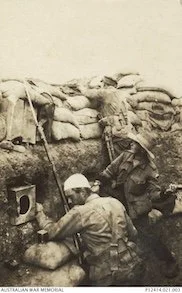
Extemporised Grenade Production at ANZAC.
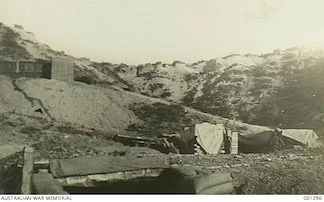
Bomb Factory at Anzac. AWM G01290. Photograpg C.E.W. Bean.
We are fortunate that the War Diaries maintained by the ANZAC units are highly detailed, containing much information on the availability and use of trench warfare munitions on the Peninsula. This is not to suggest, as claimed by some, that the ANZAC units were unique in their inventiveness and creativity, for they learned from the practices of others, whether it was information on trench warfare from the War Office or from the French, British and Indian units at Cape Helles. In turn, their suggestions and innovations were incorporated into the units' practices at Cape Helles.
The first mention of grenades in the War Diaries of the ANZAC units is 29 April, when three Turkish grenades, two time-fused and one percussion, were brought into the headquarters of the 1st Australian Divisional Engineers to be examined by the adjutant, and he, the next day, took them up to Quinn's post and returned them to the enemy.[1] The result appears to have been satisfactory for the next day, 1 May, a party of No 4 section, 2nd Field Company were told off to produce grenades and we must assume that the first trial grenades were a success for two days later before any of the extemporised grenades were issued to the infantry, the Divisional Engineers put their grenade manufacturing on a more permanent footing and half of No 4 section, under the command of a Corporal Probert, were detached from the 2nd Field Company with instructions to make grenades until further notice.
By June, Probert, now promoted sergeant, had a staff of five sappers supervising infantry working parties producing 200 grenades a day, with two additional sappers committed full-time to producing trench periscopes. By August, Probert's bomb factory was making more than 4,000 jam-tin and hairbrush grenades a week.[2]
Some idea of the ingenuity exercised by these bomb factories is given by a New Zealander,
The hand-grenade position was often desperate. For the first few months, no grenades were available, and the supply had to be improvised on shore. A bomb factory was instituted, and here, day and night, men toiled to make the weapon so effective in the short-range fights that burst with such fury around the devoted posts of Quinn's and Courtney's. The Turk had a plentiful supply of a round, cricket-ball hand grenade, with a patent match-head ignition, and these he literally showered on Quinn's.
The Anzac factory retorted with several brands, but the most favoured one was made out of the green fuse tin from the 18-pr. guns. These tins were stout and of the size of a condensed milk tin. Two holes were punched in the bottom for a wire to go through, and three holes in the lid—two for the wire and a larger one for the fuse. The wire came from hawsers salvaged from the wreckage of the trawlers off the beach. Into the centre of the tin was placed a dry gun-cotton primer or half a stick of gelignite, the detonator and a five-second fuse was fitted, and the remaining space packed with unexploded Turkish cartridges with the bullets cut off to let the lid close, after which the whole was secured across the top by joining the two ends of the wires. So, from the cast-off tins and wires, captured ammunition, and the engineers' stores of explosives, these grenades were manufactured to repel the apparently rejuvenated "Sick Man of Europe."
A time came when the gun-cotton and gelignite got scarce, and a powder explosive called ammonal had to be used. This presented a difficulty, as the stuff had to be packeted. But an active brain came to the rescue with a suggestion that cloth might be used for the packet. It so happened that about this time a large consignment of shirts had been opened up, all cut out and in the multitude of parts that go to make a shirt, but no two parts stitched together! This material was requisitioned, cut into squares, and the explosive packed like little bags of washing blue, with the detonator and fuse inside. Another time, tins ran out. The little mountain battery fuse tin was used as a stopgap, and then, luckily for Quinn's, another rascally manufacturer sent a shipment of mildewed tobacco to Anzac. The stuff was condemned, and before the day was done the empty tins lay in the bin of the bomb factory. Thus, though they did not intend it, did the careless London shirt inspector and the bad tobacco specialist help to keep the front line of the Anzac area.[3]
The ANZAC bomb factory produced an interesting variation of the hairbrush pattern, the Lotbiniere bomb, developed by Major-General A.C. de Loly de Lotbiniere that differed from the standard hairbrush pattern in that they carried a substantial explosive charge of guncotton and once made up had to be stored in specially designed boxes surrounded by torn up rags kept damp as gun cotton becomes highly unstable when it dries out. The weight of the Lotbiniere made them too heavy to throw any distance, but that was not their function. They were made up immediately before use and designed to break into Turkish trenches during an infantry assault where a sizeable explosive charge was necessary to blast through the head cover of the Ottoman trenches, which in some areas, such as Lone Pine, consisted of thick tree trunks. Once blasted apart, the Australian infantry dropped down into the dark, gloomy tunnel to fight, hand to hand, with the Ottoman trench garrison.[4]
At ANZAC, the proximity of the trenches at critical points in the line, such as Quinn's Post, brought the enemy trenches within hand-throwing distance, resulting in a high demand for grenades and bombers trained to use them to the best advantage. At first, this did not happen. Grenades were a novelty, and with their enthusiasm to try out anything new, as soon as small numbers were issued to the infantry, it became the practice for local commanders to permit anyone in the trench to throw one in the direction of an Ottoman trench whenever they fancied, a practice immediately stamped on by Lieutenant-General Birdwood.[5] He pointed out that by allowing untrained men to use them, units were not getting the best out of the small number of grenades currently available and ordered the practice to cease immediately and replaced, as a matter of urgency, by the training of 10 men per company as bombers following the detailed curriculum attached to his order.[6]
In this pamphlet, the trench diagrams used as illustrations are clearly those of the Western Front, providing insight into the transmission of information and best practices across an army fighting in different theatres of operation several thousand miles apart.[7]
In planning the training of its bombers, the 1st Australian Division did not follow the pamphlet blindly but treated it as a guide to best practice. The Divisional Bombing Officer extracted the essential details relating to the training of bombers, combining them with information and advice from a 19th Infantry Brigade memorandum on grenade fighting on the Western Front and local experience of trench fighting to produce a training manual issued as an operational order on Divisional training.[8] It makes interesting reading, giving training details absent from the more formal instructional pamphlets issued by the War Office, with an emphasis on the use of dummy bombs to accustom throwers to the techniques of lighting the bombs and to give trainees confidence in handling their unfamiliar weapon, a great deal of time was to be spent learning the characteristics of safety fuse burning for five seconds as it had been noticed, in the early training sessions, that once alight the smoke and flame of the burning fuse panicked untrained men into throwing the grenade prematurely.[9]
With grenades in short supply their use was closely monitored, with each Infantry Company appointing an officer, or senior NCO, responsible for their stock of grenades to ensure that only trained bombers had access to the Company supply and to prevent waste by attacking targets of little value, By the end of August there were sufficient grenades for each Brigade to maintain a stock of 1,500, which they maintained by requisitioning from the bomb factory replacements for each day's expenditure, providing the bombing officers could overcome the endemic problem among ANZAC units, a failure to return the empty bomb boxes for, without them, no new bombs could be issued.[10]
Members of the 20th Battalion in a trench at Gallipoli. One soldier is spotting the enemy whilst another prepares to throw a stick grenade.
In September, the General Staff issued a memorandum on the provision and performance of officially issued grenades, giving us the best information we have on grenade availability at ANZAC, and by extension, Cape Helles.[11]
There are now several varieties of bombs in stock, each of which has its special characteristics. The number of types is, it is understood, to be reduced and only the most effective retained; but as a large stock exists, it is well to know the circumstances in which each type can be used most effectively.1. The Cane handle No. 2 and the Hales rifle grenade are percussion grenades – the need for careful throwing, ample throwing room and a hard surface to strike on makes them unsuited to trench warfare, and it is unlikely that many more will be issued.2. The cricket ball bombs are of inferior workmanship to the Turkish sample, burst into a few large pieces and are the least effective of our fuse ignition grenades though useful in a narrow trench.3. The double cylinder is a far better weapon, has a more wounding effect and much feared by the enemy.4. The Lotbiniere bomb- guncotton fixed on a hair brush backing which has little effect on personnel or trenches but is particularly destructive in closed spaces or breaking down head cover.The undermentioned grenades are of a much superior type and power to the foregoing, which are mostly improved bombs.1. The Pitcher and Mills have a scattering effect from the many pieces into which the envelope is shattered. Both are very powerful and apparently safe to handle.2. The time and friction No.6 has an entirely different action. It gets its results from the highly localised destruction caused by the high explosive compound with which it is filled. Experiment shows that a bursting grenade will clear a circle of a yard diameter in bush, destroy roots to a depth of 6 inches, while leaves and twigs outside the circle are not even injured. In addition the explosion has a terrifying effect. This grenade is therefore obviously best suited to attacking up trenches – the thrower being immune from flying pieces.At present there is a very large stock of double cylinders, a large stock of cricket balls and a limited supply of the three better grenades.In using these grenades, therefore, the double cylinder and cricket balls should be earmarked specially for use in the normal interchange of grenades between trenches.The Lotbiniere Grenade should be used whenever headcover in enemy trenches has to be destroyed, but not otherwise, as it is an expensive weapon and in every other use has its superior in one or other of the smaller grenades.The Pitcher, Mills and No 6 should not be used daily except for special purposes such as the repelling of a real bomb attack, or for dealing with bombing parties that cannot be quieted by local grenades – that is they should not be used for bombing trenches and areas as such, so much as for dealing with trenches and areas in which the enemy is known to be insufficient numbers to warrant the use of these more effective grenades.In other words the Mills and Pitcher grenades should be used for –1. Repelling attack.2. Use by our bombing parties.3. Attack on enemy trenches as part of an operation.The Time and Friction No 6 is especially indicated by its characteristics for clearing the enemy from trenches in which a lodgement has been made. It should as a rule be reserved for this purpose or for an attack on enemy trenches.D. Glasfurd, Major,For Colonel, General Staff.Colonel John Monash, Commander of the 4th Australian Infantry Brigade, issued the following instructions for the employment of battalion bombers. Monash favoured jam-tin grenades, claiming that they were the easiest to light with a burning match or cigarette and throw under the stress of combat. He suggested that when holding the line, there should be one trained bomber for every 8 yards of trench, giving 12 to 13 bombers for every 100 yards of frontage, each supported by two bomb carriers who were also trained throwers. In the attack, bombers should follow behind a line of skirmishers, bombing the enemy trenches in front, like a miniature artillery bombardment, just before the main infantry assault went in, a departure from the usual practice where the bombers operated on the flanks of the assault to seal off the trenches being attacked to prevent the rest of the trench garrison reinforcing their colleagues under attack. Monash suggests that each bomber carry 15 bombs in a special rucksack, in addition to his rifle and bandolier, with each bomb carrying 30, giving him 75 bombs to attack his section of the enemy's trench. The bomb carriers restocked their supply from boxes of 100 grenades brought forward with the second wave of infantry.[12]
[1] AWM4. 14/7/1. Part I: 1st Australian Divisional Engineers HQ. War Diary, Aug.1914-Aug. 1915.
[2] AWM4. 14/21/3: 1st Australian Divisional Engineers HQ. War Diary, Aug.1914-Aug. 1915.
[3] Fred Waite, The New Zealanders at Gallipoli. 2nd Ed. (Auckland: Whitcombe and Tombs Limited, 1921)
[4] AWM4.1/42/8. Part 9: General Staff. 1st Australian Division. War Diary, September 1915
[5] Lieutenant-General Sir William Birdwood. Acting General Officer Commanding Australian Expeditionary Force, May-June 1915. General Officer Commanding Australian Expeditionary Force, September 1915-1919.
[6] AWM4. 1/25/3. Part 3: Memorandum from Army Corps Headquarters 7 June 1915. War Diary. G.H.Q. ANZAC. June 1915. Appendix 7(a)
[7] AWM4. 1/25/3. Part 3: War Diary. G.H.Q. ANZAC. June 1915. Appendix 7(a)
[8] AWM4. 1/42/5. Part 4: Operational Order No. 6. War Diary. 1st Australian Division. General Staff HQ June 1915. Appendix 5. Hand Grenades in Trench Warfare
[9] The burning gunpowder in the fuse produces a surprisingly large amount of dense white smoke, and when thrown at night, the flame becomes a trail of sparks that allows a vigilant enemy to move out of the way or take cover.
[10] AWM4. 23/4/1. Part 2: Memo to all units 29/8/15. War Diary. 4th Infantry Brigade May-Sept. 1915
[11] AWM4. 1/42/8. Part 9: War Diary. General Staff. HQ. 1st Australian Division. September 1915
[12] AWM4. 23/4/1. Part 2: Colonel John Monash, Organisation of Bomb Offensive. War Diary. 4th Infantry Brigade May-Sept. 1915