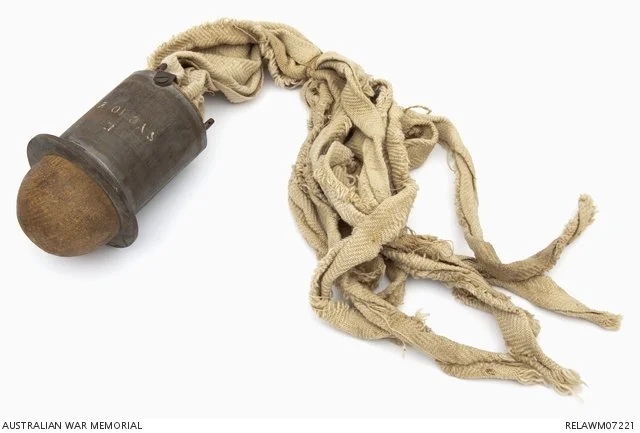
Grenades designed by the Roayl Navy.
Grenade. H.M.S. Cornwallis. Australian War Memorial. Image RELAWM07221.
The warships cruising off the coast of Gallipoli provided valuable fire support to the embattled infantry and assisted the Royal Naval Division, which still functioned as an Admiralty unit, though under army orders. All Royal Navy vessels had armouries stocked with rifles and ammunition, which in the larger vessels also contained rifle grenades and one or more machine guns, and these were used to arm the Royal Naval Division whose reinforcements tended to arrive with redundant rifles or, in extreme cases, none at all, and on landing these men received modern arms and ammunition drawn from the ships' armoury. For example, on May 16, the Deputy Director of Ordnance Services received 2,000 modern rifles and ammunition from the Fleet to equip the Royal Naval Division's reinforcements and replace battle-damaged rifles.[1]
One of the under-explored facets of the Gallipoli campaign is the other ways in which the Navy could have contributed to the land battle. All warships had engineering workshops, which in the larger vessels were extensive, equipped with modern machinery and operated by skilled artificers, an obvious resource to the military and one is left to ponder why such assets were utilised to produce extemporised munitions such as trench mortars. All ships carried a wide range of steel tubing; the army had its twenty 3.7-inch light mortars as models, and suitable ammunition could have been produced by a number of sources. In some areas, there was collaboration. Royal Navy artificers collaborated with the ANZAC Sappers in manufacturing telescopic rifles and in carrying out experiments with fuses for grenades.[2] GHQ also made an effort. On June 19, following a request from the military, the senior Naval officer on Mudros signalled to the Fleet inviting them to submit drawings and samples of hand grenades.[3]
Three ships responded: HMS Prince George, which submitted two designs, and HMS Chatham and HMS Cornwallis, which submitted one each. The HMS Prince George No 1 grenade was a percussion grenade derived from the design of the No 8 double-cylinder hand grenade that used a tobacco tin as the outer larger cylinder into which was inserted a smaller and shorter tin containing the bursting charge of high explosive and sealed at the bottom with a heavy brass disk recessed to take either a revolver cartridge with the bullet removed, or a conventional primer and detonator, depending upon the nature of setting off the bursting charge. The space between the tins was filled with scrap iron, or balls removed from a 12-pounder shrapnel shell, and inside the lid of the outer tin was a brass disk onto which was soldered a small striker pin, held clear of the revolver cartridge by a large safety pin. When used as a percussion grenade, the safety pin was withdrawn, the grenade thrown, releasing the cloth streamers that ensured it landed on the lid; the impact drove the striker pin down to fire the blank revolver cartridge, setting off the main charge. The No 2 grenade was the timed version and had a similar design, except that a length of safety fuse and detonator replaced the firing pin and blank cartridge.
The HMS Cornwallis grenade was a percussion grenade based on a tobacco tin. Its trigger was a wooden mushroom-shaped cap with a stalk ending in a firing pin, held by a safety pin. Cloth streamers ensured the grenade landed on the cap, pushing it down to engage the striker pin and activate a short instantaneous fuse, like that in the Pippen rifle grenade. The design from HMS Chatham was more straightforward: a glass soda bottle filled with explosive, fitted with a safety fuse and detonator. Trials showed this grenade created a powerful blast, with large shards of glass causing serious wounds.
All four grenades were sent to Lieutenant-Colonel G. R. Pridham, Divisional Engineer at ANZAC, at the end of June, who reported that he saw merit in all four designs, but at the moment they were expecting a large delivery of grenades from the U.K., but if these did not materialise, it may be necessary to manufacture one or more of the Navy's designs.[4]
[1] AWM 4 1/17/1 Part 1: General Staff. Dardanelles Army. War Diary. DDOS 16 May 1915
[2] AWM4. 14/7/1. Part II: War Diary. 1st Australian Divisional Engineers HQ. Aug.1914-Aug. 1915. Entries for 1 June & 2 July
[3] Rick Landers, Norman Bonney & Gary Oakley, ‘Grenade’ British and Commonwealth Hand and Rifle Grenades (Dural (Australia): Landers Publishing, 2001), pp. 29-31
[4] Landers, p. 31