Beech and the Periscopic Rifle.
The periscopic rifle is one of the iconic images of trench warfare on the Gallipoli Peninsula. It is particularly associated with the Australians, who have claimed it as one of their significant contributions to trench fighting. The purpose of the device, mainly used in sniping, was to permit the rifle to be fired while the soldier remained concealed below the parapet.
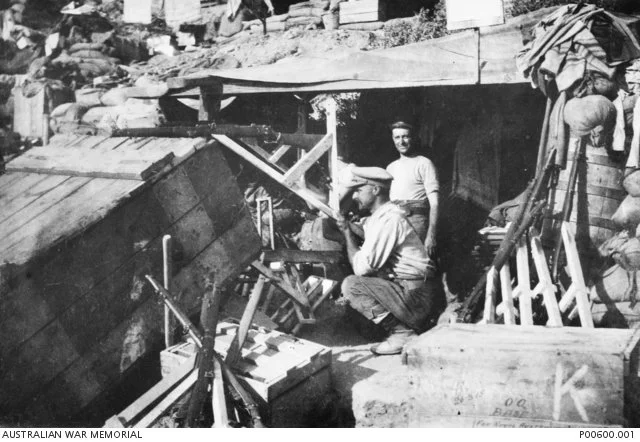
Sargeant Beech testing one of his periscopic rifles in his workshop on the beach at Anzac Cove, 1915. Australian War Memorial P00600.001
In its simplest form, it was a frame, tied or bolted to a service rifle, to support a periscope, and a wooden extension allowing the trigger to be pulled. The upper mirror of the periscope is fixed so that it aligns with the rifle's sights; the image is reflected in the lower mirror, allowing the marksman to aim the rifle.
The sniper team consisted of two men, the rifleman and his observer, also equipped with a periscope, who identified the target and reported the result of the shoot. Although less accurate and effective than conventional shooting, these devices were critical at many places along the ANZAC trench line, such as Quinn's post, where the Ottoman trenches were less than 50 yards away, making it impossible, before the introduction of the periscopic rifle, for a soldier to fire during the day if this required raising head and shoulders above the parapet.[1]
In common with many of the extemporised weapons that appeared during the war, the origins of this gadget are obscure, for there were many variations on the basic design, leading to multiple individuals claiming to be the inventor, with some even patenting their designs. All small arms instructors probably knew the basic principles of the periscopic rifle in the years before the war, but there was never the need to introduce them into musketry training other than perhaps for demonstration purposes, for it was doubtful that such a device would be required in the mobile warfare that formed the planning orthodoxy of the day. However, as soon as trench warfare appeared and the infantry disappeared into the earth, the utility of such devices was quickly apparent on the Western Front, and various patterns employed by the British, French, and German infantry began to appear by early December 1914.
On Gallipoli, credit for the periscopic rifle sight goes to Corporal William Beech, A Company, 2nd Battalion, AIF. Born in Wellington, Shropshire, he served five years in the Shropshire Yeomanry and two years in the Boer War as artillery before emigrating to Australia. On 24 September 1914, at 36, he enlisted in the Australian Expeditionary Force and found himself on Gallipoli. By his account, when several colleagues were shot by Ottoman snipers while firing over the parapet, he decided to act.[2] He made his periscopic rifle by cutting a service rifle's stock in half, reconnecting them with a board, and attaching a periscope aligned with the sights. Beech was not the only Australian looking for safer trench sniping; around the same time, Private George Tostie, 10th Battalion, and Lieutenant H.R.W. Meager, 3rd Battalion, created their own periscopic rifles. Both were tested, but neither was adopted.[3] Beech's was preferred because it was easy to make, convenient, and accurate enough for its purpose. The ANZAC troops widely adopted Beech's design, and after the war, he received £100 from the Patent Rewards and Royalty Section of the War Office.[4]
[1] C.E.W., Bean, The Official History of Australia in the War of 1914-1918. Volume II. The Story of ANZAC from 4 May 1915 to the Evacuation of the Gallipoli Peninsula (Canberra: Australian War Memorial, 1941), pp. 250-261
[2] Ottoman snipers were highly skilled at shooting and in the use of camouflage, being mostly selected from infantry recruited from Northern Anatolia, where game hunting was practically a way of life.
[3] Anthony Saunders, Dominating the Enemy. War in the Trenches 1914-1918 (Stroud: Sutton Publishing 2000), p. 101
[4] http://medalsgonemissing.com/military-medal-blog/military-medals/necessity-the-mother-of-all-invention-william-beech-the-beech-periscope-rifle-gallipoli-1915/ Last access March 2018.