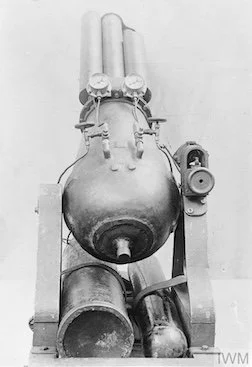
The Bellairs Gun. (or Bellairs multiple trench howitzer)
This mortar was developed by Captain A. de Mowbray Bellairs, RNVR, RM. It consisted of four barrels, 3.7-inch calibre, and although it could fire a wide variety of munitions, including the Mills bomb, each barrel holding 16, giving a total of 64 per volley with a range of about 300 yards.
However, de Mowbray Bellairs’ primary objective was to deliver saturating concentrations of chemicals onto a limited, defined target such as an enemy strong point, or machine gun position. For this purpose, special glass bombs were developed to hold Jellite, or a similar chemical agent, and fired by a mixture of acetylene and oxygen, stored in separate cylinders to be mixed in the correct proportions in the firing chamber just before ignition by means of a sparking plug in each barrel, the burning acetylene producing the gas pressure to fire the bombs without smoke and with very little noise.
The Bellairs gun was submitted to the Inventions Department of the War Office, who had no intention of sharing it with the Trench Warfare Department and sent it to the Special Brigade for evaluation. One of its members, Martin Fox, has left us a rather humorous account of their efforts,
Christmas Day (1915) was one of fine weather. There were no parades, but a party of us were detailed to assist a certain Capt. Bellairs in matters relating to an ingenious gun he had invented. It was a bulky contrivance devised to fire a number of bombs simultaneously, the propelling force being an explosive mixture of hydrogen and oxygen supplied in correct proportions from cylinders of these gases. This remarkable gun had four barrels, each of which could hold sixteen missiles of the Mills Bomb type, so that sixty-four of them could be thrown to burst in a confined area at a distance of about 300 yards. We conveyed the gun to some demonstration trenches, and man-handled it into position. Then we waited around while Bellairs discussed various problems with several officers. All this completed, we carried the gun out again and made for home.
As mere pawns in this game, we were quite content to do as we were told and leave the responsibility to others. For Christmas dinner there was a special brand of stew, with dumpling, and Daily News bulletin. Much ribald humour and jollity enlivened the feast, as vivid descriptions were bandied about of the wonderful celebrations many of us had enjoyed in pre-war days. Celebrations and estaminet drinking ended the day; some of us attended a very good sacred concert given in Béthune Theatre by occupying troops.
Two days later, we were on fatigue once more with Bellairs' gun. A longer journey this time took us to some open fields beyond Bethune. Having fixed the gun in position on a sort of firing range, we awaited the arrival of Staff Officers. They were abominably late, and so we hung around while Bellairs tested his apparatus and filled the explosion chamber with the gases removing the safety-pin from each Mills Bomb as a sergeant passed them to him, he slid sixteen bombs down each barrel and sighted the gun.
At last there was a clatter of horses and riders as a batch of Staff galloped over the field and reined near us. The General dismounted, chatted with Bellairs, and examined the gun. The others remained on horseback, moving away somewhat to witness the spectacle while at the same time feeling safer, and the General peered into the barrels.
The signal was given, and the gun went off. A shower of bombs hurtled through the air and burst on their target. We all proceeded to see what the effects had been. The result did not appear to be devastating, and the General was obviously not impressed. Mounting, he spoke briefly to Bellairs, finishing with the terse comment, "Come back when you have something which will fire half a ton". Turning away, he quickly rode off, and his staff hurriedly followed. Bellairs looked depressed at such a summary dismissal. The gun was packed up, accessories and all, and we returned to Chickory. We were never asked again to give demonstrations, and shortly afterwards "Billy Bellairs" departed with his chauffeur, fur collar and gun.[1]
[1] Martin Sidney Fox, Corporals All - With Special Brigade RE 1915-1919. (Privately published, 1965.)