Pneumatic Bomb Throwers.
By 1915, the technology of firing guns with compressed gases was well understood. The British Army had experimented with the technique in the late 19th century with the establishment of a coastal battery to protect Milford Haven, and although the guns proved to be effective and accurate, the Ordnance Board rejected the adoption of the technology on the grounds that firing shells by means of compressed gases was too cumbersome compared with the simple act of inserting a high explosive charge into a gun barrel.
There the matter appears to have rested until early 1915, when Colonel Jackson of FW3 developed, in conjunction with an industrial partner, a pneumatic trench mortar that was superior in range and accuracy to the Woolwich 3.7-inch light mortar just coming into service. Once again, this method of firing projectiles was rejected by the Ordnance Board on the grounds of complexity, and the methodology was never adopted by the British, which was in contrast to the Continental armies, where bomb throwers powered by compressed gases were standard equipment in the French, German, Austrian and Italian armies, ranging from light, portable trench mortars to ordnance akin to heavy artillery.[1]
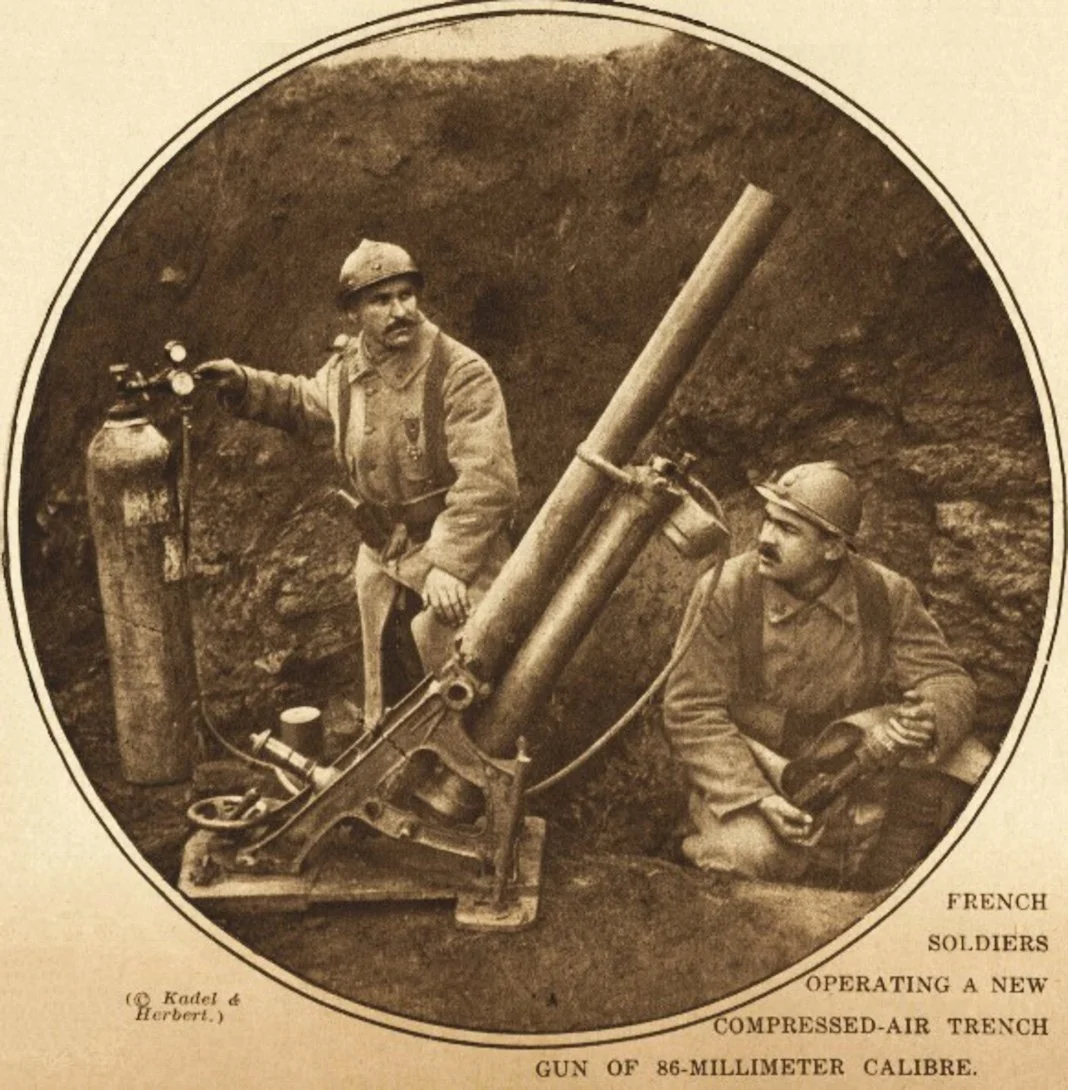
In France, the most prolific inventor and manufacturer was Edgar Brandt, the leading metalsmith of the early 20th century, who designed and manufactured some of the most beautiful architectural and decorative metalwork of the Art Deco period. He was also a prolific inventor of weapons, predominantly mortars and their ammunition and the company he created remains a major manufacturer of mortars and grenade launchers. The first trench mortars he designed were introduced in early 1915. Without its compressed air cylinder, it weighed 17 kg; its bombs were correspondingly light, about 0.65 kg, and their range could be adjusted by varying the propellant pressure between 10 and 40 psi (pounds per square inch). Each gas cylinder could fire 120-150 bombs, with a maximum range of about 600 meters. The Mark II, introduced in early 1916, was heavier, some 22 kg, following the introduction of a base plate like the Stokes 3-inch light mortar, and it fired a heavier bomb. In 1916, the French army placed an order for 3,000 of these mortars with 3 million shells. The illustration shows two French soldiers operating an 86 mm Brandt medium mortar that fired a 1.64 kg bomb up to 275 metres. The rate of fire was 10 rounds/minute, and the range was adjusted by controlling the gas pressure and the mortar barrel's elevation between 45 and 60 degrees.
French soldiers operating a new compressed-air trench gun of 86-millimetre calibre. New York Times, 17 February 1918. Library of Congress.
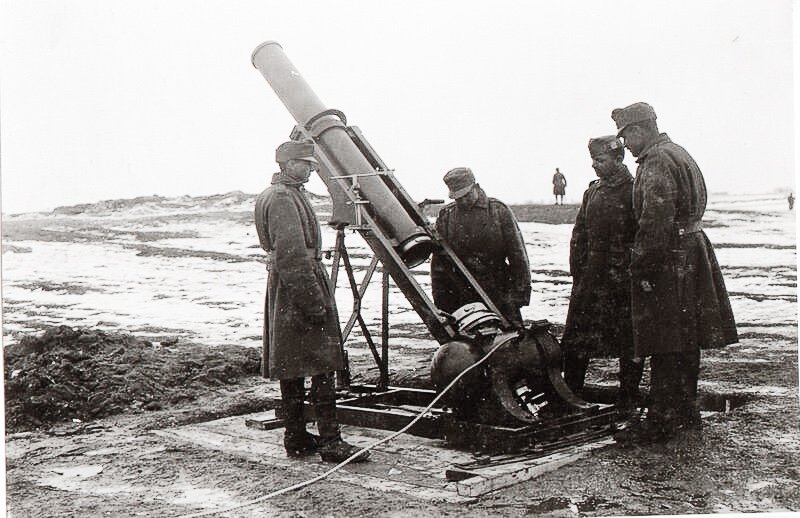
The German and Austrian armies used a variety of pneumatic mortars (Luftminenwerfer) with calibres ranging from 8 to 20 cm, mostly on the Eastern Front. One of the largest pneumatic mortars was the 20 cm Luftminenwerfer M16 operated at 800 psi and could throw its 50 lb. or 76 lb. bombs 1150 meters, but, as these mortars weighed 1600 lbs and with a crew of five, they were installed and fired from fixed positions like any other item of heavy artillery. The air canister below the breech had to be replaced after each shot, limiting the rate of fire to one every 6 minutes.
Minenwerferkurs.20 cm Luftminenwerfer. K.u.k. Kriegspressequartier, Lichtbildstelle - Wien - https://www.bildarchivaustria.at/Preview/15663313.jpg

The British may not have developed a pneumatic gun during World War I. In the Second World War, however, a civilian inventor produced one. The Royal Navy adopted it and installed it on merchant ships during 1940 and 1941 to defend against low-level attacks by enemy torpedoes and dive bombers. Morris Orman, an engineer at Holmans, a manufacturer of compressors and mining machinery based in Camborne, Cornwall, designed the device.
The Holman Projectors used steam from the ship’s boilers to fire a screen of grenades. These were not very effective at destroying aircraft, but did force enemy planes to fly higher, which impaired their attack accuracy. Over two years, 4,500 projectors were installed. In the absence of conventional anti-aircraft munitions, they were generally considered effective, with the crew of one ship even shot down two enemy planes. When grenades ran out, it is recorded that potatoes were used as a substitute.[2]
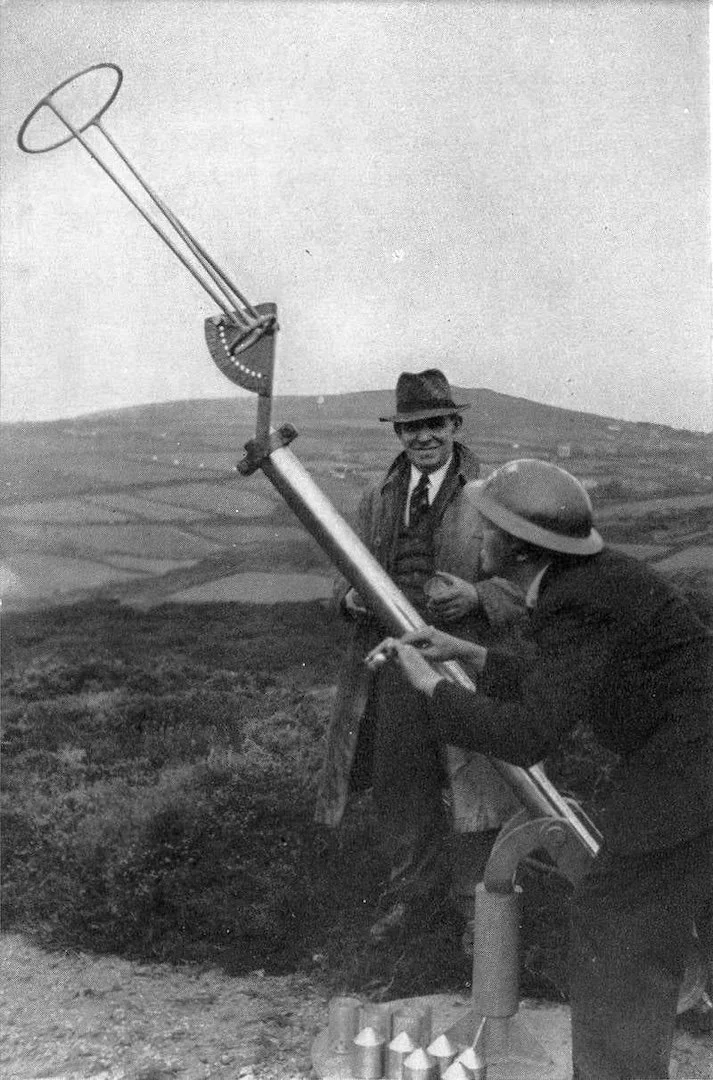
A Holman Projector prepared for early trials at Carn Brea in Cornwall. A crude anti-aircraft sight is fitted to the mortar barrel. Grenades are on a stand. Morris Oram, the designer, is firing.
[1] The size and variety of these weapons were very diverse, and I recommend the site maintained by Douglas Self to anyone who wants a more comprehensive introduction to pneumatic artillery. <http://www.douglas-self.com/MUSEUM/museum.htm> (Last accessed Feb. 2025)
[2] Holman Projector. <https://en.wikipedia.org/wiki/Holman_Projector> (last accessed Feb 2025.) Public domain.