The Memorial to Sister Margaret Mayne, ARRC 1880-1917
by
John M Sneddon & Heather Johnson.
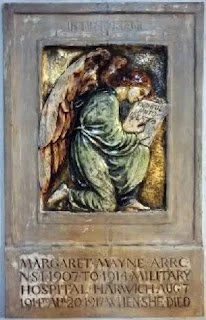
This stunning memorial commemorates the life and service of a nurse, Margaret Mayne, and this article brings together what we know about the memorial and Margaret’s life.
Margaret Mayne was born in Ballinamallard, County Fermanagh, Northern Ireland, on 21 September 1880, the fourth daughter of George Wesley Mayne and his third wife, Anna Shepherd. Margaret, known as Madge in the family, was one of six sisters and one brother. The family was Methodist, as were many others in the village, and the Chapel was central to village life. Although nothing is known of Margaret’s early life and education, at some point after 1901 she moved to England to begin training as a nurse at the North Staffordshire Infirmary in Stoke-on-Trent. This large hospital already employed many nurses and probationary nurses from Northern Ireland. By the time of the 1911 census, Margaret Mayne, aged 29, was recorded as a staff nurse at the hospital (the census lists her birthplace as Ballinamallard, County Tyrone).
On August 4th, 1914, Margaret Mayne was still a staff nurse at the North Staffordshire Infirmary. Two days later, on August 6th, she left with Matron Jane MacMaster and another staff nurse called Wilson to take up positions at the Military Hospital being established at the Great Eastern Railway Hotel in Harwich. This sequence suggests that the War Office mobilised these nurses immediately after the outbreak of war, but we have no evidence that any of the three were members of the Queen Alexandra’s Imperial Military Nursing Service Reserve or the Territorial Force Nursing Service Reserve. It is more likely they were members of the Civil Hospital Reserve, established in 1910 when the War Office asked large hospitals to keep a register of trained nurses who met the requirement of three years’ training in a hospital of at least 100 beds and who were willing to serve on mobilisation. These nurses were assured their jobs would be protected, allowing them to return to their positions after the war.
The Garrison Military Hospital, Great Eastern Railway Hotel, Harwich Quay.
An account of the hospital was given by Miss D Mathew in the hospital magazine, August 4th 1919.
At the outbreak of war in August 1914, the Admiralty and War Office requisitioned many properties in Harwich, transforming the town into a fortress against enemy attack from the sea and providing a base for Royal Naval operations. Among the buildings taken was the sizable Great Eastern Railway Hotel on the Quay. Between August 4th and 6th, volunteers worked alongside hotel staff to convert the hotel and its annexe into a military hospital. While the majority of the nursing staff, both male and female, were members of the Voluntary Aid Dispensary (V.A.D.s), the hospital was under direct War Office control. This meant that working conditions, such as shift patterns, resembled those of a regular military hospital and differed from VAD auxiliary hospitals overseen by the Joint Committee of the British Red Cross and the Order of St John. As a designated Military Hospital, it admitted wounded patients directly from France after embarkation from casualty hospitals. The hospital ran as an 80-bed unit, with capacity for up to 40 extra beds in emergencies, including an operating theatre, X-ray, and dental facilities. It was staffed by the Essex No. 33 V.A.D. Detachment (Men) and the Essex No. 84 V.A.D. Detachment (Women). Nursing Members serving in a military hospital received £20 to £30 per annum, plus food and board and a £2 10s uniform allowance every six months.
The V.A.D. nurses were supported by a small party of qualified nurses, a Matron, Miss J MacMaster, previously Matron of the North Staffordshire Infirmary, who brought with her two qualified ward sisters, Sister Mayne, who took charge of the surgical ward, and Sister Wilson, who became Theatre Sister. They were joined later by Sister Arkoll, also from Stoke, who took charge of the small wards on the top floor, and by Sister Brady from Ipswich Nursing Home, who took charge of the medical ward. To complete the qualified staff, Nurse Moore, who had almost completed her training at Guy’s Hospital, became a staff nurse, along with Mrs Walker, who had some hospital training. The medical staff in attendance were a surgeon, a physician, an anaesthetist, and a dentist.
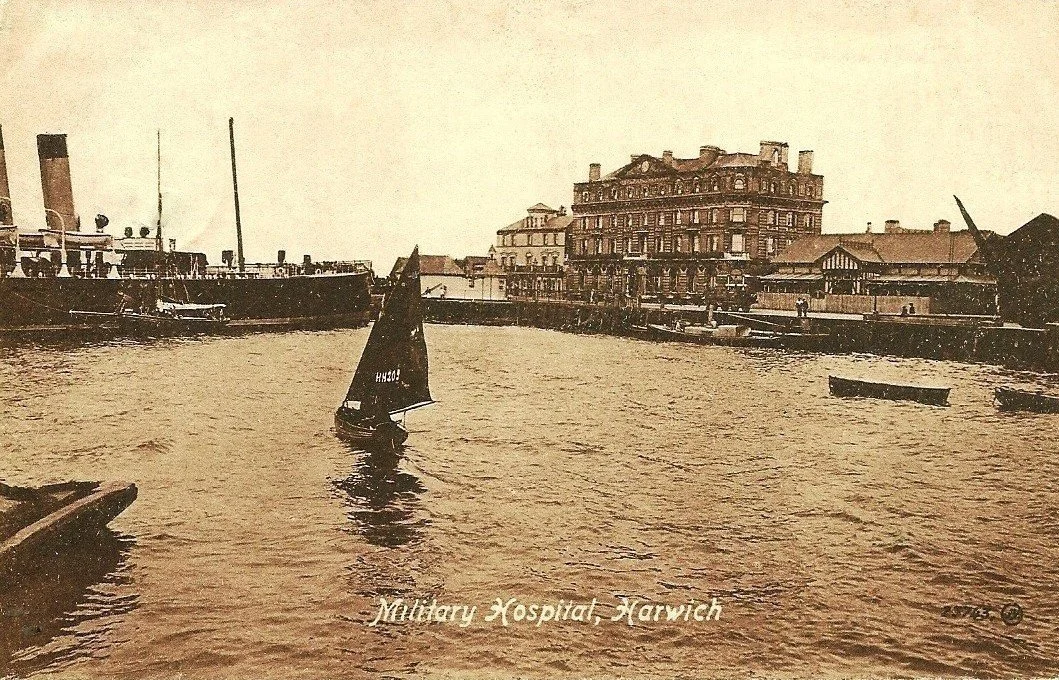
WW1 Harwich: Military Hospital: The Great Eastern Railway Hotel. Courtesy/© Heather Anne Johnson.
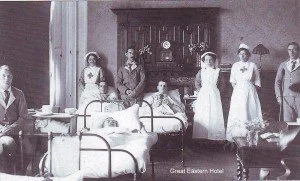
The Great Eastern Hotel Military Hospital interior, c1914. Courtesy of http://www.harwichanddovercourt.co.uk.
On 23 February 1917, The London Gazette Supplement announced that Sister Margaret Mayne had been awarded the Royal Red Cross, 2nd Class. The Royal Red Cross is a military decoration for exceptional services in nursing, created by Queen Victoria in 1883 with only a single class until a second class (Associate) was introduced in early 1917, during World War 1. The award recognises nurses from officially recognised military nursing services for continuous exceptional devotion and competence, or for singular acts of bravery and duty.
Margaret Mayne. Death and Commemoration.
Towards the end of April 1917, Marget contracted an infection, likely from a patient, and grew gravely ill with fever. On 26 April, she was admitted to Colchester Infectious Disease Hospital. She died three days later, on 29 April, of cerebrospinal meningitis. On 3 May, she was buried in the military section of Colchester Cemetery. Alongside wreaths, more than 200 bunches of primroses from Harwich Military Hospital patients formed a cross over her grave.
The Memorials. Margaret Mayne is commemorated by two impressive memorials, each a notable work of art and likely designed by the same artist.
The first is the large Celtic cross carved in granite that adorns her grave, making it stand out from the surrounding graves.
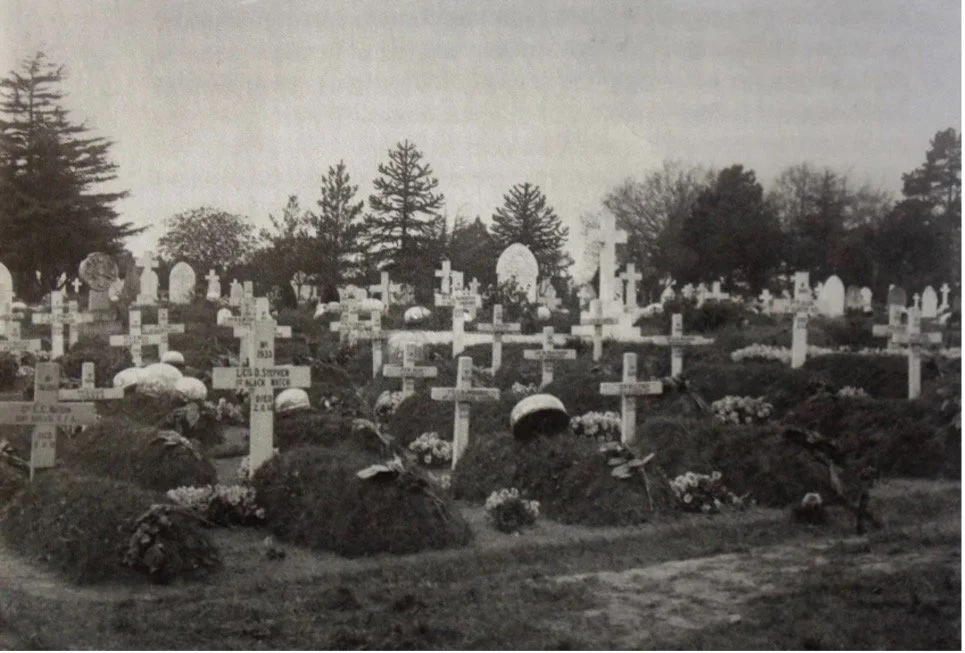
The Mayne Celtic Cross (back, left). Military Section, Colchester Cemetery, c1919. Courtesy/© of Jess Jephcott.
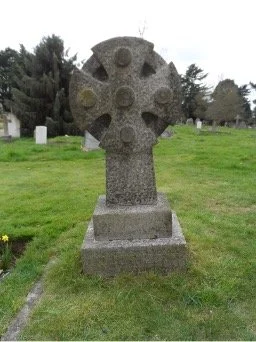
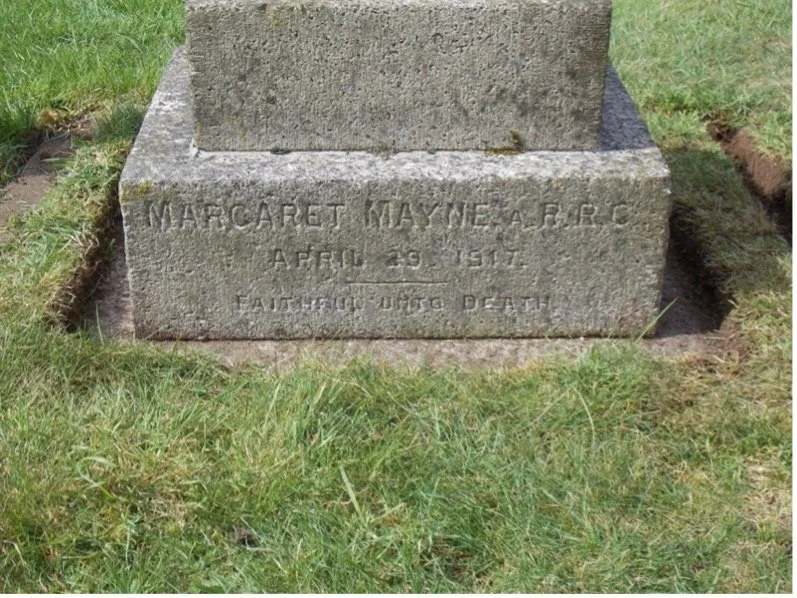
Margaret Mayne’s Grave. Colchester Cemetery. Plot S 2 15.
The second memorial to Margaret Mayne was on the wall to the right of the Altar in the demolished chapel of the redundant North Staffordshire Royal Hospital (It has been relocated to the first floor in the atrium of the Royal Stoke University Hospital).
It is in the form of a bas-relief plaster plaque depicting an angel inscribing the quotation “Faithful unto Death” on a page. Below the image of the angel is the inscription:
Margaret Mayne ARRC NSI 1907 to 1914. Military
Hospital Harwich, Aug 7 1914, to April 20 1917
When she died.
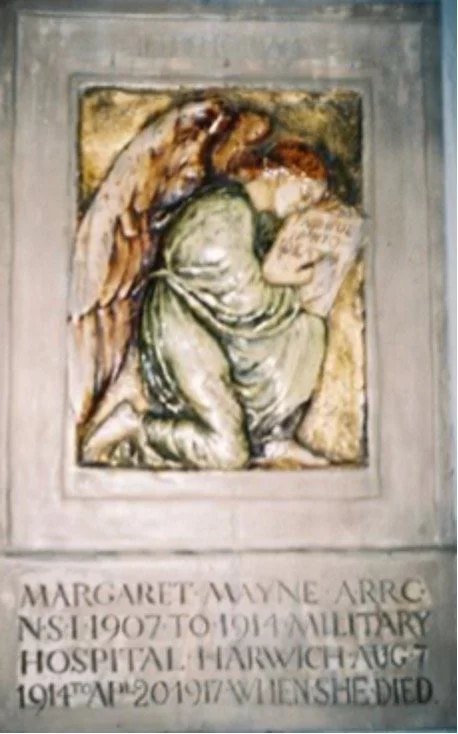
The Plaque is signed E M Rope.
This is Ellen Mary Rope (1855-1934), a significant female sculptor whose professional output was chiefly in bas-reliefs, predominantly in stone, cast metals, plaster and designs for pottery. Her sculpture particularly focuses on children, mythological scenes and religious subjects.
Ellen Mary Rope was born on 14 March 1855, the seventh of nine children born to George and Ann Rope of Grove Farm, Blaxhall, Suffolk. Ellen started her formal artistic training at the all-girls Nottingham Place School, Marylebone, in London, where she was taught drawing by the philanthropist and social reformer, Octavia Hill (1838-1912), herself a pupil of John Ruskin. She returned to Suffolk to study at the Ipswich School of Art, where she exhibited paintings and drawings alongside her brother, George Thomas. In 1877, she enrolled in the Slade School of Art, initially to study painting and drawing, but from 1880 onwards, sculpture and modelling under Professor Alphonse Legros.
She left the Slade in 1884 and worked as an illustrator and painter, but continued to model in clay, and in 1885 the Royal Academy accepted three low-relief terracottas. This was the turning point in her artistic career, bringing important recognition as a sculptor and leading to many commissions from architects who sought to incorporate her bas-reliefs into their buildings. Her most significant architectural commission was for the design of four spandrels for the Woman’s Building at the Chicago 1893 World Columbian Exposition.
From 1886 to its closure in 1906, Rope was an important designer for the Robbia pottery in Birkenhead and exhibited annually at the Arts & Crafts Exhibition Society from 1889. There are many significant family memorials in churches and cathedrals by her and, from 1917 to the 1920s, she undertook many commissions for war memorials, those for individuals usually featuring an angel motive as in the memorial to Margaret Mayne
She retired to Blaxhall and died there on 13 September 1934.
Ellen Rope was a significant artist to her contemporaries, but since her death, interest in her work has waxed and waned. In recent years, there has been a significant revival of interest in her work and that of other female sculptors of the late Victorian Period. She is well represented in museums and art galleries in Britain and abroad.
Who commissioned the memorial is unknown. Our best guess is that it was commissioned by Matron Jane MacMaster.