The 8th Division. (Chap.1 Pt.5)
Hastily assembled from battalions withdrawn from Colonial Stations, the 8th Division was hustled across to France in November 1914, destined to relieve the Indian Corps on the northern section of their line from north of Éstaires to Neuve Chapelle. Its advanced units liaised with the Indian Corps to understand the nature of the sector and absorbed some of the characteristics of trench fighting. The first order issued by the Division Commander, Royal Engineers, was to purchase all the mirrors in the area to convert them into trench periscopes.
The Bomb Factory.
The Divisional Engineers took over the billeting area and workshops of the Sappers and Miners at Nau Monde, where they were instructed in the techniques of grenade manufacture. On 29 November, the War Diary of the 2nd Field Company noted that they had established a bomb factory and had produced their first 50 Indian Pattern hand grenades. In common with other Divisional workshops, the bomb factory became the primary source of gadgets required for trench fighting, such as periscopes, rifle rests, range blocks for rifle grenades, and machine-gun mounts. To meet these various demands, the Divisional Engineers were, in the middle of December, given funding to employ civilian labour and to order the manufacture of trench furniture, such as storage boxes, duckboards, and even tables and stools for the larger dugouts, from local manufacturers.
It had several research programmes developing and testing new gadgets for use in the trenches or modifying existing equipment to make it more effective. In December 1914, they became engrossed in trying to improve the No. 1 Service grenade by replacing the throwing handle and canvas streamers with a fishtail made of zinc sheeting to be able to throw like a dart in the belief that this would make it safer to throw from a trench. After many fruitless trials, Lieutenant Calverswell succeeded in developing a method of throwing that guaranteed the grenade landing on the detonator, but, as the level of skill required to do this regularly was probably beyond the average infantryman, the project was abandoned. [1]
Trench Mortars.
The 8th Division was introduced to trench mortars not by the Sappers and Miners, as one may have expected, but by the French. On 25 November, the Commander, Royal Artillery, was informed that he was about to receive two trench mortars from Paris along with a ration of ammunition, which he allocated to the 5th Brigade, Royal Horse Artillery. No description of these mortars exists, but the 5th Brigade War Diary records that Captain Grosvenor now had command of two trench mortars sent from Paris, dated 1810, which he was using to hurl bombs at the enemy trenches with variable results. [2] Given a date of 1810 these were most likely Coehorn pattern mortars, referred to as Toby mortars by the troops of the BEF after Lieutenant-Colonel A Rawlinson, the officer who first suggested their use. [3] By the middle of January Grosvenor’s trench mortar section was exceptionally well equipped for the time having, in addition to the Toby mortars, two Woolwich produced 3.7-inch trench howitzers and a 4-inch light mortar.
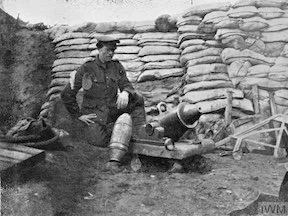
Soldier of the Oxfordshire and Buckinghamshire Light Infantry with an ancient trench mortar ('Toby' mortar) in a sandbagged trench. Image: IWM (Q 52982S)
Vignette: Trials and Tribulations of Captain Grosvenor’s trench mortar section.
On the extreme right of the Division’s line, a pronounced salient jutted towards the German lines in front of Neuve Chapelle, known as Port Arthur. This was a very active part of the line, with many ruined houses on the German side concealing snipers and machine guns. On 5 January, Captain Grosvenor moved two mortars into the salient to deal with some of these buildings. Mounting one of his guns on the parapet, he demolished, at 40 yards range, a house known as Snipers House, a feat considered notable enough for him to receive a note of congratulations from Divisional HQ. On the 8th, he demolished another house believed by the infantry to harbour a machine gun before moving along the line to deal with a cluster of houses that the infantry wanted destroyed.
All movement had to take place at night, for enemy snipers dominated the British positions. The mud at the base of the breastworks through which they moved varied in depth from a few inches to almost up to their knees, and great care was taken to keep hands as clean as possible, as the mud had a particular sticky quality and could render weapons inoperable. Sloshing along between the sandbag walls in the darkness to their new position, Captain Grosvenor lost one of the mortars when the man carrying it missed his step on a slippery plank while crossing a ditch and fell in. Leaving the mortar to be recovered later, the team, after a frustrating struggle through the trenches, managed to get the remaining mortar in position. However, it was now so coated in mud that the firing tube would not fit properly into the vent, nor would the bomb slide down the barrel. In the dark, it was impossible to clean the mortar or the bombs thoroughly, and as a ranging shot barely cleared the parapet, the shoot was abandoned.
The Archibald.
The 8th Division developed its own trench mortar, although a grenade thrower is a more accurate description of its function. The War Diary of the Commander, Royal Engineers for 16 December 1914, records that a gun for throwing grenades, invented by Captain Pears RE, was proving highly successful in dealing with enemy working parties and saps at distances of up to 200 yards. By February 1915, the Division had fourteen Archibalds, ten of which were in action, and four held in the bomb factory as reserves. These little grenade throwers were christened Archibald and were infantry weapons and not incorporated into Captain Grosvenor’s mortar battery.
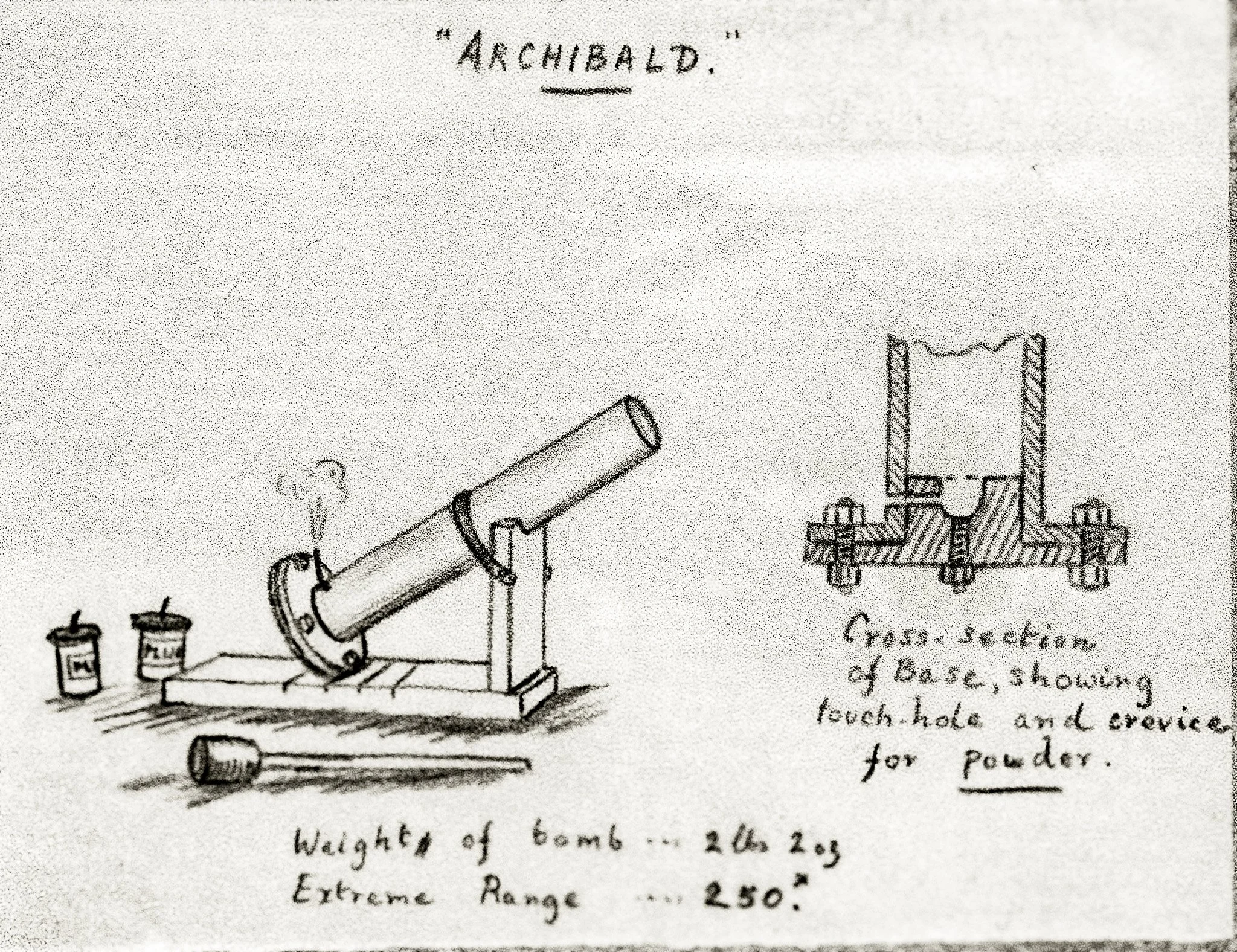
Made from cast-iron drainpipe, about two feet long and closed at one end with a plate bolted onto a flange at the base of the pipe. A touchhole was drilled through the pipe just above the flange, allowing the fuse to be pushed into a slight depression containing the propellant charge of black powder with the range adjusted by altering the angle of the tube by moving it so the edge of the flange engaged with a series of grooves cut into the wooden base and, depending upon the groove chosen, the range was read off a range table previously determined for each gun. They fired modified jam pot grenades to a maximum distance of about 250 yards with an acceptable degree of accuracy. [4]
These weapons saw action in the Battle of Neuve Chapelle, 11-13 March.

What appears to be Archibalds in action. A Bomb Gun Section, 1st Seaforth Highlanders. Girdwood Collection. The British Library, photo No.24
1] TNA: WO95/1683: 8th Division HQ. War Diary, Commander, Royal Artillery. Entry 27 December 1914.
[2] TNA: WO95/1693: 8th Divisional Troops. 5th Brigade, Royal Horse Artillery. War Diary, Entry 7 December.
[3] Official History 1915 (i) p. 8. Not Lieutenant-General Sir H.S. Rawlinson, Bt. as sometimes assumed.
[4] TNA: WO95/1723: 8th Division. 1st Battalion Worcester Regiment. War Diary. Entry 31 December 1914.