Chapter 3. Part 1 Gallipoli. Introduction.
Introduction.
From its very beginning, the ill-fated Gallipoli campaign was poorly equipped with troops and the materiél required to conduct a successful operation, a situation that persisted throughout the campaign, as waging war in the Eastern Mediterranean was anathema to many senior staff in the BEF and War Office. They believed that the best way to win the war was to defeat the main German army, so their priority was to maintain the supply of equipment and men to the major Theatre of Operations in France. As a result, Sir Ian Hamilton's Mediterranean Expeditionary Force remained at the bottom of the pile when it came to the War Office allocating resources between it, the BEF, and the New Armies forming in Britain and destined for the Continent.
Beginnings.
We will start our Gallipoli journey on the morning of 18 March 1915. Sir Ian Hamilton, aboard HMS Phaeton, left Lemnos for his first reconnaissance of the western shore. What he saw was not good. Almost a month had passed since the Royal Navy bombarded the Turkish forts on the western shore of the Bosphorus, which signalled to Ottoman troops and their German advisors the Allies' interest in the Dardanelles Straits. Throughout that month, the Navy kept their ships in close, observing the Turks, who worked steadily to build increasingly complex coastal defences.[1] General Hamilton, also sailing as close as he dared, noted that there were few possible landing places. Where landing was possible, the beaches were too small for his entire force. Ottoman troops had fortified the forward slopes of the overhanging hills with trenches and belts of new, un-rusted wire glinting in the sun.
Hamilton, an experienced commander with a long active service career, clearly understood the dangers faced by infantry attacking entrenched enemies without fire support from howitzers, trench mortars, and grenades. He recorded these concerns in his Gallipoli Diary,
Have cabled home begging for more engineers, a lot of hand grenades, trench mortars, periscopes and tools. The barbed wire bothers me! I am especially keen about trench mortars; if it comes to close fighting on the Peninsula, with its restricted area, trench mortars may make up for our lack of artillery, especially howitzers. Luckily, they can be turned out quickly.[2]
Sir Ian Hamilton first requested grenades from the War Office on the evening of his initial reconnaissance but received no reply. He repeated his request several times in March and April while his troops prepared in Egypt. Discouraged by the War Office's evasive responses, he turned to local resources, contacting military commanders in Malta and Egypt for help.[3]
Glad I did not lose a minute after seeing the ground in asking Maxwell[4] and Methuen[5] to make some trench mortars. Methuen says he can't help, but Maxwell's Ordnance people have already fixed up a sample or two – rough things, but better than nothing. We have too little shrapnel to spare any for cutting entanglements. Trench mortars may help where the Fleet can't bring their guns to bear. The thought of all that barbed wire tucked away into the folds in the ground by the shore follows me about like my shadow.[6]
As a result, the Mediterranean Expeditionary Force relied almost entirely on improvised weapons to conduct trench warfare during the Gallipoli campaign.
Trench Fighting on Gallipoli.
The Gallipoli landings took place on 25 April. The landing forces at ANZAC and Cape Helles fought hard to widen their bridgeheads by driving Ottoman troops from their trenches and strongpoints. Because they lacked training and specialised weapons, no breakthrough happened. After several days, the fighting settled as the Allies dug trenches to avoid being pushed back into the sea.
Trench warfare on the Gallipoli Peninsula was both similar to and different from that on the Western Front. Information on troop training and the implementation of tactics was derived from the pamphlets and other documents issued by the War Office for troops in France. However, these materials were modified as necessary to accommodate local conditions. In addition, personal correspondence with serving officers in France supplemented this information. Nonetheless, such correspondence was limited, as most battalions on Gallipoli were Territorial or New Army formations that lacked the contacts and networks found in the professional army.
The Landscape.
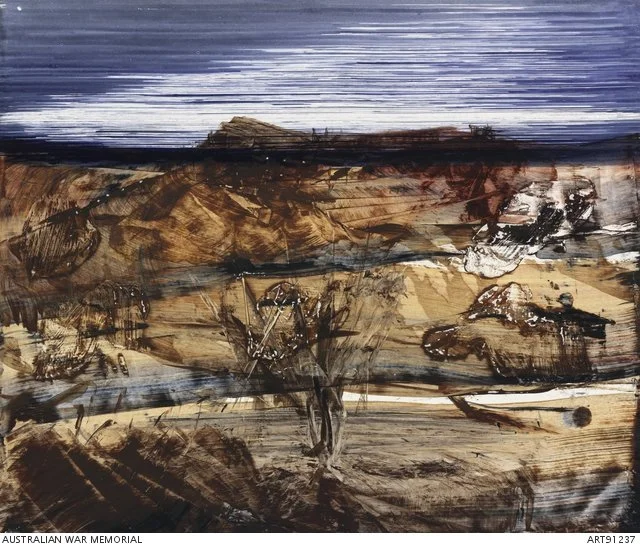
Sydney Nolan. Gallipoli Landscape. Copyright Australian War Memorial.
The defining characteristic of trench warfare on the Gallipoli peninsula was its rugged, inhospitable terrain. Much of the coastline, especially at Anzac Cove, has near-vertical cliffs and high ridges, some reaching 300 meters. Inland, steep ravines and gullies like Shrapnel Valley and Monash Valley provided limited, dangerous cover for troops. Thick, thorny shrubs and stunted gorse covered the ground, hindering movement in battle. Thin, rocky soil made digging trenches difficult for both attackers and defenders. The Allies aimed to capture high points such as ridges and plateaus (e.g., 400 Plateau and Lone Pine). The difficult terrain favoured defence. Ottoman forces, familiar with the land, turned the landscape into a brutal war of attrition in complex trench lines. Areas like Quinn's Post became infamous "killing zones," with opposite trenches only yards apart, well within grenade-throwing distance.
While most accounts of the Gallipoli campaign focused on the landings and the unsuccessful Allied offensives, the more common experience of the troops, both at ANZAC and Cape Helles, was the daily grind of attritional trench warfare. Artillery, because of the shortage of guns and the difficulties in maintaining an adequate supply of ammunition made a smaller contribution to the nature of trench fighting than it did on the Western Front so, on the peninsula, given the nature of the terrain and the relative closeness of the trenches, trench fighting involved more soldier to soldier contact where the principle weapons were rifles and hand grenades. On the British side, frontline commanders were expected to submit frequent reports on the "minor enterprises" they had conducted against the enemy, and, generally, these involved the classic tactics of siege warfare, sapping towards, and then attacking the enemy's positions and driving him from his trenches, one trench at a time.
The process was to dig a number of saps, ten feet or so apart, out towards the enemy position until close enough to throw hand grenades, at which point the sap head was converted into a bombing station holding a garrison of two men, a skilled thrower and a damper, whose responsibility was to keep the thrower supplied with grenades and to smother, with a sandbag one third filled with earth, any enemy grenades that fell into their sap, a tactic only effective against the low powered grenades with external fuses commonly used by both sides. Once the continuous grenade throwing had degraded the enemy garrison in their front line, they were suddenly rushed by a party of infantry, and the captured section of the enemy immediately put into a state of defence. Once connected to the saps, the captured section of trench served as the base for clearing the remainder of the enemy trench, and once consolidated, it became the new front line, with the process repeated against the next line of enemy trenches.
[1] C. F. Aspinall-Oglander, Military Operations. Gallipoli Vol . 1. p 94. (Uckfield: The Naval & Military Press. Ltd. nd.)
[2] Ian Hamilton, Gallipoli Diary. Vol 1. (London: Edward Arnold, 1920), p. 48
[3] ditto
[4] General Sir John Grenfell Maxwell, General Officer Commanding British troops in Egypt.
[5] General Paul Sanford Methuen, 3rd Baron Methuen. Governor and Commander-in-Chief, Malta.
[6] Gallipoli Diary. Vol. 1, p. 73