British Flame Projectors’ Use During the Battle of the Somme.
4.And Samson went and caught three hundred foxes, and took firebrands, and turned tail to tail, and put a firebrand in the midst between two tails.
5.And when he had set the brands on fire, he let them go into the standing corn of the Philistines, and burnt up both the shocks, and also the standing corn, with the vineyards and olives.
Book of Judges. 15. vers. 4&5.[1]
[1] < https://www.bibleserver.com/text/KJV/Judges15 > (Last accessed October 2018)
Background.
After the Battle of Loos, the War Office decided to increase its commitment to chemical warfare and approved the expansion of the Special Companies into the Special Brigade, consisting of 21 Companies, 16 of which dealt with cylinder release of chlorine and other gases, four responsible for the one hundred and ninety-two 4-inch Stokes mortars, and the remaining Company of four special sections, Z Company which, unlike the other companies in which many of the officers and men had chemical knowledge, was predominately composed of individuals with engineering experience. It was commanded by Captain William Howard Livens.[1] Z Company maintained a very close relationship with the Trench Warfare Department in the Ministry of Munitions in developing and improving the equipment that was essential to the functioning of the Special Brigade, and officers from its chemical warfare research staff were frequently seconded to Z Company to collaborate on projects that had support from the Ministry of Munitions. Z Compant was also unique in the Special Brigade in that it had workshop facilities necessary for the Special Brigade’s equipment and provided Livens with the resources to develop his inventions, including the flame projectors. In December 1915, Levins accompanied Major-General C.H. Foulkes, O.C. Special Brigade, to a demonstration of the Trench Warfare Department’s experimental flame projectors at the Wembley Experimental Ground. When Foulkes expressed interest in the Vincent machine, Livens said he could develop a superior machine and persuaded Foulkes to allocate £450 to develop a large flame projector of his own design.
[1] William Howard Livens (1889-1964) was the son of Frederick Livens, Chief Engineer and later Chairman of Ruston and Hornsbury of Lincoln, a major manufacturer of a wide range of machinery, including traction engines, boilers, and steam-powered excavators. William Livens attended Oundle School, where he was a sergeant in the Officers Training Corps (OTC) and, in 1908, went up to Christ’s College, Cambridge to study engineering, again serving in the OTC. He was an exceptional shot with a rifle and pistol and the Captain of the University of Cambridge Rifle Team. At the outbreak of war, he was commissioned into the Royal Engineers in September 1914 and posted to the Royal School of Military Engineering at Chatham, where he was primarily employed on administrative duties. In his spare time, he experimented with designing weapons for trench warfare, including flamethrowers and a simple trench mortar. He was one of the first officers recruited by General Louis Jackson, Director-General of the Trench Warfare Department for the initial Special Company.
[2] Donald Richter, Chemical Soldiers. British Gas Warfare in World War One (London: Leo Cooper, 1994), p.150
[3] This raises an intriguing question not answered in the accounts of the battle. Each projector was only fired once so were the projectors assemble underground without the “header” tanks containing the reservoir of oil? This would make assembling underground easier.
[4] TNA WO95/122/6: General Headquarters Troops. Special Brigade. Special Section RE; TNA MUN5/385/1650/6: Captain P. S. Hay, History of the Supply of Flame Projectors. June 1915-March 1918 and Donald Ritcher, Chemical Soldiers, Leo Cooper, London 1992 pp. 148-158.
[5] In the War Diary, the large projectors are referred to as flamenwerfer to distinguish them from the semi-portable machines.
[6] TNA: WO95/406/1. None of these events is recorded in the War Diary of the 183rd Tunnelling Company R.E.
[7] TNA: MUN5/385/1650/6: Captain Hay
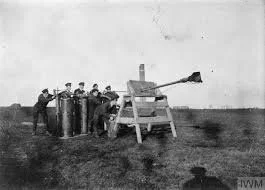
Demonstration of the Vincent flamethrower that was used by HMS Vindictive during the Zeebrugge raid. Q64463 Imperial War Museum.
Livens proposed to work independently of the Trench Warfare Department, collaborating with his father on the design and using the resources of Rushton and Hornsbury for engineering work that Z Company’s workshops could not undertake, an arrangement that put Foulkes in a rather delicate situation,
It was a somewhat delicate matter, and I arranged that he should be given a free hand from the Trench Warfare Department in order to employ himself upon the production of the Flammenwerfer, which he had suggested to me.[2]
Although the collaboration with his father continued and proved very successful, Livens’ independence from the Trench Warfare Research Department was short-lived, as his project relied on their experience with the Menchen and Vincent machines and Livens’ proposal became a tri-patriate project with the Trench Warfare Department providing the funding as well as expertise.
Based on the ranges obtained with the Vincent machines, Livens recognised the impossibility of operating a large flame projector, with a maximum range of about 100 yards, close to enemy positions unless completely protected. He believed this could be achieved by placing the Projector underground, setting himself the challenge of designing a machine that could operate from an underground gallery 10 to 20 feet below ground.
The principles of the machine were relatively straightforward, incorporating many of the successful features of the Menchen and Vincent designs; his greatest challenges were engineering. How to create a machine weighing about two tons that could be assembled in its underground gallery from many individual components bolted together in sequence in a narrow tunnel in near darkness, with no single component so heavy that it could not be carried and manoeuvred in a confined space by one man. Livens collaborated with his father to solve this massive engineering challenge.
In its final form, the Livens Large Gallery Projector consisted of a firing pipe constructed from seven short lengths of 9-inch diameter steel piping bolted together to form a continuous pipe laid horizontally along the floor of the underground gallery. This held about 80 gallons of the oil mixture. Above were five additional steel tanks, connected to the firing pipe by short lengths of steel tubing fitted with valves and filled with oil to form a reservoir for recharging the firing pipe. This allowed the Projector to fire a second, or even a third, shot, all within four minutes, significantly adding to the enemy’s surprise and shock.[3] Unlike other flame projectors, in which the compressed gas required for discharge was in direct contact with the oil mixture, the oil was driven out of the firing pipe under pressure by an ingenious piston arrangement invented by Livens Senior. This separated the oil from the compressed gas stored in high-pressure cylinders at the rear of the discharge pipe.
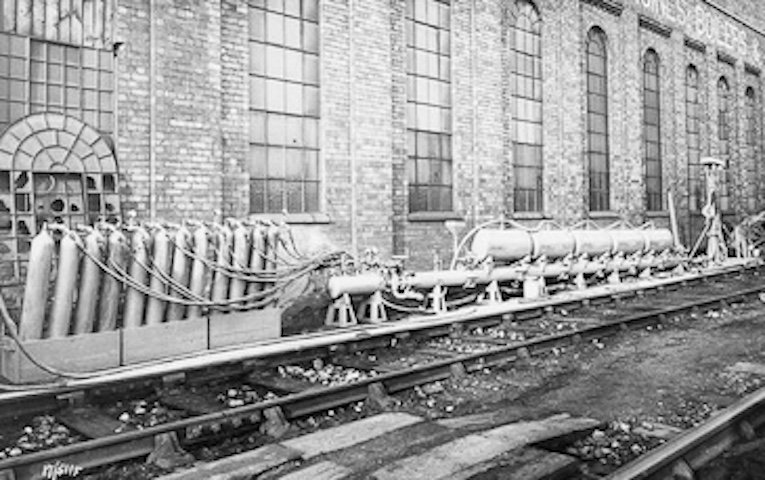
The Livens Large Gallery Projector. National Archives MUN5/385/1650/2
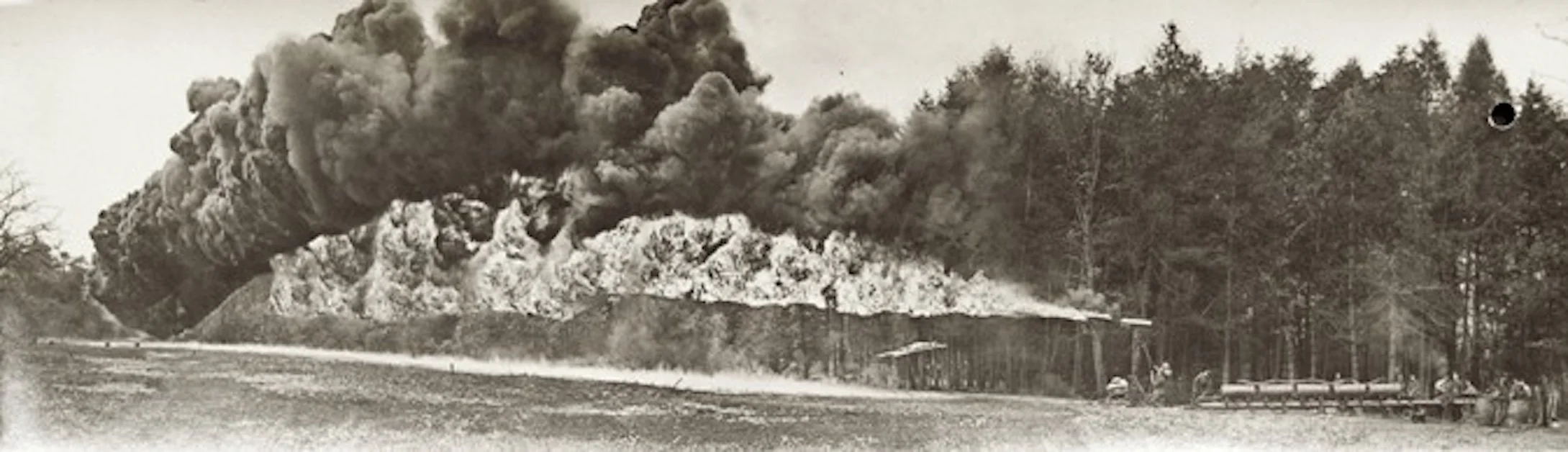
Demonstration of Livens Projector. Trench Warfare Department Test Ground Wembley. National Archives MUN5/385/1650/2
The Livens Large Gallery Projector held 250 gallons of a mixture of petrol and heavy oil. When ready to fire, the valves to the gas cylinder were opened, driving the piston forward to compress the oil, and the hydraulic pressure raised the firing monitor up its vertical shaft, breaking through the surface to reach a height of about several feet. The nozzle facing the enemy was opened, and the oil ignited, projecting about 100 yards into the enemy position. Each shot took 20 to 30 seconds, using up all 80 gallons in the discharge tube. As the oil pressure fell towards the end, the Monitor collapsed back into its shaft, ready for the next shot. However, this was rarely attempted due to the lack of suitable secondary targets within range.
From July to October 1916, the large flame projectors, mainly the Livens type, but on occasion the Livens semi-portable type, were fired on fourteen occasions, but even before the last discharge, they were redundant, superseded by a more straightforward and cheaper weapon, another invention of Captain Livens, his oil drum mortar or Projector.
The Employment of Large Flame Projectors on the Somme 1916.
The Livens Large Gallery Type were employed on the first day of the Battle of the Somme, July 1st, 1916, an event that has almost attained legendary status in British mythology about the battle.
They, and the semi-portable projectors, were employed on several other occasions throughout the battle, but it is difficult to unravel how many, and which types of projectors were used on each occasion, as the unit War Diaries, where entries exist, are brief and uninformative, while other accounts, both official and personal, some dating many years after the events described, are often partisan and contradictory. The analysis of the validity of such reports is outside the remit of this article, but it is helpful to know something about how these large flame projectors were employed in battle. What follows is a generalised account to give a flavour of events, and not a definitive history of each firing.[4]
The deployment of smoke and gas by the troops of the Special Brigade were integral to the detailed planning of General Rawlinson’s Fourth Army offensive on the Somme in the summer of 1916, but there is nothing to suggest the deployment of flame projectors figured in the planning until Lieutenant-Colonel Foulkes, always extolling the tactical merits of his Special Brigade, suggested that their new experimental weapon, the large flame projector, could be added to the mix, albeit in a minor role. In the month leading up to the Battle, Livens and the men of Z Company were still experimenting with their Large Gallery Projector, either at the Trench Warfare Research Department’s ground at Wembley or the more secure location of Hatfield Park, where the development of the tank was also taking place. It was not until June 24th, a week before the start of the battle, that the sappers of Z Company, with four large and 24 semi-portable flame projectors, all designed by Livens, travelled from Southampton for Le Harve, then by train to Corbie, sixteen miles from the front in the Fourth Army area. Here they established their main Depot, followed by a forward Depot at Bronfay Farm, near Bray-sur-Somme.
With less than a week before the offensive was due to start, their choice of targets was limited to those already in range of the shallow tunnels (Russian Saps) driven into No Mans Land by the 183 Tunnelling Company to assist the infantry in their assault. To set up the flame projectors, the men of Z Company were divided into three sections.
I. Install one large flamenwerfer for 7th Division, XV Corps.[5]
II. Two flamenwerfer for XIII Corps.
III. Divided into small detachments with semi-portable projectors for X, VIII and XV Corps Fronts.
June 27. Section I,
Bronfray Farm, 10 am-8 pm. Sorting and loading one large flamenwerfer onto three 3-ton lorries supplied by XV Corps. Completed supplies of oil and compressed gases.
8:00 pm, the convoy moved off, Lieut. Bansall and one section are proceeding with it.
9:00 pm. Meet 10 G.S. wagons and transfer.
10:00 pm proceed towards Ludgate Circus via Waterloo Junction
11:00 pm arrived behind Ludgate Circus; continuing by road proved impossible for transport, and we unloaded there. Delay in bringing the infantry carrying party, 200 strong (8/Devons 20 Inf. Bde) from the rendezvous at Ludgate Circus.
June 28th. 2 am. Long and heavily loaded carrying parties of RE and Devons moved slowly through Communication Trenches, collided with a party of Pioneers with picks & shovels in 71 Street. Heavy hostile bombardment of trenches occurred at this point. Parts of flamenwerfer dropped & men took cover.
5am. Most important parts of the flamenwerfer collected & placed in Sap 14: this was done chiefly by the small R E Party, who worked exceedingly well.
6 am. A heavy shell sealed off the end of Sap for 20 ft, burying the projector and damaging it beyond repair.[6]
Noon. The party withdrew through the deep gallery. Circumstances reported to C.O. of Devons and B.M. 20th Inf. Brigade. No casualties. Returned to billets.
Section II.
They were to have slightly better luck with the other projectors. The site chosen was in front of the 18th Division, where the width of No Mans Land was about 200 yards and penetrated by numerous shallow Russian Saps, all about 10 feet underground. It was the existence of these galleries, rather than gaining any significant local tactical advantage, that determined where the Large Gallery Projectors were to be employed. Three galleries, Nos. 7, 10, and 13, were identified by the mining company as suitable.
Two were astride the Carnoy-Montauban road and penetrated 160 and 175 yards into No Mans Land, while the third (No13) stopped 60 yards from an enemy strong point known as Casino Point. An important factor in selecting these saps was that the headroom was just sufficient for the men to assemble the projectors, an arduous task accomplished with incredible difficulty. Components for three projectors were transported to the saps on the 27th and assembled on the surface in the correct order, before manoeuvring along the narrow galleries with minimal free headroom to be bolted together. On June 28th, No. 13 sap was blown in during a heavy bombardment and was abandoned. On the 29th, No. 10 sap was blown in, but upon clearing the debris, there was only slight damage to the minenwerfer. The same thing occurred to No. 7 sap on the 30th. During the night of June 30/July 1, the monitors of both machines were pushed to the surface, and their associated machine gun positions were cleared for action.
At 7.15 am on July 1, both minenwerfers fired a single shot, the flames reaching well over the enemy trenches. At 7.30 am, the infantry attacked, suffering few casualties in the areas blasted by the minenwerfers. After that attack, 2/Lieutenant Stewart went forward to assess the damage. He found a few charred bodies and rounded up about 50 enemy prisoners. He then set about setting up an aid post and started to collect the wounded, all under heavy enemy fire. For these acts of bravery, his Company Commander recommended him for the Victoria Cross, which was not awarded.
Section III.
Small detachments took semi-portable flame projectors to the various parts of the line. None were ever brought into action, as it was found impossible to negotiate trenches with these weapons because they were too heavy.
After July 1. The next planned deployment was the capture of High Wood, planned for August 18th. Two Livens projectors were assembled in open saps. Both were severely damaged by enemy artillery fire and abandoned before the attack. However, sufficient usable components were salvaged to rebuild a single machine to support an attack on the Leipzig Salient planned for the 21st, but on the morning of the attack, the infantry decided that the position was so lightly held that they could capture it without the Projector's help. It was dismantled and returned to the advanced Depot at Bronfay Farm.
In the meantime, several replacement projectors arrived from England and on August 28th, one of these was assembled in Arrowhead Copse, southwest of Guillemont, and fired successfully on September 3rd. On the same day, three Livens and one entered action to support yet another attack on High Wood, and, as the infantry attack failed to clear the wood, the machines that had survived were refilled and fired again at the start of the assault on September 8th.
Captain Hay’s history of the large flame projectors prepared for the Historical Section of the Ministry of Munitions states that 24 Livens Large Gallery Type were sent out to France during July 1916, and later, the equivalent of 10 more were sent out as spares, numbers that are difficult to reconcile with the surviving reports of the number fired. This may suggest that many were damaged or destroyed before coming into action, or the machines were never used but stored at the Depot, as insufficient targets and locations were identified to justify the labour required to bring a Livens Large Gallery machine into action.[7] The last occasion the large flame projectors were used in anger was on October 5th, when both Livens and Vincent projectors were installed in French trenches at Neuport, where they were fired, in conjunction with a gas attack also mounted by the Special Brigade, in support of a combined French and Belgian attack.
The British army was not the only one interested in the Livens Large Gallery Projector. The Russian Government ordered 50, and Rushton, Proctor & Co. were given special authorisation by the War Office to deal directly with the Russians and succeeded in delivering all 50 machines towards the end of 1916.