Mesopotamia Siege of Kut. Extemporised Trench Warfare Weapons.
The production and use of extemporised munitions during the campaigns in Mesopotamia and Palestine have yet to be researched in detail. In this respect Mesopotamia would be of particular interest for it was mainly an Indian Army effort, with the Government of India supplying most troops, munitions and other necessities. There is no reason to assume that the Field Companies of Sappers and Miners supporting the infantry were less inventive than their colleagues on the Western Front, except that they were fighting in a pre-industrial country where materials of any sort would be almost impossible to obtain as illustrated by the achievements of the Sappers and Miners during the siege of Kut,[1]
Hand grenades were very scarce in Kut, and here the Turks had a great advantage over us. We could not afford to expend a great number of grenades, as it was necessary to retain a large reserve to repel possible assaults. The R.E. Field Park in Kut rose nobly to the occasion and kept the fort supplied with the most efficient improvised grenades of the "jam pot" variety as well as the McClintock pattern (all manufactured in the workshops behind the DEC's house); whilst Lieutenant F. Mayo, of the Sirmoor Sappers, made twenty or thirty bombs daily at the fort from old jam tins charged with gun cotton primers and Turkish shrapnel bullets picked up within the fort, and these were found to be excellent missiles at short range. The R.E. Field Park also sent out two wooden wire-bound guns to the fort, and others elsewhere to our trenches, and very extraordinary weapons they looked. They were soon given up, however, as they were liable to burst, yet the two wooden guns sent to the fort effectively checked all work by day in the nearest enemy saps when operated by two properly trained bomb-gun parties.
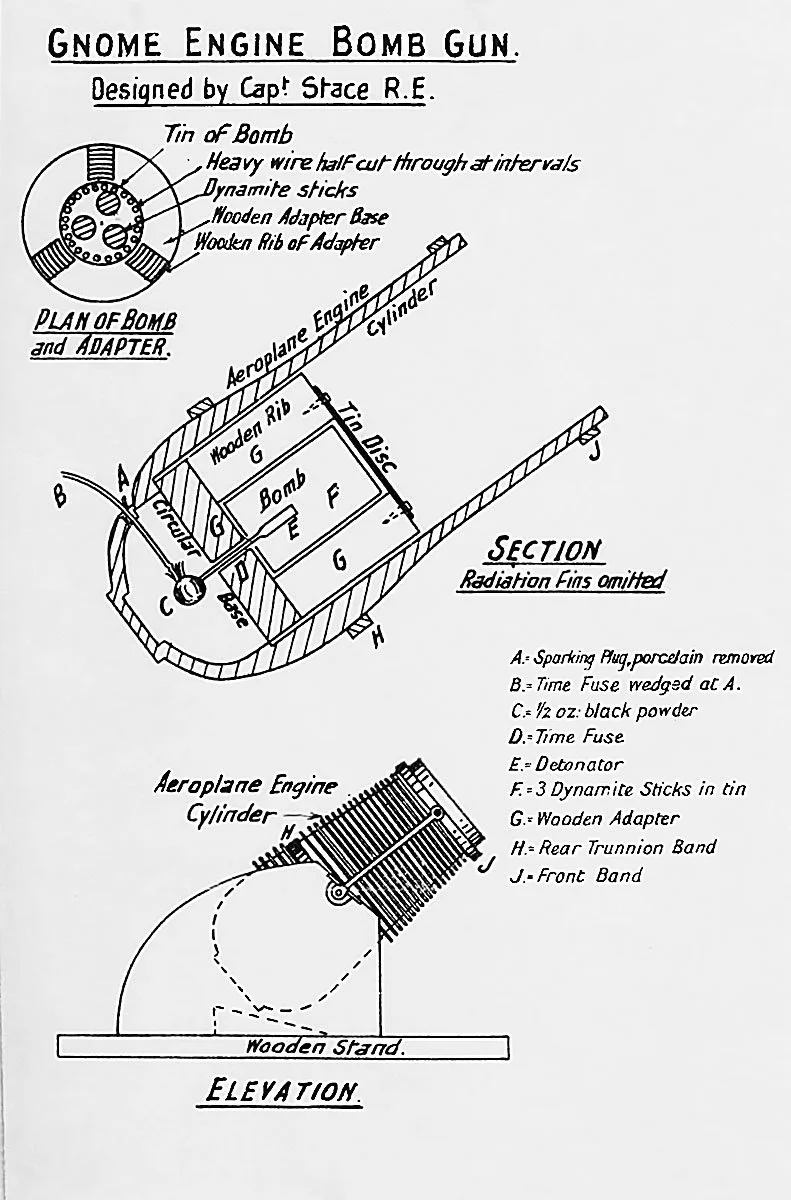
Captain R E Stace, R.E. then devised some very efficient and ingenious bomb guns from the cylinders of a 70 H.P. Gnome aeroplane engine, and two of these little guns were sent to the fort. A sketch of the completed bomb gun is appended.
Gnome Engine Mortar designed by Captain Stace RE. Kut, Mesopotamia. Illustration: Sandes, E.W.C., In Kut and Captivity with the Sixth Indian Division (London: John Murray, 1919.) p.158
At first these guns threw 3-lb. TNT aeroplane bombs fitted with special wooden adapters and were fairly accurate up to, say, 100 yards range if all went well, but the adapter frequently wedged onto the bomb instead of falling away from it at once as intended, and this spoiled the flight. It was found that these bomb guns fired the old tin- cylinder variety of bomb equally well, so the old type was readopted. These steel bomb guns were much safer and more accurate than the wooden guns in which the wood soon dried out and opened out after about 20 rounds or so, and in which the bombs never fitted the bore with any accuracy after a few rounds had been fired and often detonated in the gun itself with disastrous results.
The R.E. Field Park also turned out a supply of periscopes, which were altogether lacking at first. Every available mirror in Kut was bought up and cut into small rectangular pieces, and these were mounted at the correct angles between wooden side-pieces. In addition to these useful accessories "hyposcope" (periscope) rifles were issued in small numbers to the troops by the R.E. Field Park, the design being copied from a photo in an illustrated paper of a similar arrangement invented by an Australian in Gallipoli. The wooden periscopic frame in which the rifle was fixed enabled the marksman aim and fire the weapon over the parapet, while himself completely undercover. Two or three rifles thus mounted was sent to the fort and others elsewhere, and they were useful in dealing with the enemy's snipers.[2]
[1] The Siege of Kut Al Amara (7 December 1915 – 29 April 1916) that resulted in Major-General Charles Townshed surrendering his Anglo-Indian army to Ottoman forces.
[2] Major E.W.C. Sandes. In Kut and Captivity with the Sixth Indian Division. (London: John Murray, 1919), pp. 155-157